What's inside
- Best Cornhole Board Sets for Backyard Tournaments
- Quick buying decision
- Regulation dimensions that actually matter
- Wood versus composite construction
- Finish durability: the feature most buyers underestimate
- Specifications worth comparing
- How much durability do you need?
- Setup and maintenance that prevent early failure
- Final recommendation
- Best Cornhole Board Sets for Backyard Tournaments
- Quick buying decision
- Regulation dimensions that actually matter
- Wood versus composite construction
- Finish durability: the feature most buyers underestimate
- Specifications worth comparing
- How much durability do you need?
- Setup and maintenance that prevent early failure
- Final recommendation
As an Amazon Associate I earn from qualifying purchases. This post may contain affiliate links at no extra cost to you.
Sections
- Best Cornhole Board Sets for Backyard Tournaments
- Quick buying decision
- Regulation dimensions that actually matter
- Wood versus composite construction
- Finish durability: the feature most buyers underestimate
- Specifications worth comparing
- How much durability do you need?
- Setup and maintenance that prevent early failure
- Final recommendation
Best Cornhole Board Sets for Backyard Tournaments
The best cornhole board sets for backyard tournaments are regulation-size wooden boards with a smooth, durable playing surface, solid bracing, and bags that meet tournament dimensions; composite sets are usually the better choice when portability and weather resistance matter more than traditional feel.
Quick buying decision
| Situation | Best choice | Why it fits | Typical market range |
|---|---|---|---|
| Occasional family games | Regulation wood set with folding legs | Good rebound and slide characteristics without the cost of tournament-grade construction | $150–$300 |
| Frequent backyard play | Sealed plywood set with reinforced framing | More stable under repeated setup, transport, and bag impact | $250–$500 |
| Rain-prone storage or frequent travel | Composite or molded-plastic set | Lower moisture risk and easier cleaning | $120–$350 |
| Club or tournament hosting | Regulation wood set with replaceable legs and verified bags | Consistent dimensions, predictable play, and easier long-term repair | $350–$700+ |
| Limited storage space | Folding composite or nesting set | Usually lighter and quicker to carry, though some models feel less rigid | $100–$300 |
Regulation dimensions that actually matter
A regulation cornhole board is approximately 48 inches long and 24 inches wide. The playing surface slopes from about 12 inches high at the rear to 3–4 inches high at the front. The hole is 6 inches in diameter and is centered across the board, with its center approximately 9 inches down from the back edge. Exact tolerances vary slightly between sanctioning organizations, so tournament hosts should follow the rules of the organization governing their event.
As an Amazon Associate we earn from qualifying purchases at no extra cost to you.


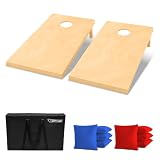

The standard distance is 27 feet from the front edge of one board to the front edge of the other. Players generally throw from a foul line aligned with the front of their board. A regulation-size board is not automatically a regulation-quality board: a surface that flexes, legs that wobble, or a hole that is off-center can change the game as much as an incorrect measurement.
Compact boards can be useful for children, apartments, or very small yards, but they are a poor choice for a tournament. A set described as “large” may still be several inches short of regulation dimensions, so check the actual measurements rather than relying on marketing language.
Wood versus composite construction
Wood boards: the traditional tournament choice
Wooden boards typically use a plywood playing surface over a lumber frame. The familiar feel comes from the combination of surface finish, slight board flex, and bag fabric. A 1/2-inch plywood top can be adequate for casual use when properly supported, while a 3/4-inch top generally provides a more rigid platform for frequent play. A sturdy frame, center support, and properly fastened legs matter as much as top thickness.
Wood is the better choice when you want the most traditional response, custom graphics, repairability, and a substantial platform that will stay planted on grass. It is also easier to refinish if the surface becomes worn. Its disadvantages are weight and moisture sensitivity. A wooden board left in wet grass or stored in a damp shed can swell, warp, loosen its fasteners, or develop finish failure.
Composite boards: easier ownership
Composite and molded-plastic boards are often lighter, easier to wipe clean, and less vulnerable to brief exposure to dew or light rain. Some use a plastic shell with internal ribs; others combine a composite top with a metal or plastic frame. These sets are attractive for campers, renters, and families that carry equipment frequently.
The trade-off is play consistency. A lightweight composite board may shift on hard ground, sound louder when struck, or have a slicker surface than a conventional sealed wood board. Plastic can also become brittle or fade after prolonged ultraviolet exposure, depending on the material and finish. Look for molded reinforcement underneath, non-skid feet, and legs that lock securely rather than simply swinging into position.
Finish durability: the feature most buyers underestimate
The finish controls how quickly bags slide, how easily the surface cleans, and how well the artwork survives. Glossy polyurethane can produce a fast surface, but several thick coats may become too slick for some players. Satin or semi-gloss coatings usually offer a practical balance between smooth play and glare control.
For a wooden set, prioritize a sealed top, sealed edges, and sealed areas around the hole. The edges and exposed end grain absorb moisture first. A printed graphic under a clear coating is usually more durable than a thin decal applied on top. Ask whether the finish is intended for exterior use and whether the manufacturer specifies a maintenance or recoating process.
Surface speed is not measured consistently across brands. Two sets both described as “professional” may play very differently. Bags also affect speed: slick synthetic fabric tends to travel farther, while brushed or suede-like fabric provides more control. For a tournament, use matched bags rather than mixing bags from unrelated sets.
Specifications worth comparing
| Feature | Casual minimum | Frequent-play target | Tournament-minded target |
|---|---|---|---|
| Board size | At least 47 x 23 inches | About 48 x 24 inches | 48 x 24 inches within the event’s stated tolerance |
| Playing-surface material | 1/2-inch plywood or rigid composite | 1/2–3/4-inch sealed plywood with bracing | Rigid 3/4-inch plywood or certified tournament construction |
| Hole diameter | Approximately 6 inches | 6 inches | 6 inches, centered and cleanly cut |
| Board-pair weight | 20–35 pounds | 30–45 pounds | Often 35–55 pounds |
| Bag count | 8 bags | 8 matched bags plus a spare pair | At least 8 approved or event-compliant bags per court |
| Storage protection | Carry handles | Handles and a fitted cover | Cover, bag storage, and replaceable hardware |
How much durability do you need?
Consider frequency rather than the word “tournament.” If you host four events a year and play casually between them, a well-sealed midrange wood set may be more sensible than a commercial-grade pair. If the boards are assembled every weekend, transported in a vehicle, and exposed to changing temperatures, reinforced framing and replaceable hardware become worthwhile.
For example, a $300 set used 30 times annually over five years costs about $2 per use before repairs. A $600 set used only six times per year over the same period costs about $20 per use. The more expensive set makes financial sense when it prevents downtime or replacement, not simply because its graphics look more elaborate.
Setup and maintenance that prevent early failure
- Choose firm, level ground. Grass is preferable to loose gravel because it reduces sliding, but check both boards with a straight edge or visual sightline before play.
- Measure the court. Set the front edges 27 feet apart for regulation play. Leave additional space behind each board for players and spectators.
- Keep boards dry. Do not store wood directly on a concrete floor or grass. Stand boards on edge in a dry, ventilated area.
- Clean without soaking. Remove dust with a soft brush, then use a lightly damp cloth. Avoid pressure washing, abrasive pads, and household solvents that can cloud clear coats.
- Inspect the hardware. Tighten loose leg bolts, replace damaged washers, and check that folding legs lock before every event.
- Protect the finish. Use a fitted cover during transport and never leave a covered wet board in a hot vehicle; trapped moisture can damage wood and graphics.
The components that usually wear first are leg pivots, rubber feet, the finish around the hole, and bag seams. These are easier to replace than a warped board, so replacement parts and accessible fasteners are valuable ownership features.
Final recommendation
For most backyard tournaments, choose a regulation-size wooden set with a 3/4-inch or well-supported plywood top, exterior-grade sealing on every exposed surface, folding legs, and a carry case. Choose composite when weather exposure, frequent carrying, or compact storage is the priority. Whichever construction you select, verify the dimensions, inspect the underside for bracing, and treat the finish and storage system as seriously as the graphics.