What's inside
As an Amazon Associate I earn from qualifying purchases. This post may contain affiliate links at no extra cost to you.
A combination square is one of the most useful measuring and marking tools on a carpentry site. It checks 90- and 45-degree angles, marks lines parallel to an edge, finds depth, and can lay out tenons, housings, and stair work. The head is the part that takes the abuse, and its construction matters more than the finish or the number of scales printed on the rule.
Most combination-square heads are either cast or forged. A cast head is made by pouring molten metal into a mould. A forged head starts as a solid billet or heated metal blank that is pressed into shape. Neither process automatically produces a good tool. Machining, inspection, the quality of the locking mechanism, and the straightness of the rule still determine whether the square is useful.
As an Amazon Associate we earn from qualifying purchases at no extra cost to you.



Sections
Our Top Picks
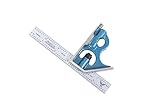
 Starrett Steel Combination Square with Square Head12"1 x 1.4 x 12.3 inches1.22 PoundsCheck on Amazon

What a cast head offers
Cast heads are common because casting makes complicated shapes economically. A manufacturer can form the body, fence, blade slot, and reinforcing ribs in one operation, then machine the important faces. Zinc alloy is common on inexpensive squares, while better tools may use cast iron or cast steel.
The main advantage is price. A decent cast-head square is often inexpensive enough to keep in a tool belt or site box without worrying about it being scratched. For general carpentry—checking stud ends, setting a saw guide, marking sheet goods, or laying out rough framing—a sound cast square is usually adequate.
The weaknesses appear when the head is dropped, clamped hard, or repeatedly knocked against masonry. Zinc alloy can crack or break at thin sections. A cast iron head is stiffer but can chip or fracture under a sharp impact. Poorly machined castings may also have a slight twist or an uneven fence. That error can be small at the head but become obvious several inches along a marked line.
Cast surfaces are not the problem by themselves. The critical surfaces are the fence face, the blade slot, and the reference edge. If those are machined accurately and the head locks firmly without shifting, a cast square can work as well as a forged one for routine site work.
What a forged head offers
Forging compresses the metal and generally produces a tougher, more impact-resistant part. Grain flow follows the shape of the head instead of ending at the boundaries of a mould. In practical terms, a forged head is less likely to crack when dropped and better suited to rough handling in a busy site environment.
Forged heads are often made from steel or ductile iron, then machined and finished. They tend to feel denser and more rigid than cheap cast zinc heads. That extra stiffness is useful when scribing against a timber edge, checking a long cut, or using the square repeatedly with gloved hands.
Forging does not guarantee accuracy. A poorly finished forged head can still have a misaligned blade slot, a loose locking screw, or a fence that is not square to the rule. It may also cost considerably more. For a tool that lives in a dry workshop and is used for occasional marking, the extra toughness may never pay for itself.
Cast versus forged for site use
| Consideration | Cast head | Forged head |
|---|---|---|
| Typical price | Lower, especially in zinc alloy | Higher because of material and processing |
| Impact resistance | Fair to poor on thin zinc or brittle iron castings | Usually better, particularly with forged steel |
| Rigidity | Good if thick and well machined | Usually very good |
| Accuracy potential | Good after proper machining | Good after proper machining |
| Weight | Light to medium | Medium to heavy |
| Best fit | General carpentry, backup tools, occasional use | Daily site work, rough handling, long service life |
Check accuracy before relying on either type
Do not choose on head construction alone. Put the fence against a straight board and draw a line along the rule. Flip the square over, keeping the fence in the same position, and draw a second line. On a 6-inch test length, the lines should coincide. A visible gap at the far end indicates an error; a 1/32-inch gap over 6 inches is too much for fine cabinet layout and can cause trouble on joinery.
Check the blade for burrs, bends, and a clear, readable scale. Lock the head and push the rule sideways. It should not rock or creep. The locking screw should tighten without needing excessive force, and the scriber or small level—if fitted—should not be allowed to dictate your purchase. A reliable square with no extra features is more useful than a feature-packed square that shifts when marked.
For general framing and repair work, a 12-inch cast-head combination square is often the sensible low-cost choice. Twelve inches is long enough to check common timber widths and establish a straight cut line across most boards.
How each type survives a site
A combination square carried loose in a tool belt is exposed to falls, rain, cement dust, and contact with chisels and fasteners. Cement residue can bind the sliding head, while grit in the locking threads makes adjustment rough. Wipe the rule and head at the end of the day, and put a light film of oil on steel parts. Do not leave a wet square in a closed tool bag; rust on the rule can make the head stiff and obscure the graduations.
The most common failure is not a broken head but a loose head. Once the rule shifts under pressure, every mark is suspect. The next is a damaged reference fence, often caused by using the square as a hammering guide or dropping it on a concrete slab. On a cheap zinc head, a crack around the blade slot usually means replacement rather than repair.
If the square is used daily by several people, or travels between unfinished buildings, a forged-steel combination square earns its higher price through durability. It is still worth storing it separately from loose metal tools and checking it after a hard drop.
Which head should you buy?
Choose cast when the square is for occasional carpentry, indoor fitting work, or a backup in the site box. Buy the best-machined example you can find, verify it with the flip test, and avoid very thin zinc heads with vague scales or a coarse locking screw. Spending less is reasonable when a damaged tool can be replaced easily and the work does not depend on tight joinery.
Choose forged when the square is a daily reference tool, will be shared on site, or must survive frequent drops and rough transport. A forged head is not a substitute for checking calibration, but it gives you more margin against impact damage. For fine furniture or bench joinery, prioritize verified accuracy and a smooth, low-play adjustment over the word “forged” on the packaging. A quality precision 6-inch combination square may be the better choice for small work, while a tougher 12-inch square belongs in the everyday site kit.