Key takeaways
- Compare six spirit levels for framing, from 96-inch wall levels and plate levels to torpedo and extendable models, with specs and buying advice.
What's inside
As an Amazon Associate I earn from qualifying purchases. This post may contain affiliate links at no extra cost to you.
For plumbing and leveling wall frames, the STABILA 196 Framer Set with its 96-inch and 48-inch levels is the best overall pick: the long level spans a full 8-foot stud wall in one reading, and the shorter one handles headers, openings and general work. A framing level is simply a rigid, straight-edged tool with vials that show level (horizontal) and plumb (vertical), and its job is to keep studs, plates and openings true. Crews who set wall plates over an eight-to-twelve-foot span should look at the extendable plate levels, while pocket torpedo levels and a short extendable level round out the kit for tight spots and cabinets.
Sections
Quick List
- STABILA 35712-KIT Plate Level 2 (7-12 ft) – best for plumbing top and bottom wall plates
- STABILA 196 Framer Set (96 and 48 in.) – best for full-height wall framing and general carpentry
- Firecore 9 in. Magnetic Torpedo Level – best for a pocket-sized check on small installs
- WORKPRO 12 in. Magnetic Torpedo Level – best for pipe, conduit and pitch checks
- Johnson Level 5800-0712P (7-12 ft) – best for an extendable plate level with a clear scale
- OX Speedframe Extendable Level (29-48 in.) – best for cabinets, trim and between-stud measurements
Which One Is Right for You?
| If you… | Choose |
|---|---|
| Frame whole walls and want one reliable pair of long and mid-length levels | STABILA 196 Framer Set |
| Set top and bottom plates and need to plumb from floor to ceiling | STABILA 35712-KIT Plate Level 2 |
| Prefer an orange, scale-marked extendable plate level from a level specialist | Johnson Level 5800-0712P |
| Need a level that fits in a pouch and clings to steel | Firecore 9 in. Torpedo Level |
| Work with conduit, pipe or slopes and want a pitch vial | WORKPRO 12 in. Torpedo Level |
| Hang cabinets or set trim and want to measure between points | OX Speedframe Extendable Level |
The levels here do different jobs, so the best kit is usually two or three of them. A single long level is the foundation of a framing kit, a torpedo level covers tight corners, and an extendable plate level pays for itself only if you handle tall walls regularly. Do not expect a pocket torpedo level to replace a four-foot level on a long stud wall, because short levels amplify small errors.
All 6 Picks in Detail
1. STABILA 35712-KIT Plate Level 2 (Type 106T) – Best for Plumbing Wall Plates
As an Amazon Associate we earn from qualifying purchases at no extra cost to you.
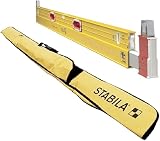
This is an extendable plate-to-plate level that telescopes from 7 to 12 feet. You hold it between the bottom and top plate and read the plumb vials, so you can align the top plate over the bottom without a plumb bob. The listing name includes a case. Stabila’s published details describe a sealed six-sided rail extension, removable stand-offs for working around diagonal braces, and a positioning scale on both sides of the pole.
Who it suits: framers who set tall walls, door installers, and cabinet crews who need plumb over a long span. It is a specialist tool, so a homeowner who frames one shed may not need it.
- Extends from 7 to 12 feet
- One horizontal and two vertical vials, per manufacturer details
- Accuracy stated as 1/32 in. at 72 in. in the normal position
- Removable 1-5/8 in. stand-offs
- Made in Germany; includes a case per the listing name
On the job: set the bottom end on the sole plate, extend until the top end touches the top plate, lock the pole, then nudge the wall until the plumb vials center. Because the pole length can be read off the scale, you can also confirm that both ends of a wall are the same height before you nail it off.
Pros:
- Plumbs a full wall height with one tool
- Stand-offs clear braces and fasteners
Cons:
- Costly for occasional use
- Single-purpose compared with a standard level
Compared with the Johnson plate level, this one is the better-known choice, though both do the same job.
2. STABILA 196 Framer Set (96 and 48 in.) – Best for Full-Height Wall Framing

The Framer Set pairs a 96-inch and a 48-inch level in Stabila’s Type 196 aluminum profile. The 96-inch level matches an 8-foot wall, so you can plumb studs plate to plate in one reading, and the 48-inch level covers openings, headers and jamb checks. Manufacturer details describe a reinforced aluminum profile with finger-grip openings, removable shock-absorbing end caps, and two vertical vials for easy reading in any position.
Who it suits: professional framers and serious remodelers who want a durable pair of levels they can lean on for years. For a casual user, the pair is a big investment.
- 96-inch and 48-inch levels in a two-piece set
- Reinforced aluminum profile with finger-grip openings
- Locked vials; accuracy stated as 1/32 in. at 72 in.
- Removable end caps for working into corners
- Made in Germany; the set weighs roughly 8 pounds per the maker
On the job: use the 96-inch level to check each corner and layout stud, then the 48-inch level for window and door rough openings. Because the pair shares one profile, you get the same feel and vial style in both lengths, which makes quick readings less error-prone.
Pros:
- Two lengths cover most framing tasks
- Stable, easy-to-read vials
Cons:
- The 96-inch level is awkward to store and carry
- Premium positioning
Next to the plate level, the framer set is the more versatile purchase because it also works for door, window and general wall layout.
3. Firecore 9 in. Magnetic Torpedo Level – Best for Pocket-Sized Checks

A torpedo level is a short, tapered level that rides in a pouch or pocket. This Firecore model is 9 inches long, magnetic and described as shockproof, with three bubble vials marked for 45, 90 and 180 degrees. The listing promotes it for picture hanging, shelves and light renovation. For framing, think of it as a companion tool: it is useful on small tasks, but it is not the right instrument for plumbing a full-height wall.
Who it suits: remodelers, handymen and homeowners who want a handy level in a nail pouch for light jobs.
- 9-inch length
- Magnetic edge for steel studs and pipes
- Three vials: level, plumb and 45 degrees
- Shockproof construction, per the listing
- Frame material: confirm on listing
On the job: the magnet lets you stick it to a steel stud track or a pipe while you read it, which frees both hands. Keep it for blocking, shelf brackets and quick checks of an installed fixture.
Pros:
- Fits anywhere and sticks to metal
- Includes a 45-degree vial
Cons:
- Short length reduces accuracy
- Not a primary framing level
It is smaller than the WORKPRO below, which gains length and a pitch vial.
4. WORKPRO 12 in. Magnetic Torpedo Level – Best for Pipe, Conduit and Pitch Checks

The WORKPRO is a 12-inch aluminum-frame torpedo level with four bubbles, including a pitch vial, and a V-groove so it sits securely on conduit and pipe. It is magnetic and listed for plumbers, electricians and carpenters. The extra three inches over a 9-inch torpedo make it a little more reliable on studs and headers, and the pitch vial helps when you set a slope for drainage or check a stair stringer angle.
Who it suits: carpenters who work with trades, electricians and plumbers, and DIYers who want a torpedo that handles round stock. Like the Firecore, it supports framing but does not replace a long level.
- 12-inch aluminum frame
- Four bubbles, including a pitch vial
- V-groove for conduit and pipe
- Magnetic edge
- Weight and vial accuracy: confirm on listing
On the job: the V-groove seats on conduit or a copper line so you can set a slight slope, and the pitch vial gives a quick visual on stairs, ramps or drain runs. It is a pouch tool that quietly earns its place.
Pros:
- More vial options than a basic torpedo
- Longer base for better readings
Cons:
- Still a short level, so errors grow over distance
- Accuracy specifications are not stated in the name
Choose it over the Firecore when you want the pitch vial and the extra length.
5. Johnson Level 5800-0712P (7-12 ft) – Best for an Extendable Plate Level with a Clear Scale

Johnson Level lists this as a 7-to-12-foot extendable plate level with three vials, a metal frame and an orange finish. The listing highlights a triple-secured vial mounting system, and the company’s information mentions lock pins at every foot and scale markings on both sides of the extending arm. Like the Stabila, you set it between the bottom plate and top plate to plumb a tall wall in one reading.
Who it suits: crews that prefer an orange, high-visibility tool with a locking scale, and those who want a plate level from a company known for levels and layout gear.
- Extends from 7 to 12 feet (144 in. fully extended)
- Three vials with an eye-level plumb vial
- Lock pins at every foot, per manufacturer details
- Aluminum frame; orange finish
- Stand-offs: confirm what ships with this listing
On the job: extend to the wall height, drop in the lock pins, and read the plumb vial at eye level while you push or pull the top plate. If you use it with a laser or a string line as a cross-check on long runs, keep the pole clean and the pins free of grit.
Pros:
- Clear scale and positive locking
- Same job as a premium plate level
Cons:
- Accuracy at full extension is not stated in the name
- Bulky to carry
Next to the Stabila plate level, it is the other leading option, and the choice often comes down to brand preference and handling.
6. OX Speedframe Extendable Level (29-48 in.) – Best for Cabinets, Trim and Between-Stud Measuring

The OX Speedframe is a different kind of tool: an extendable level that doubles as a point-to-point measuring device. Its twin-rail design extends from 29 to 48 inches, holds the length with a lock switch, and shows the distance in a scale window. The manufacturer lists three vials, a scribing edge, removable magnets and a hook. For framing, it is best treated as a runner-up helper for openings, backing and cabinets rather than a main wall level.
Who it suits: finish carpenters, cabinet installers and framers who measure between studs or headers many times a day.
- Extends from 29 to 48 inches
- Three vials and a built-in scale window
- Scribing edge and removable magnets
- Anodized aluminum profile, per manufacturer details
- Includes a small hook, per manufacturer details
On the job: slide it between two studs to read the opening width, then use the vials to confirm a shelf or blocking line is level. It shines when you repeat the same short measurements, and it frees you from juggling a tape and a separate level.
Pros:
- Combines level and measurement
- Compact when closed
Cons:
- Not long enough to plumb a full wall
- More moving parts than a fixed level
Compared with a fixed 48-inch level in the Stabila set, it trades some rigidity for measuring convenience.
Specs Compared
| Product | Length | Vials | Magnetic | Notable features |
|---|---|---|---|---|
| STABILA 35712-KIT Plate Level 2 | 7-12 ft extendable | 1 level, 2 plumb (maker details) | Confirm on listing | Stand-offs, case in kit name |
| STABILA 196 Framer Set | 96 in. and 48 in. | Confirm on listing | Confirm on listing | Two-piece set, removable end caps |
| Firecore Torpedo Level | 9 in. | 3 | Yes | 45, 90, 180 degree vials |
| WORKPRO Torpedo Level | 12 in. | 4 including pitch | Yes | Aluminum frame, V-groove |
| Johnson Level 5800-0712P | 7-12 ft extendable | 3 | Confirm on listing | Lock pins, scale on both sides |
| OX Speedframe Extendable Level | 29-48 in. extendable | 3 | Removable magnets (maker details) | Measuring scale, scribing edge |
How We Chose These
We compared the product names, listing specifications and manufacturer information for each level, and we did not handle or use any of them. The criteria were length for the framing task, a rigid profile, readable vials, stated accuracy where a manufacturer provides it, and magnets or stand-offs that help on a real job site. We marked up any fact that a listing does not state with “confirm on listing” and avoided guessing at accuracy or weight. We also noted when a tool is better as a supporting level than as a primary one, so you can build a kit rather than expect one tool to do everything.
What to Look For
Length and the job it matches
Longer levels average out small errors, so match the length to the task. A 96-inch level reads an 8-foot stud wall plate to plate. A 48-inch level suits headers, doors and windows. A 24-inch level is useful for blocking and cabinets. A 9- or 12-inch torpedo helps in tight spaces but should not be used to plumb long members. If you frame 9- or 10-foot walls, add an extendable level or a 6-foot level. As a rule of thumb, a level should be at least as long as the thing you are checking, or you should check from two positions.
Accuracy and how to read the spec
Manufacturers state accuracy as a fraction of an inch over a distance, for example 1/32 in. at 72 in. That means the bubble is within 1/32 inch of true across six feet. Worked example: if a stud is 96 inches tall and your level is accurate to 1/32 in. per 72 inches, an error of about 1/24 inch at the top is possible, which is well inside a typical framing tolerance. Short torpedo levels often do not state an accuracy value, so treat them as rough checks. Also remember that the level only reports what the vial says, so a bent or dropped level can mislead you.
Vials, visibility and vial mounting
Look for vials that are easy to see in poor light, with a clear fluid and a mark that does not fade. Plumb vials at each end save you from turning the level. Locked vials, which are fixed in place rather than glued in a loose seat, tend to hold their calibration. Many pros prefer a level with a vial at the end that you can read from above when you plumb a post. An extra 45-degree vial is a convenience for braces, not a precision tool.
Frame, end caps and durability
Box-profile aluminum with reinforcing ribs resists twist and keeps the measuring surfaces straight. Rubber or plastic end caps protect the profile from impact, and removable caps let you reach tight corners. Magnets help with steel studs, beams and pipes, but they add weight and can pick up filings. Extendable levels should lock firmly and stay stable when extended. Keep levels away from sharp tools, never use them as a straightedge for cutting, and avoid leaving them leaning where they can fall.
Building a framing level kit
A practical kit starts with a four-foot level, because it handles the widest range of work. Add a six- or eight-foot level if you plumb tall walls, and a torpedo level for tight spots. An extendable plate level is a luxury that pays off once you do many tall walls or install tall openings. Spend your money in this order: one good long level, one good torpedo level, then specialty extendables. Cheaper levels are fine for rough work as long as you check them against your main level now and then.
Using a level on rough lumber
Lumber is rarely straight, so a level reading on a bowed stud can mislead you. Place the level on the edge of the stud rather than the face, hold it against the flattest part, and read the vial with your eye directly above it. For crowned plates, sight along the board and put the crown up. If a reading seems off, try again at a different spot or on a shim. A long level helps because it bridges the bow, whereas a short one rides the curve and gives a false reading.
Checking and caring for a level
Verify a level before you trust it. Put it on a flat surface, note where the bubble sits, then rotate the level end for end and compare. If the bubble reads the same both ways, it is true. Do the same for plumb vials against a fixed vertical edge. If a level fails the check, many models allow an adjustment, but a lost-accuracy level is best demoted to rough work. Store levels flat or hanging, and wipe off mud and drywall dust that can hide the vials.
Questions
What size level is best for framing walls?
A 48-inch level is the most common general size, and a 96-inch level is better for full-height plumb checks on 8-foot walls. Many framers carry both, plus a torpedo level for small areas.
Do I need an extendable plate level?
Only if you set tall walls or install tall doors and cabinets often. For most 8-foot framing, a 96-inch level and a shorter level cover the work, and the extendable models are mainly for pros who save time on taller spans.
Are torpedo levels accurate enough for framing?
They are fine for quick checks and small tasks, but their short base amplifies error across a wall. Use them as backup tools and rely on a longer level for studs, plates and headers.
What does “plate to plate” mean?
It refers to a level that fits between the bottom plate and top plate of a wall. By reading the plumb vials on the extended level, you can adjust the top plate until it is directly above the bottom plate without using a plumb bob.
How do I know if my level is still accurate?
Place it on a flat surface, mark where the bubble rests, then flip the level end for end and compare. If the readings match, it is accurate; if they differ, the level is out of calibration and should be adjusted or replaced.
Are magnetic levels better?
Magnets are a convenience when you work with steel studs, beams or pipe, because they hold the level in place and free your hands. For wood framing, they are optional and mostly useful on torpedo and extendable levels.
Update History
- October 20, 2026 – Initial publication; product set drawn from current catalog listings.
- Check the product page for current specifications and availability before buying.
Sources
- Manufacturer product and specification pages for STABILA, Johnson Level and OX Tools
- Retailer listing titles and specification fields for each product named above