Our Top Picks

What's inside
As an Amazon Associate I earn from qualifying purchases. This post may contain affiliate links at no extra cost to you.
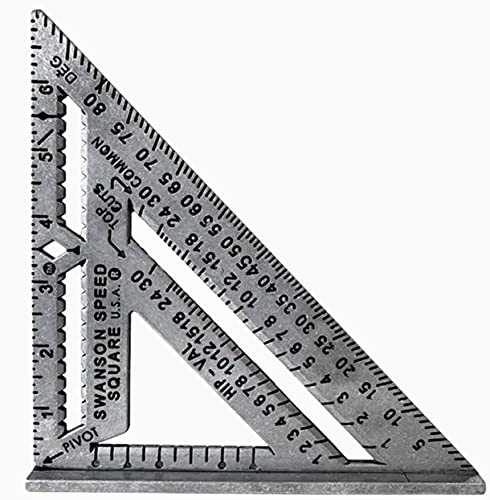
The Swanson Speed Square 7 in. (S0101) is the best all-round pick for framing. It is the original aluminum rafter-and-layout triangle, small enough to live in a nail pouch, and it comes with the Blue Book of rafter tables. A speed square is a right-angle triangle with a raised fence on one edge, a pivot corner and a degree scale, so a single tool marks square cuts, 45-degree miters and roof pitches. Production framers who mark studs all day will prefer the Pro version, while hobbyists who like built-in extras can look at the multi-function 7-inch alternatives. The two 12-inch squares in this guide suit wider boards and shop-style layout work.
Sections
Quick List
- Swanson Speed Square 7 in. (S0101) – best for all-round framing layout and learning rafter cuts
- Swanson Speed Square Pro 7 in. (S0100-A) – best for marking both sides of a stud in one pass
- THORVALD 2 Carpenter Square 7 in. – best for DIYers who want pencils and extras in the same package
- Beslands 7 in. Rafter Square with Level – best for quick plumb and level checks while you mark
- Matework Carpenter Square 12 in. – best for wider stock where a 7-inch fence runs short
- 12 in. Advanced Rafter Square and Combination Square Set – best for workshop benches that need two squares in one buy
Which One Is Right for You?
| If you… | Choose |
|---|---|
| Frame walls and roofs regularly and want the proven standard | Swanson Speed Square 7 in. (S0101) |
| Lay out stud walls, plates and double studs all day | Swanson Speed Square Pro (S0100-A) |
| Want a marking kit with pencils and a few extra functions | THORVALD 2 Carpenter Square |
| Check plumb or level on small jobs without pulling out another tool | Beslands 7 in. Rafter Square with Level |
| Cut 2×8, 2×10 or wider boards and need a longer fence | Matework 12 in. Carpenter Square |
| Build at a bench and want both a rafter square and a combination square | 12 in. Rafter and Combination Square Set |
If you are buying only one, start with a 7-inch square, because that size fits a pouch, a back pocket and nearly every common framing task. Add a 12-inch square later if you regularly cut wide stock. Treat the multi-function squares as supplements to a standard speed square rather than replacements for one, since the established Swanson layout and its Blue Book are what most framing instructions assume.
All 6 Picks in Detail
1. Swanson Speed Square 7 in. (S0101) – Best for All-Round Framing Layout
As an Amazon Associate we earn from qualifying purchases at no extra cost to you.

This is the square most carpenters picture when they hear “speed square,” and the listing describes it as a 7-inch aluminum layout square made in the USA by Swanson Tool Company. It includes the Blue Book, a pocket reference of rafter and roof cut tables that pairs with the scales stamped on the tool. If you are learning to cut common rafters, stair stringers or angled braces, this is the easiest place to begin because every tutorial uses this layout.
- 7-inch aluminum triangle with a square fence along one edge
- Pivot corner with a degree scale for marking angles from 0 to 90
- Common and hip-valley rafter scales on the face
- Includes the Blue Book rafter reference (listed on the product page)
- Made in the USA, per the listing
Who it suits: apprentices, remodelers and homeowners who want one dependable square for walls, rafters, stair stringers and angled braces. If a friend or instructor shows you how to cut a common rafter, they will almost certainly be holding this exact layout, so you can follow along without translating between different scale arrangements.
Pros:
- The reference standard, so help and tutorials match your tool
- Light and compact enough to carry all day
Cons:
- The 7-inch fence needs a second pass on boards wider than a 2×6
- Does not have the added stud-marking features of the Pro
Compared with the Pro below, this one gives up the double-stud layout guides but keeps the same footprint, so it is the better choice if you only occasionally frame.
2. Swanson Speed Square Pro 7 in. (S0100-A) – Best for Stud Wall Layout

The Pro keeps the classic 7-inch triangle but adds features aimed at wall framing. According to Swanson’s product information, the 1-1/2 in. edge matches the width of 2X material, so you can mark both sides of a stud without sliding the square down the plate. Guides for 3/8, 1/2, 3/4 and 1-1/2 inch offsets speed up double-stud and corner layout, and an extra mark helps with 2×6 material. It also includes the PRO edition of the Blue Book.
- 7-inch die-cast aluminum construction
- 1-1/2 in. edge for marking both sides of a stud
- Built-in 3/8, 1/2, 3/4 and 1-1/2 inch layout guides
- Longer scribe bar with 1/8 in. increments (per Swanson)
- Beveled edges and black-filled gradations for readability
Who it suits: framing crews, deck builders and anyone who spends days marking plates and top plates. The stud-width edge is most useful when you are repeating the same layout dozens of times, because each saved pencil movement multiplies across a whole floor of walls.
Pros:
- Fewer pencil-tip slides when laying out studs
- Same carry size as the standard square
Cons:
- Extra guides add little for roof-only work
- More markings can take a few jobs to get used to
Next to the standard S0101, the Pro is the one to choose when more than half of your layout is walls.
3. THORVALD 2 Carpenter Square 7 in. – Best for DIYers Who Like Extras
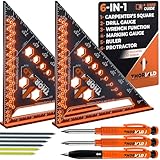
This listing bundles a 7-inch square with 1/16-inch precision markings, two pencils and twelve spare leads. The product name also mentions protractor, ruler and wrench-style functions, which makes it a general-purpose layout helper rather than a pure framing tool. For a first toolbox it is a sensible starter, because you receive marking supplies in the same package. Confirm the material and any scale details on the listing, since the name does not spell out the alloy.
- 7-inch carpenter square with markings stated to 1/16 inch
- Includes 2 pencils and 12 leads
- Multi-function design with protractor and ruler features
- Material and weight: confirm on listing
- Brand scale layout differs from the Swanson standard
Who it suits: first-time buyers, hobby woodworkers and people stocking a new toolbox who would rather get marking supplies and several measuring functions in one package. It is less aimed at a framer who already has a preferred layout and a favorite pencil.
Pros:
- Marking supplies included
- Extra functions for general DIY layout
Cons:
- Rafter tables and instructions are less standardized than Swanson’s
- Extra features can crowd the face
Compared with the Beslands square, it leans toward marking convenience, while Beslands leans toward leveling.
4. Beslands 7 in. Rafter Square with Level – Best for Quick Plumb and Level Checks

The Beslands is a 7-inch aluminum rafter square that adds a vial so you can check plumb or level while you mark. The listing also mentions a triangle ruler design. That makes it handy when you are tacking up a short brace, setting a post or checking a ledger, because you do not need to reach for a separate level. A vial this small is a convenience check, not a substitute for a proper 24-inch or longer level.
- 7-inch aluminum rafter square
- Built-in level vial
- Triangle ruler design for angle marking
- Scale styles and finish: confirm on listing
- Suited to woodworking and general carpentry layout
Who it suits: small-project carpenters, deck and shed builders, and DIYers who want a fast level glance while they hold a brace or post in place. Professional crews will usually still carry a torpedo level for this job, but the built-in vial is a pleasant shortcut.
Pros:
- Two jobs in one pouch-sized tool
- Useful for small carpentry and woodworking tasks
Cons:
- A tiny vial gives limited accuracy over long runs
- The vial window adds a place for dirt and damage
Choose it over the THORVALD if checking level matters more to you than included pencils.
5. Matework Carpenter Square 12 in. – Best for Wider Stock

A longer fence is the whole point of this 12-inch aluminum framing square. A 7-inch square spans a 2×6 comfortably, but a 2×10 or 2×12 forces you to shift and re-register, which invites small errors. The 12-inch size lets you square across wider boards in one pass and gives you a longer straightedge for layout lines. Check the listing for the exact scale layout and whether it carries rafter tables, because the name only states the size and the material.
- 12-inch size
- Aluminum framing square construction (stated in the name)
- Marketed for woodworking and carpentry layout
- Rafter and degree scale details: confirm on listing
- Larger footprint than a standard speed square
Who it suits: builders who regularly cut joists, headers and wide plank stock, as well as woodworkers who want a bigger square for cabinet and furniture layout. If your day is mostly 2×4 walls, the extra size will feel like overkill.
Pros:
- Covers 2×10 and 2×12 stock without repositioning
- Longer edge for marking lines
Cons:
- Bulky for a nail-pouch carry
- Less standard than a 7-inch for field framing
Pick this over the combination set below if you want a single large square rather than two tools.
6. 12 in. Advanced Rafter Square and Combination Square Set – Best for Bench Layout

This listing is a set that pairs a 12-inch imperial rafter square with a combination square, and the name highlights a protractor and layout ruler function. A combination square adds a sliding head for marking depths, 45-degree lines and checking edges, which a pure speed square cannot do. For framing it is a supporting cast member: use it at the saw bench or when fitting trim, and keep a standard 7-inch square in your pouch for the field.
- 12-inch imperial rafter square
- Combination square included, per the name
- Triangle and protractor layout functions
- Material and finish: confirm on listing
- Imperial markings only
Who it suits: hobbyists and shop users who want a layout station: a large square for broad boards and a combination square for depth marks and edge checks. Check the listing to see exactly how the two pieces are marked and finished.
Pros:
- Two layout tools in one purchase
- Good for bench and finish work
Cons:
- Not pouch sized
- Specifications are thinner than the name-brand options
Compared with the single Matework square, the set adds a second tool but offers less clarity on build details.
Specs Compared
| Product | Size | Material | Notable features | Includes |
|---|---|---|---|---|
| Swanson Speed Square (S0101) | 7 in. | Aluminum | Pivot, degree and rafter scales | Blue Book |
| Swanson Speed Square Pro (S0100-A) | 7 in. | Die-cast aluminum | 1-1/2 in. stud edge, layout guides | PRO Blue Book |
| THORVALD 2 Carpenter Square | 7 in. | Confirm on listing | 1/16 in. markings, multi-function | 2 pencils, 12 leads |
| Beslands Rafter Square with Level | 7 in. | Aluminum | Built-in level vial, triangle ruler | Confirm on listing |
| Matework Carpenter Square | 12 in. | Aluminum | Framing square layout | Confirm on listing |
| 12 in. Rafter and Combination Square Set | 12 in. | Confirm on listing | Protractor and layout ruler | Combination square |
How We Chose These
We built this list from the product names, listing specifications and manufacturer information for each item, and we did not hold or use any of them ourselves. We looked for tools whose size, material and scales are clearly stated, and we gave extra weight to products with a recognized layout (the Swanson scales and Blue Book) because that makes instructions easy to follow. We compared stated features such as stud-marking edges, level vials and included accessories, and we flagged details the listing does not confirm. Where a name gives no material or scale information, we say so and ask you to confirm it on the product page before buying.
What to Look For
Size and fence length
Seven inches is the working standard for a speed square, and it is the size that framing books and videos assume. The fence is the raised lip you hold against the board edge, and it must be long enough to register across your stock. Actual lumber is smaller than its name: a 2×4 measures about 3.5 inches across, a 2×6 about 5.5, a 2×8 about 7.25, a 2×10 about 9.25 and a 2×12 about 11.25. A 7-inch fence therefore squares a 2×6 in one pass but needs a second pass on a 2×8 or wider. A 12-inch square handles even a 2×12 in one move.
Material and markings
Aluminum is the practical choice because it is light, resists rust and survives drops. Die-cast construction, as on the Pro, tends to hold crisp edges. Read the markings in bright sun and in a dim garage if you can: black-filled numbers on a matte finish are easier to read than shallow stamping. Check whether the scales are imperial only, because metric-only or mixed markings can slow you down on a framing crew that works in inches and sixteenths.
Scales that matter for framing
Three scales do most of the work. The degree scale along the hypotenuse lets you set angles from 0 to 90. The common rafter scale gives roof pitch cuts for matching rafters, and the hip-valley scale covers the longer, angled members. To mark a 6-in-12 plumb cut, pivot the square on the board’s edge, swing it until that edge crosses the 6 on the common scale, and draw along the straight edge. The Blue Book then tells you the length per foot of run, so you do not need to calculate it from scratch.
Stud-layout features
If most of your day is wall framing, look for an edge that matches the 1-1/2 inch width of a 2x stud. A tool that spans a stud lets you mark both faces with one position, which saves a step on every stud on 16-inch centers. A typical wall needs a mark at 16, 32, 48 and 64 inches, plus extra studs at corners and openings, so these small savings add up over a full house. Layout guides for 3/8, 1/2 and 3/4 inch offsets are also helpful when you mark trimmers and cripples.
Care and accuracy over time
A speed square lasts for years if you treat it as a measuring tool instead of a pry bar. Avoid using the fence to scrape or tap boards into position, because a dented lip is hard to trust afterward. Wipe sawdust and pitch from the markings with a dry cloth, and store the square flat or on a hook rather than loose in a bucket of fasteners. Every few months, repeat the flip-and-draw check described above, especially after a drop from a ladder or roof. If the two lines no longer match, retire the tool or demote it to rough work such as marking pallets.
Pencil, scribe and cut habits
Most layout mistakes come from the pencil, not the square. Use a sharp carpenter pencil or a mechanical pencil, and keep the lead tight against the edge so the mark does not wander. Many squares include small notches along the scribe bar, which let you score a line parallel to the board edge by dragging the pencil along the notch. When you cut, decide in advance which side of the line you will remove, and keep the saw kerf on the waste side so you do not shorten the part. A 1/16-inch error on each end of a stud or rafter adds up on long runs.
Rule of thumb for buying
Buy one standard 7-inch square first, then add a second tool only when a task demands it. For example, if you cut a few 2×10 joists a year, a 12-inch square is a cheap fix to avoid shifting the fence. If you rely on a level vial, treat it as a quick check only, and verify anything critical with a proper 24-inch or longer level. Do not trust a new square on faith: confirm that a new square reads 90 degrees by drawing a line, flipping the square over and checking that the two lines coincide.
Questions
What is a speed square used for in framing?
It marks square cuts, 45-degree miters and roof pitch angles, and it also serves as a saw guide. Because of its pivot corner and rafter scales, one small tool covers most layout steps in wall, floor and roof framing.
Is a 7-inch or 12-inch speed square better?
For most framing the 7-inch size is better because it fits a pouch and matches the common instructions. Choose 12 inches when you often cut wide stock such as 2×10 or 2×12, where a short fence needs repositioning.
Do I need the Blue Book?
It is not required, but it is useful when you cut rafters because it provides lengths per foot of run for common pitches. If you already know the math or use a rafter calculator app, you can skip it, though it is a convenient bonus on the two Swanson listings.
How do I check that a speed square is accurate?
Hold it against a straight board edge and draw a line along the fence side. Flip the square over and draw again along the same edge; if the two lines match, it is square. Replace any square that is bent or chipped on the fence.
What is the difference between a speed square and a framing square?
A framing square is a large L-shaped steel or aluminum square, typically 16 by 24 inches, used for stair layout and big rafters. A speed square is a small triangle built for quick marking, and many carpenters carry one every day.
Can a speed square replace a combination square?
Not completely. A speed square marks angles and square cuts quickly, but a combination square adds a sliding head for depth marking and checking edges. Many carpenters own both and use the speed square for rough work and the combination square for finer layout.
Update History
- October 20, 2026 – Initial publication; product set drawn from current catalog listings.
- Check the product page for current specifications and availability before buying.
Sources
- Manufacturer product and specification pages for Swanson Tool Company
- Retailer listing titles and specification fields for each product named above
- General lumber sizing conventions for nominal and actual dimensions