
Key takeaways
- Find the best pocket hole screws for joinery and cabinets at home. Coarse and fine-thread screws that pull joints tight without splitting the wood.
What's inside
- Quick Answer
- 1. Kreg SML-C125-100 1-1/4 Inch #8 Coarse Pocket Hole Screws, 100 Count
- 2. Kreg SML-F125-250 1-1/4 Inch #7 Fine Pocket Hole Screws, 250 Count
- 3. Kreg SML-F125S5-100 Stainless 1-1/4 Inch #7 Fine Pocket Hole Screws, 100 Count
- 4. Kreg SML-C250B-250 Blue-Kote 2-1/2 Inch #8 Coarse Pocket Hole Screws, 250 Count
- 5. Kreg SK03 Pocket-Hole Screw Kit, 5 Sizes
- How to Choose Pocket Hole Screws
- Who Should Skip These
- Frequently Asked Questions
- Final Verdict
- Product and ASIN Reference
As an Amazon Associate I earn from qualifying purchases. This post may contain affiliate links at no extra cost to you.
A pocket hole joint lives or dies on the screw. The jig drills the angled hole, but the screw pulls two boards tight, holds the joint square while glue dries, and keeps a cabinet face frame from racking years later. The wrong screw splits the board or strips out before it seats; the right one makes a joint stronger than the wood.
Thread type, length, head shape, and finish are the differences that matter: thread decides whether the screw grips soft pine or dense maple without splitting, length decides whether it bites deep enough without poking through, and finish decides whether it survives a damp garage or rusts inside a joint. This guide compares five Kreg screws for softwood and plywood, hardwood, damp locations, outdoor builds, and a kit spanning every size a home shop needs.
As an Amazon Associate, we earn from qualifying purchases.
Sections
- Quick Answer
- 1. Kreg SML-C125-100 1-1/4 Inch #8 Coarse Pocket Hole Screws, 100 Count
- 2. Kreg SML-F125-250 1-1/4 Inch #7 Fine Pocket Hole Screws, 250 Count
- 3. Kreg SML-F125S5-100 Stainless 1-1/4 Inch #7 Fine Pocket Hole Screws, 100 Count
- 4. Kreg SML-C250B-250 Blue-Kote 2-1/2 Inch #8 Coarse Pocket Hole Screws, 250 Count
- 5. Kreg SK03 Pocket-Hole Screw Kit, 5 Sizes
- How to Choose Pocket Hole Screws
- Who Should Skip These
- Frequently Asked Questions
- Final Verdict
- Product and ASIN Reference
Quick Answer
For most home joinery and cabinet work, the Kreg SML-C125-100 in 1-1/4 inch coarse thread is the best all-round pick, since it suits 3/4 inch plywood and pine, the most common home-shop materials. Choose the fine-thread SML-F125-250 for hardwood, the stainless SML-F125S5-100 for damp locations, the Blue-Kote SML-C250B-250 for outdoor builds, and the SK03 kit when one box must cover every thickness.
1. Kreg SML-C125-100 1-1/4 Inch #8 Coarse Pocket Hole Screws, 100 Count

The SML-C125-100 is the default pocket hole screw for home shops. It is a 1-1/4 inch, number 8 screw with a coarse thread and a Maxi-Loc washer head, sized for the single most common joint in home woodworking: a 3/4 inch board joined to another board. Pine, poplar, plywood, and MDF all fall in its sweet spot.
The Maxi-Loc head is what separates a pocket hole screw from an ordinary wood screw: its wide, flat washer face seats against the flat shelf at the bottom of the pocket and spreads clamping force across a broad area, where a bugle or flat head would wedge in and split the board. The self-tapping tip cuts its own thread, and the square drive seats deeply enough to apply real torque without camming out.
One caution: the most recent crawl showed no featured offers despite a listing note recording recent purchases, so confirm the listing is live before ordering. It earns the top spot because it matches the material most home shops use most often.
Specs
- Length: 1-1/4 inch
- Gauge: number 8
- Thread: coarse
- Head: Maxi-Loc washer head
- Drive: square
- Finish: zinc, indoor use
- Count: 100
- Best for: softwood, plywood, and MDF in 3/4 inch stock
2. Kreg SML-F125-250 1-1/4 Inch #7 Fine Pocket Hole Screws, 250 Count

Hardwood changes the rules: a coarse thread in dense oak or maple acts like a wedge, pushing fibers apart instead of cutting through them, so the board can split near the pocket. The SML-F125-250 answers with a fine thread on a slightly slimmer number 7 shank, cutting cleanly into hard fibers and lowering the splitting risk that makes hardwood pocket joints fail.
The 1-1/4 inch length suits the same 3/4 inch stock as the coarse version, and the 250 count box suits a shop building hardwood cabinets regularly — every joint takes two screws, and one cabinet can easily use forty or more.
One flag: the last tracking record for this listing is eight months old, so the stock picture is dated. The product is the standard fine-thread choice in the Kreg lineup, and a shop working in both pine and oak should keep both boxes on hand.
Specs
- Length: 1-1/4 inch
- Gauge: number 7
- Thread: fine
- Head: Maxi-Loc washer head
- Drive: square
- Finish: zinc, indoor use
- Count: 250
- Best for: hardwood such as oak and maple in 3/4 inch stock
3. Kreg SML-F125S5-100 Stainless 1-1/4 Inch #7 Fine Pocket Hole Screws, 100 Count

Moisture is the enemy of an ordinary zinc screw: in a bathroom vanity, a sink cabinet, or a laundry room shelf, a zinc screw can corrode inside the wood long before the joint wears out. The SML-F125S5-100 swaps zinc for stainless steel and keeps the fine thread that suits hardwood, making it the right screw for damp locations and exterior-adjacent work.
Dimensions mirror the fine-thread pick above: 1-1/4 inch, number 7, fine thread, Maxi-Loc head, square drive. The difference is the material: stainless resists corrosion far better than zinc, and it suits hardwoods that react with ordinary steel and leave dark stains around the fastener. Oak in particular can discolor around a zinc screw when damp, so stainless earns its place in fine hardwood work.
Availability flag: the most recent check showed third-party sellers only, with no Amazon-sold offer — confirm the listing before ordering. For a bathroom cabinet or a mudroom bench, this is still the screw to reach for first.
Specs
- Length: 1-1/4 inch
- Gauge: number 7
- Thread: fine
- Head: Maxi-Loc washer head
- Drive: square
- Finish: stainless steel, corrosion resistant
- Count: 100
- Best for: damp locations, bathrooms, kitchens, and hardwood that stains
4. Kreg SML-C250B-250 Blue-Kote 2-1/2 Inch #8 Coarse Pocket Hole Screws, 250 Count

Outdoor furniture and thick stock need a longer screw. At 2-1/2 inches, the SML-C250B-250 suits 1-1/2 inch material, the actual thickness of a nominal 2 by 4, which deck furniture, planters, and garden benches all use; a 1-1/4 inch screw would barely reach the second board. The coarse thread suits softwood, and the number 8 gauge gives the joint real holding power.
The Blue-Kote finish is a triple anti-corrosion coating that gives the screw its blue color — Kreg’s weather-resistant option for joints that live outside in rain and humidity. The Maxi-Loc head and square drive follow the same pattern as the rest of the lineup, so the driving feel is familiar.
This pick carries the clearest availability flag in the group: the most recent Amazon crawl names the product, model SML-C250B-250, and ASIN in text, but also shows the item as currently unavailable, with no featured offers. The screw is real and the code is confirmed — but check the listing before ordering.
Specs
- Length: 2-1/2 inch
- Gauge: number 8
- Thread: coarse
- Head: Maxi-Loc washer head
- Drive: square
- Finish: Blue-Kote triple anti-corrosion coating, outdoor use
- Count: 250
- Best for: outdoor builds and 1-1/2 inch softwood stock
5. Kreg SK03 Pocket-Hole Screw Kit, 5 Sizes
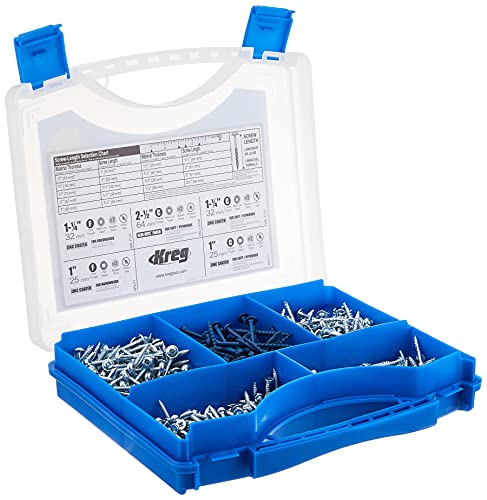
No single screw length covers every joint, so the SK03 kit packs five sizes into one box: 1 inch, 1-1/4 inch, 1-1/2 inch, 2 inch, and 2-1/2 inch, in both coarse and fine thread — covering material from 1/2 inch plywood to 1-1/2 inch solid stock.
Beyond variety, the kit lets a builder still learning pocket hole joinery experiment with lengths without buying five separate boxes, and a shop building one-off pieces in mixed materials always has the right length on hand. The screws follow the standard Kreg pattern — self-tapping tips, Maxi-Loc heads, square drives — so driving feel stays the same at every size.
The same availability note applies as to the stainless pick — third-party sellers only, no Amazon-sold offer — so confirm the listing before ordering. As a way to cover every thickness with one purchase, the kit remains the most practical pick here, and it pairs well with a pocket hole jig for a builder setting up a first joinery station.
Specs
- Sizes: 1 inch, 1-1/4 inch, 1-1/2 inch, 2 inch, 2-1/2 inch
- Thread: coarse and fine included
- Head: Maxi-Loc washer head
- Drive: square
- Finish: zinc and Blue-Kote options by size
- Count: assorted kit, five sizes
- Best for: mixed-material shops and builders covering many thicknesses
How to Choose Pocket Hole Screws
Match the thread to the wood first. Coarse thread suits softwood, plywood, and MDF, where the wide spacing bites into soft fibers and holds; fine thread suits hardwood, where the tighter pitch cuts cleanly into dense fibers and avoids splitting. Using a coarse screw in oak is the most common pocket hole mistake in a home shop, and it shows up as a cracked board or a joint that never quite closes.
Match the length to the thickness next: the screw should bite about an inch into the second board without breaking through its face. As a rule, 3/4 inch stock takes a 1-1/4 inch screw, 1 inch stock takes a 1-1/2 inch screw, and 1-1/2 inch stock takes a 2-1/2 inch screw. Kreg publishes a selection guide mapping nine thickness bands between 1/2 inch and 1-1/2 inch to a screw length — following that chart removes the guesswork. When in doubt, test on scrap and check that the tip stops short of the far face.
Match the finish to the environment last: zinc suits dry indoor work, stainless suits damp rooms and hardwoods that stain around ordinary steel, and Blue-Kote suits outdoor builds in rain and humidity. A screw that rusts inside a joint is a joint that fails quietly, so the finish is not a cosmetic choice.
One more point: all five picks in this guide are Kreg screws. Kreg defined the pocket hole format, and its screws are the default recommendation because head shape, tip design, and square drive all match Kreg jigs exactly. Other brands make compatible screws, and any self-tapping screw with a flat washer head and a square drive can work in a pocket hole, but the picks here stay within one lineup for direct comparison.
Who Should Skip These
Skip pocket hole screws entirely if the joint will carry heavy structural loads, such as a workbench leg or a bed frame rail: they are strong for cabinets, face frames, and furniture, but no substitute for mortise and tenon joints or through bolts where the joint holds the structure up. Skip them too for wood thinner than 1/2 inch, since the screw has too little material to grip and the board can split.
Skip the coarse-thread picks if the project is entirely hardwood, and the fine-thread picks if it is entirely softwood — the wrong thread in the wrong wood is the fastest way to a failed joint. Skip zinc screws for any joint that sees regular moisture, and skip the long 2-1/2 inch screw for thin stock, since the tip will break through the far face. Finally, skip a bulk box for a single small project: a 100 count box is plenty for one cabinet, while a 250 count box suits a builder who joins wood every week.
Frequently Asked Questions
What length pocket hole screw should I use for 3/4 inch plywood?
Use a 1-1/4 inch screw: it bites about an inch into the second board for full holding power without breaking through the far face. Match the thread to the wood — coarse for plywood and softwood, fine for hardwood.
Can I use coarse-thread screws in hardwood?
No. A coarse thread acts like a wedge in dense wood and can split the board near the pocket. Use fine-thread screws for oak, maple, and other hardwoods, and keep coarse-thread screws for pine, poplar, plywood, and MDF.
Do pocket hole screws work without glue?
Yes — the screw alone forms a strong mechanical joint that holds even before any glue dries. Glue adds long-term strength and keeps the joint from working loose under vibration, so most builders use both; for a joint that may need to come apart later, screws alone are the better choice.
Why do pocket hole screws have a washer head instead of a flat head?
The wide, flat washer head seats against the flat shelf at the bottom of the pocket hole and spreads clamping force across a broad area, where a flat head would wedge into the angled pocket, split the board, or fail to pull the joint closed. The washer head is what makes the joint hold.
Final Verdict
The Kreg SML-C125-100 in 1-1/4 inch coarse thread is the best all-round pocket hole screw for home joinery and cabinets, because it matches the 3/4 inch plywood and pine most home shops use. Add the fine-thread SML-F125-250 for hardwood, the stainless SML-F125S5-100 for damp rooms, and the Blue-Kote SML-C250B-250 for outdoor builds; for many thicknesses, buy the SK03 kit instead of five separate boxes. Check availability before ordering — two picks showed no featured offers at the last crawl — and match thread, length, and finish to the wood before driving the first screw.
Product and ASIN Reference
| Product | ASIN |
|---|---|
| Kreg SML-C125-100 1-1/4 Inch #8 Coarse, 100 Count | B0000DD5H1 |
| Kreg SML-F125-250 1-1/4 Inch #7 Fine, 250 Count | B01E1E86OM |
| Kreg SML-F125S5-100 Stainless 1-1/4 Inch #7 Fine, 100 Count | B000VK3TN4 |
| Kreg SML-C250B-250 Blue-Kote 2-1/2 Inch #8 Coarse, 250 Count | B000VK3TES |
| Kreg SK03 Pocket-Hole Screw Kit, 5 Sizes | B001DC9USC |
Related guides
More from Amazon
Programs that pair well with the guide above. Offers and eligibility are set by Amazon and may change.
A free business account with business pricing and bulk-buying tools for work, shop or home office.
Create a business accountFree shipping on eligible items, Prime Video and more. Eligible new members can start with a free trial.
Start a Prime free trialAudiobooks and podcasts to listen to on the go. Eligible new members can start with a free trial.
Try Audible freeAd-free music streaming. Eligible new subscribers can start with a free trial.
Try Music Unlimited freeAs an Amazon Associate we earn from qualifying purchases.



Write Your Review
No reviews yet. Be the first to share your experience!