What's inside
As an Amazon Associate I earn from qualifying purchases. This post may contain affiliate links at no extra cost to you.
Sections
Best guitar amp stands: the right choice depends on your amp and where you play
The best guitar amp stands are sturdy enough for the amp’s loaded weight, wide enough to support its feet, and angled to project sound toward your ears without making the setup unstable. For most small and mid-sized combo amps, a folding steel stand with adjustable tilt is the practical all-round choice; heavier combos and speaker cabinets need a stand rated for their actual weight, with a platform sized to support them fully.
Before buying, check your amp’s weight and base dimensions in its manual or manufacturer specifications. Stand capacities and platform measurements vary by model, even within the same product line. The numbers below are representative specifications for established stand designs; verify the exact version and current manufacturer listing before purchase.
As an Amazon Associate we earn from qualifying purchases at no extra cost to you.


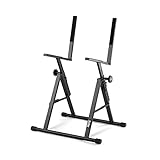
Compare the main stand types
| Stand or type | Published capacity | Platform or support dimensions | Angle and storage | Best fit |
|---|---|---|---|---|
| On-Stage RS7000 tilt-back amp stand | 150 lb (68 kg) | About 18 × 16 in (46 × 41 cm) | Adjustable tilt; folds for transport | Many combo amps and some compact cabinets, after checking foot placement |
| Hercules Stands HA205 amp stand | About 55 lb (25 kg) | About 11.4 × 13.8 in (29 × 35 cm) | Adjustable angle; compact folding design | Lightweight practice and small combo amps |
| Quik Lok BS-625 amp stand | About 66 lb (30 kg) | About 14.6 × 13.8 in (37 × 35 cm) | Multiple angle positions; folds down | Small to medium combos where a broader base is useful |
| Heavy-duty steel platform stand | Commonly 100–150 lb (45–68 kg); check the model | Often 16–20 in wide; measure the specific platform | Usually adjustable; folded size varies | Heavier combos or cabinets that fit entirely within the platform |
| Rubber isolation pads on a solid floor | Depends on the pad set and floor; not a raised stand | Position pads under the amp’s feet | No tilt or folding | Low-profile placement when floor vibration or space is the concern |
Capacities and dimensions are not interchangeable: some manufacturers specify a maximum load, while others describe a product for a particular amp size. Use the exact model’s documentation as the deciding source, particularly for a heavy cabinet or an amp with an unusual footprint.
Choose by setup, not by capacity alone
- Bedroom or home practice: A compact folding stand suits a small combo if its feet land securely on the support arms. If you do not need a raised amp, isolation pads may take up less room and reduce direct contact with a resonant floor.
- Rehearsal and frequent transport: Favor a steel stand with positive-locking adjustment, a manageable folded size, and contact points that will not easily slip. Check whether it fits in your vehicle alongside the amp and other gear.
- Heavy combo: Select a stand rated above the amp’s weight, and check both platform depth and width. A high load rating does not help if the amp’s feet sit near the edge or miss the supports.
- Speaker cabinet: A cabinet may have a larger or less convenient base than a combo. Use a broad platform stand explicitly rated for the load, or a properly matched cabinet riser. Do not balance a cabinet on narrow arms designed for a smaller combo.
- Small stage or recording room: A tilt-back stand can aim the speaker toward a seated player or microphone position. Confirm that the angled amp cannot slide and that the stand does not obstruct foot traffic.
Fit check: weight, footprint, and tilt
1. Allow a sensible load margin
Compare the stand’s stated capacity with the amp’s weight, not an estimate based on its size. A simple planning rule is to choose a stand rated for at least 1.5 times the amp’s weight. For a 40 lb (18 kg) combo, that means looking for a rating of at least 60 lb (27 kg). This is a conservative selection guideline, not a substitute for the manufacturer’s limits or instructions. Avoid exceeding the rating, and account for anything placed on the amp if the stand maker requires it.
2. Measure the base and foot positions
Measure the amp’s width and depth, then note where its rubber feet sit. The amp should be supported at stable contact points, with no foot hanging beyond an arm or platform edge. Leave room for the cabinet to sit centered; a stand can be nominally wide enough yet still place the feet awkwardly. For a cabinet with recessed or unusually positioned feet, assess the support points rather than relying on its outside dimensions alone.
3. Treat tilt as a stability setting
A modest backward tilt directs more sound toward a standing player’s ears and can make it easier to hear at lower stage volume. More tilt is not automatically better: it shifts the center of mass and can make the amp more vulnerable to a bump. Choose the least aggressive angle that aims the speaker appropriately, then check the amp for movement before playing. If the stand has multiple positions, confirm the adjustment is fully engaged on both sides.
Vibration control: what a stand can and cannot do
Raising an amp changes where its sound is aimed; it does not necessarily isolate it from the floor. Hard contact between stand and floor can still transmit vibration, while a stand with loose joints may add rattling. For a room where floor buzz or resonance is the issue, use compatible rubber isolation pads beneath the amp or stand feet, and make sure they do not create a slippery or unstable interface. Avoid soft, compressible materials that let a heavy amp rock.
For a tilted stand, look for secure support surfaces and non-slip contact points. Keep the amp’s feet clear of cables, and route power and instrument leads so they cannot pull the amp off-center. A cable snag can be a bigger stability hazard than the stand’s rated load.
Folding size and ownership details
“Folds flat” does not tell you whether a stand will fit your gig bag or storage shelf. Check its folded length and thickness, and compare those with the space you actually have. Hinges, adjustment pins, rubber caps, and foam or rubber contact strips are the parts most likely to need attention over time. Before each use, check that locking points engage, fasteners are snug, and pads have not split or become slick.
Wipe dust and grit from the contact surfaces; debris can reduce grip and mark a cabinet’s finish. Do not oil friction-based adjustment joints unless the manufacturer permits it, since lubricant can make them slip. Retire a stand with a bent support arm, cracked weld, damaged lock, or persistent wobble rather than trying to compensate with extra tilt or an improvised shim.
Bottom line
For a typical practice combo, a compact adjustable stand is convenient if its capacity and support points match the amp. For frequent gigging, prioritize secure locks and transport dimensions. For a heavy combo or cabinet, a broad, high-capacity platform—and a careful foot-placement check—matters more than a compact fold. Measure the amp, choose a suitable load margin, and use only as much tilt as the setup needs.