
Our Short List of 3

- 18-inch drum, panels up to 36 inches wide in two passes
- 1-3/4 HP motor, 115 volts, drum at 1,720 revolutions per minute
- SandSmart control slows the conveyor automatically under heavy load
- Variable feed from a crawl up to 10 feet per minute

- 22-inch drum, panels up to 44 inches wide in two passes
- 1-3/4 HP motor, 115 volts, drum at 1,725 revolutions per minute
- SandSmart control slows the conveyor automatically under heavy load
- Variable feed from a crawl up to 10 feet per minute
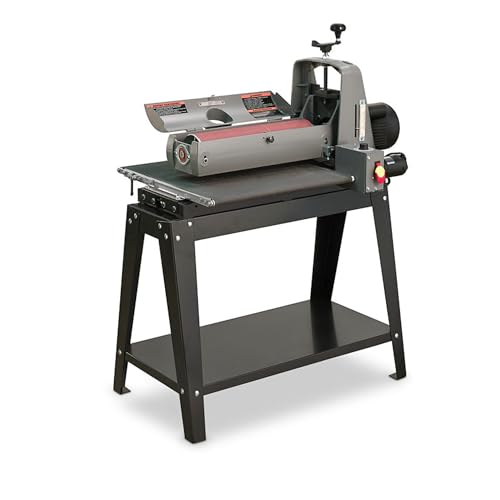
- 19-inch drum, panels up to 38 inches wide in two passes
- 1-3/4 HP motor, drum at 1,740 revolutions per minute
- IntelliSand system adjusts conveyor speed automatically to the load
- Built-in digital readout for repeatable thickness settings
All 5 Picks at a Glance
| Product | Specs | Action |
|---|---|---|
| 1. JET JWDS-1836 Drum Sander |
| Check price on Amazon |
| 2. JET JWDS-2244 Drum Sander |
| Check price on Amazon |
| 3. SuperMax 19-38 Drum Sander |
| Check price on Amazon |
 4. Powermatic PM2244 Drum Sander |
| Check price on Amazon |
 5. Powermatic DDS-225 Dual Drum Sander |
| Check price on Amazon |
Our Top Picks
- JET 22-Inch Drum Sander with Open StandSander with Stand44.31 x 27 x 30.69 inches177 poundsCheck on Amazon
What's inside
- Table of Contents
- Quick Answer
- How to Choose a Drum Sander
- 1. JET JWDS-1836 Drum Sander
- 2. JET JWDS-2244 Drum Sander
- 3. SuperMax 19-38 Drum Sander
- 4. Powermatic PM2244 Drum Sander
- 5. Powermatic DDS-225 Dual Drum Sander
- Drum Sanders Compared
- Who Should Skip a Drum Sander
- Frequently Asked Questions
- Final Verdict
- Product and ASIN Reference
As an Amazon Associate I earn from qualifying purchases. This post may contain affiliate links at no extra cost to you.
The best drum sander for most woodworkers is the JET JWDS-1836, because its 18-inch drum sands panels up to 36 inches wide in two passes, its 1-3/4 HP motor holds up on hardwoods, and SandSmart feed control slows the conveyor under load to limit burning and stalling. The JET JWDS-2244 steps up to a 22-inch drum for wider tabletops. The SuperMax 19-38 adds load-sensing feed control plus a built-in digital readout, the Powermatic PM2244 is the premium station with support tables included, and the Powermatic DDS-225 is the production pick, with two drums in one pass.
A drum sander feeds a board on a conveyor belt under a rotating drum wrapped in abrasive, removing a thin layer with every pass. That slow, shallow cut is the whole point. A planer removes thickness fast with knives, but knives can tear figured grain and chip glue joints. A drum sander works gently enough for figured grain, end-grain boards, and veneered panels.
As an Amazon Associate, we earn from qualifying purchases.
Sections
- Table of Contents
- Quick Answer
- How to Choose a Drum Sander
- 1. JET JWDS-1836 Drum Sander
- 2. JET JWDS-2244 Drum Sander
- 3. SuperMax 19-38 Drum Sander
- 4. Powermatic PM2244 Drum Sander
- 5. Powermatic DDS-225 Dual Drum Sander
- Drum Sanders Compared
- Who Should Skip a Drum Sander
- Frequently Asked Questions
- Final Verdict
- Product and ASIN Reference
Table of Contents
- Quick Answer
- How to Choose a Drum Sander
- 1. JET JWDS-1836 Drum Sander
- 2. JET JWDS-2244 Drum Sander
- 3. SuperMax 19-38 Drum Sander
- 4. Powermatic PM2244 Drum Sander
- 5. Powermatic DDS-225 Dual Drum Sander
- Drum Sanders Compared
- Who Should Skip a Drum Sander
- Frequently Asked Questions
- Final Verdict
- Product and ASIN Reference
Quick Answer
Buy the JET JWDS-1836 for most shops: its 18-inch drum covers panels up to 36 inches wide in two passes, its SandSmart control guards against burning, on a standard 115-volt circuit. Choose the JET JWDS-2244 for wider tabletops, the SuperMax 19-38 for load-sensing feed with a digital readout, the Powermatic PM2244 for a premium station with tables included, and the Powermatic DDS-225 only for production volume.
How to Choose a Drum Sander
Sanding width is the first decision, and it is set by the widest panel the shop builds. Open-end drum sanders sand about twice their drum length: a board wider than the drum is flipped and fed through a second time. An 18-inch drum covers 36-inch panels, a 19-inch drum covers 38-inch panels, and a 22-inch drum covers 44-inch panels. Closed machines sand only up to their full drum width in one pass, so a 25-inch dual-drum machine tops out at 25 inches. Measure the widest panel the shop makes before choosing.
The motor number matters less than the feed control behind it. A drum sander that feeds too fast into hard wood stalls the drum and burns the surface. Load-sensing feed control solves that by slowing the conveyor automatically when the drum motor is working hard.
Thickness range and dust collection finish the decision. The open-stand models here take stock from 1/32 inch up to 3 or 4 inches thick, which covers veneer, thin resawn boards, and thick slabs, while the dual-drum machine takes stock up to 5-1/4 inches thick. Every pick here has a 4-inch dust port, and the makers call for a dust collector moving at least 500 cubic feet per minute on the open-stand models and 1,200 on the dual-drum machine. Four picks run on 115 volts; the dual-drum machine needs a 230-volt circuit and a 40-amp breaker.
1. JET JWDS-1836 Drum Sander
- 18-inch drum, panels up to 36 inches wide in two passes
- 1-3/4 HP motor, 115 volts, drum at 1,720 revolutions per minute
- SandSmart control slows the conveyor automatically under heavy load
- Variable feed from a crawl up to 10 feet per minute
The JET JWDS-1836 is the best drum sander for most shops because it balances width, power, and control at a size that still fits a small shop. The 18-inch drum sands panels up to 36 inches wide in two passes, and the 1-3/4 HP motor drives the 5-inch drum at 1,720 revolutions per minute. SandSmart feed control slows the conveyor automatically when the cut gets heavy. The machine takes stock from 1/32 inch to 3 inches thick, with a minimum board length of 2-3/8 inches, which covers thin stock a planer cannot hold.
2. JET JWDS-2244 Drum Sander
- 22-inch drum, panels up to 44 inches wide in two passes
- 1-3/4 HP motor, 115 volts, drum at 1,725 revolutions per minute
- SandSmart control slows the conveyor automatically under heavy load
- Variable feed from a crawl up to 10 feet per minute
The JET JWDS-2244 is the wider sibling of the JWDS-1836, and it earns its place when panels outgrow an 18-inch drum. The 22-inch drum sands boards up to 44 inches wide in two passes, covering large tabletops the smaller machine cannot reach. The same 1-3/4 HP motor and SandSmart feed control carry over, and the drum turns at 1,725 revolutions per minute. Thickness capacity grows with the drum: the JWDS-2244 takes stock up to 4 inches thick, with the same 1/32-inch minimum, and a digital readout tracks drum height for repeatable settings. At roughly 296 pounds, it needs a firm floor and help to move.
3. SuperMax 19-38 Drum Sander
- 19-inch drum, panels up to 38 inches wide in two passes
- 1-3/4 HP motor, drum at 1,740 revolutions per minute
- IntelliSand system adjusts conveyor speed automatically to the load
- Built-in digital readout for repeatable thickness settings
The SuperMax 19-38 is the pick for woodworkers who want the feed control to do the thinking. Its IntelliSand system adjusts conveyor speed to the load, slowing the feed before the cut burns. The 19-inch drum covers panels up to 38 inches wide in two passes, and the 1-3/4 HP motor turns the 5-inch extruded aluminum drum at 1,740 revolutions per minute. The built-in digital readout shows drum height directly, so a thickness setting can be repeated exactly, and a quick lever adjusts height from 0 to 3 inches in one pull. Feed-belt alignment and abrasive changes take more care than on the JET models.
4. Powermatic PM2244 Drum Sander
- 22-inch drum, panels up to 44 inches wide in two passes
- 1-3/4 HP motor, 115 volts, drum at 1,720 revolutions per minute
- Feed Logic monitors the drum motor and regulates conveyor speed
- LED control panel reads drum height, feed speed, and motor load
The Powermatic PM2244 is the premium pick in this group, and it earns that place as a complete sanding station rather than a bare machine. The 22-inch drum covers panels up to 44 inches wide in two passes, with a 1-3/4 HP motor turning the 5-inch drum at 1,720 revolutions per minute. Feed Logic monitors the drum motor and regulates the conveyor, and the LED control panel reads drum height, feed speed, and motor load. Infeed and outfeed tables are included, giving 37-1/2 inches of total support, and the closed mobile stand rides on built-in casters despite weighing over 400 pounds.
5. Powermatic DDS-225 Dual Drum Sander
- Two 25-inch drums sand coarse and fine grits in a single pass
- 5 HP motor, 230 volts, drums at 1,700 revolutions per minute
- Conveyor feed at 8 and 12 feet per minute, with forward and reverse
- Maximum board width 25 inches, maximum thickness 5-1/4 inches
The Powermatic DDS-225 is the production pick, and it works on a different idea from the other four machines: two drums instead of one. The front drum runs a coarse grit and the rear drum runs a fine grit, so a board comes out thicknessed and finish-sanded in a single pass. The drums are 25 inches long and 6 inches in diameter, turning at 1,700 revolutions per minute, and the machine sands stock up to 25 inches wide and 5-1/4 inches thick. A 5 HP motor drives the drums, and the conveyor runs at 8 and 12 feet per minute. The DDS-225 is a 230-volt machine on a 40-amp circuit, weighing roughly 730 pounds. It is the wrong machine for a home shop.
Drum Sanders Compared
The JET JWDS-1836 and the SuperMax 19-38 cover the middle, at 36 and 38 inches in two passes, both with load-sensing feed control. The JET JWDS-2244 and the Powermatic PM2244 share the 44-inch two-pass capacity, and the choice between them is about the station: open stand and lighter footprint on the JET, closed mobile stand with included tables and an LED panel on the Powermatic. The Powermatic DDS-225 stands alone as a dual-drum production machine, with the only 230-volt hookup in the group.
Who Should Skip a Drum Sander
A drum sander is not the right tool for every shop. Woodworkers who only sand small parts, narrow boards, or single cabinet doors should skip it and use a planer plus a random orbital sander instead. The drum sander earns its floor space on wide panels, glued-up tabletops, and figured stock, and a shop that never builds those will not use it enough to justify the cost and the footprint. Woodworkers with no dust collector should also wait: a drum sander produces fine dust in large volume, and a shop vacuum cannot keep up with a 4-inch port. Finally, a shop that still needs a planer should buy that first, since it mills rough lumber far faster.
Frequently Asked Questions
Can a drum sander replace a planer?
No, a drum sander cannot replace a planer for milling rough lumber. A planer removes thickness far faster with knives, while a drum sander removes only a thin layer per pass. The drum sander earns its place after planing, for leveling glued-up panels and sanding thin stock.
How wide a panel can a drum sander handle?
An open-end drum sander handles about twice its drum length by flipping the panel and feeding it through a second time, so an 18-inch drum covers 36-inch panels and a 22-inch drum covers 44-inch panels. A closed machine sands only up to its full drum width in one pass.
Why does my drum sander burn the wood?
Burning usually comes from feeding too fast into hard wood, taking too deep a cut, or using a loaded abrasive that no longer cuts cleanly. Slow the conveyor, take lighter passes, and change or clean the abrasive strip when it stops cutting. Load-sensing feed control helps, but it cannot fix a dull strip or a pass that is far too deep.
What grit should I start with on a drum sander?
Start with 80 or 100 grit for leveling a glued-up panel or removing planer marks, then step to 120 or 150 grit for a smoother surface before finish sanding. Coarser grits near 60 suit heavy leveling; finer grits near 180 prepare a surface for hand sanding. Step through the grits in order rather than jumping from coarse to fine.
Final Verdict
The JET JWDS-1836 is the best drum sander for most woodworkers, because its 18-inch drum, load-sensing feed control, and 115-volt hookup cover the most shop work with the least fuss. The JET JWDS-2244 is the pick for wide tabletops, the SuperMax 19-38 is the pick for automatic feed control with a digital readout, the Powermatic PM2244 is the pick for a premium station with tables included, and the Powermatic DDS-225 is the pick for production shops that need two drums in one pass.
Product and ASIN Reference
| Product | ASIN |
|---|---|
| JET JWDS-1836 Drum Sander | B01N31I40B |
| JET JWDS-2244 Drum Sander | B07JNCD7D1 |
| SuperMax 19-38 Drum Sander | B09MVB7BT2 |
| Powermatic PM2244 Drum Sander | B0171Q8SFY |
| Powermatic DDS-225 Dual Drum Sander | B00064NGTM |
Related guides
More from Amazon
Programs that pair well with the guide above. Offers and eligibility are set by Amazon and may change.
A free business account with business pricing and bulk-buying tools for work, shop or home office.
Create a business accountFree shipping on eligible items, Prime Video and more. Eligible new members can start with a free trial.
Start a Prime free trialAudiobooks and podcasts to listen to on the go. Eligible new members can start with a free trial.
Try Audible freeAd-free music streaming. Eligible new subscribers can start with a free trial.
Try Music Unlimited freeAs an Amazon Associate we earn from qualifying purchases.
Write Your Review
No reviews yet. Be the first to share your experience!