What's inside
As an Amazon Associate I earn from qualifying purchases. This post may contain affiliate links at no extra cost to you.
Dividers transfer a distance without needing you to read it off a ruler. Set the points to a known width, then step that width along a board, mark matching parts, or carry a measurement around an edge. For timber work, that can be quicker and less error-prone than reading and re-reading a tape—especially when several parts need the same layout.
The right pair depends on the job. Small, stiff dividers suit joinery and fine layout; larger ones reach across wider stock. If you mainly need to mark a single dimension, a pencil compass may do. If you need repeatable settings, look for a firm joint that holds its position.
As an Amazon Associate we earn from qualifying purchases at no extra cost to you.


Sections
Our Top Picks
 Starrett Toolmakers Spring-Type Caliper and Divider3 Inches4.9 x 3.7 x 1 inches0.1 PoundsCheck on Amazon
 Item name- C.S.Osborne 106-6 Wing Divider with Maximum6 inches2.14 x 2.14 x 2.14 inches0.25 PoundsCheck on Amazon
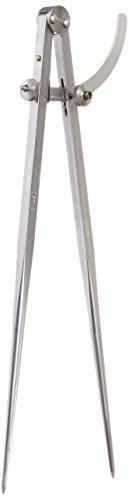 C.S.Osborne 106-12 Wing Divider with Maximum Opening 12"6 x 15.1 x 1.2 inches0.19 poundsCheck on Amazon

What dividers do well
Dividers have two pointed legs and no pencil or scale. Open them to a distance, lock or hold the joint, and transfer that span from one point to another. They are useful for dividing a board into equal spaces, stepping out a sequence of mortises, comparing two shoulders, or carrying a measurement from the face of a timber to its edge.
They do not replace a square or a marking gauge. The points locate positions, but they do not establish a reliable right angle or a line parallel to an edge. For those tasks, pair them with a marking gauge or a square. Dividers can also slip on rough or rounded surfaces, and a sharp point can leave a small hole in visible work.
Types to consider
| Type | Best use | Trade-off |
|---|---|---|
| Plain steel dividers | General layout, stepping, and transferring spans | Joint tension may need adjustment; basic versions can loosen with wear |
| Wing dividers | Holding a fixed opening during repeated layout | Bulkier to adjust, and less convenient for rapid changes |
| Spring dividers | Small, precise work and frequent fine adjustments | Limited reach and tiring to open over a wide span |
| Large timber dividers | Wide stock and full-size layout | More cumbersome; long legs can flex or snag |
For a first purchase, ordinary steel dividers are usually the sensible choice. A decent joint and straight legs matter more than a decorative finish. Wing dividers add a screw that helps retain a setting, while spring dividers use a threaded adjuster for finer changes. If you work mainly on small furniture parts, a compact pair is easier to control than a large layout tool.
Choose size and joint carefully
Check the maximum opening before buying. A 150 mm pair is manageable for cabinet parts and small framing details, but it cannot transfer a 200 mm span in one step. For larger stock, choose a pair that opens beyond the widest distance you expect to carry. Do not rely on forcing the legs beyond their intended range: the joint may loosen, or the points may spread unevenly.
Leg stiffness matters. When set to 100 mm, light legs that flex under modest pressure can change the span as you move them. Close the points gently against a ruler, then press the legs sideways. Noticeable movement is a warning, particularly if you need repeated, matching measurements. A tight joint should move smoothly but stay put when released. If it slips while you walk the setting across a board, each step can drift.
For fine joinery, consider steel spring dividers with a screw adjustment. They are useful for small changes, but their shorter legs are not ideal for transferring broad dimensions. For larger work, search for large wing dividers; check their opening range and leg rigidity rather than choosing by size alone.
Transfer a measurement without drift
Set the points against a ruler or a known reference. Seat each point gently, then lift the tool and check the opening again before marking. Pressing hard can dig into the ruler, especially with sharp points, and make the setting appear smaller. If you are transferring a measurement from one timber part to another, keep the same point orientation and approach the reference from the same direction each time.
To divide a length into equal spaces, set the dividers to an approximate interval and step along the timber. If the last step falls short or runs over, adjust the opening slightly and repeat. For example, to divide a 300 mm length into five equal spaces, set the opening near 60 mm, then refine it until five steps land on the far end. Mark lightly first. A heavy point mark can be difficult to remove or can widen as the wood compresses.
On softwood, use less pressure than you think you need. The points may sink and shift the reference, especially near an end grain edge. On rough stock, make a small flat spot with a sharp chisel or use a pencil tick as a landing point. If the timber will be visible, place the dividers on the waste side where possible.
When a cheaper option is fine
A basic pair is enough for occasional layout, rough framing, or work where a small variation will not affect the fit. You do not need a screw-adjusted tool just to mark a few repeated widths. Spend more when you need a setting to survive many transfers, when you make fine joinery, or when a loose joint would cost time remaking parts.
Keep the points sharp but not needle-thin; extremely fine tips bend more easily and can punch through thin stock. Wipe the legs dry after use, especially if they have been handled in damp conditions. If the joint loosens, check whether its fastener can be tightened before replacing the tool. Store dividers closed or protected so the points do not damage a tool belt, other tools, or your fingers.
A practical buying decision
For most carpenters transferring measurements between timber parts, choose a steel pair with enough opening for your largest common span, stiff legs, and a joint that holds its setting. Plain dividers are the best-value general option; wing or spring adjustment is worthwhile when repeatability or fine control is part of the daily work. If your measurements are usually wider than the tool can reach, buy a larger pair rather than trying to stretch a small one.