
Our Short List of 3

- Best for: Everyday jobsite cooling in dry heat.
- Polymer-embedded cooling technology activates in 2 to 5 minutes of soaking
- Up to 4 hours of cooling relief per soak
- Quilted nylon outer with mesh side panels for ventilation
- Water-repellent liner

- Best for: Workers who want the lightest evaporative vest.
- PVA evaporative material activates quickly in water
- Up to 4 hours of cooling relief
- Mesh side panels for breathable comfort
- Water-repellent inner liner

- Best for: Fixed-temperature cooling in humid or enclosed work.
- 8 non-toxic phase-change cooling packs included
- Maintains 59°F for up to 2.5 hours in 100°F heat
- Packs recharge in about 20 minutes in ice water or 1 hour in a freezer
- Weighs just under 5 pounds with packs
All 5 Picks at a Glance
| Product | Specs | Action |
|---|---|---|
| Ergodyne Chill-Its 6665 Cooling Vest |
| Check price on Amazon |
| Ergodyne Chill-Its 6667 Cooling Vest |
| Check price on Amazon |
| Glacier Tek Sports Cool Vest |
| Check price on Amazon |
 TechNiche HyperKewl 6529 Sport Vest |
| Check price on Amazon |
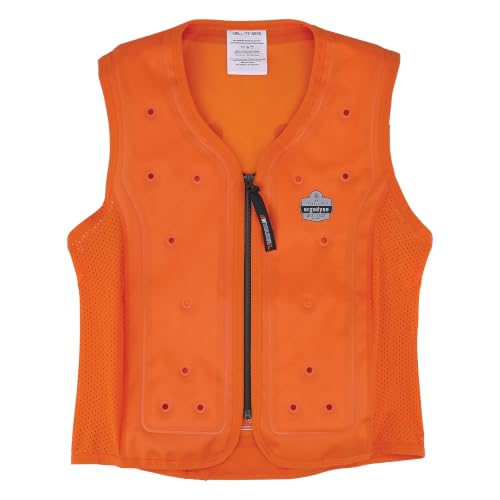 Ergodyne Chill-Its 6685 Cooling Vest |
| Check price on Amazon |
Key takeaways
- Compare five cooling vests that keep you cool on hot jobsites, with lightweight designs, long-lasting chill and fits that layer well over work shirts.
What's inside
As an Amazon Associate I earn from qualifying purchases. This post may contain affiliate links at no extra cost to you.
Working under a summer sun turns a long shift into a trial of endurance, and a cooling vest is one of the simplest ways to keep your core temperature down while you keep moving. The five vests below use three different cooling methods, so you can match the vest to your climate, your shift length, and the layers you already wear on site. Each one layers over a work shirt, leaves your arms free, and recharges with nothing more than water, a freezer, or a fresh set of packs.
We compared evaporative vests that soak and go, a phase-change vest with swap-in packs, and a dry reservoir vest that stays dry against your shirt. Fit, recharge time, and cooling duration matter more than brand names here, because a vest that dries out halfway through a shift does not help, no matter how light it feels at the beginning of the day.
Sections
Quick Picks
As an Amazon Associate we earn from qualifying purchases
| Product | Best for | Key spec |
|---|---|---|
| Ergodyne Chill-Its 6665 | Everyday jobsite cooling | Up to 4 hours per soak |
| Ergodyne Chill-Its 6667 | Lightweight PVA cooling | PVA fabric, up to 4 hours |
| Glacier Tek Sports Cool Vest | Fixed-temperature cooling | Holds 59°F up to 2.5 hours |
| TechNiche HyperKewl 6529 | Longest wear between soaks | 5 to 10 hours per soak |
| Ergodyne Chill-Its 6685 | Multi-day dry cooling | Up to 3 days per fill |
How to Choose
Match the cooling method to your climate
Evaporative vests work by letting water leave the fabric slowly, which pulls heat away from your torso. That process needs dry air and airflow, so it shines on open sites in arid regions and fades in muggy air. Phase-change vests use sealed packs that hold a set temperature, so they keep working in humidity and under coveralls. Dry reservoir vests sit between the two: you fill a sealed chamber once and stay dry while the water inside does the work. Pick the method that fits the air you work in, not the one with the longest number on the box.
Check cooling duration against your shift
A vest that cools for two hours is plenty for a short morning task and useless for a ten-hour pour with no break room nearby. Look at how long one activation lasts and how long a recharge takes. Soak vests recharge in minutes at a tap or a cooler, so a second soak at lunch is easy. Pack vests need a freezer or ice water, so you need spare packs or a cold box on the truck. Reservoir vests run for days on one fill, which suits remote sites. Match the duration to the longest stretch you work without a cold water source.
Get the fit right over your work layers
A cooling vest only works when it sits close to your torso, so sizing matters more than it does for a loose hi-vis shell. Measure your chest over the shirt you actually wear on site, then check the size chart instead of guessing from your jacket size. Look for side straps or mesh panels that let you cinch the vest in, and a front zipper that opens fully so you can put it on over a hard hat and gloves without a struggle. A vest that rides up or gaps at the sides wastes its cooling on the air around you instead of your core.
Weigh recharge effort and upkeep
The cheapest vest to buy can become the most annoying vest to own if it needs a freezer you do not have or a wash routine you will skip. Soak vests need a water source and a few minutes, and most go in the wash like a shirt. Pack vests need freezer space and spare packs, and the packs add weight you carry all day. Reservoir vests need only a measured fill of water, yet you must keep the valve closed in the wash and let the vest hang dry. Choose the upkeep you will actually do, because a vest left dirty in a locker helps nobody.
The 5 Best Options
Ergodyne Chill-Its 6665 Cooling Vest
- Best for: Everyday jobsite cooling in dry heat.
- Polymer-embedded cooling technology activates in 2 to 5 minutes of soaking
- Up to 4 hours of cooling relief per soak
- Quilted nylon outer with mesh side panels for ventilation
- Water-repellent liner
Everyday jobsite cooling in dry heat.
Hand wash only, and cooling fades in humid air.
The Chill-Its 6665 is the workhorse of this group, a polymer-embedded vest you soak for a few minutes and wear over a shirt for up to four hours of cooling. Its quilted nylon outer stands up to rough handling, while mesh side panels move air across your torso and a water-repellent liner keeps the damp layer off your clothes. Five sizes from medium to triple extra large cover most crews, and the gray and hi-vis lime colors let you match site visibility rules. It is hand wash only, so it suits workers who rinse gear at the end of the day.
Ergodyne Chill-Its 6667 Cooling Vest
- Best for: Workers who want the lightest evaporative vest.
- PVA evaporative material activates quickly in water
- Up to 4 hours of cooling relief
- Mesh side panels for breathable comfort
- Water-repellent inner liner
Workers who want the lightest evaporative vest.
Cooling weakens in humid air, so check your climate first.
The Chill-Its 6667 swaps quilted nylon for a PVA fabric that feels lighter on the shoulders and soaks up water in a couple of minutes. It delivers the same four-hour cooling window as the 6665, yet the lighter build and full size run from medium to 5XL make it a friendlier pick for long days and bigger frames. Mesh side panels keep air moving, the front zipper opens wide for easy on and off, and the whole vest goes in the washing machine. Its one real limit is climate: PVA cooling leans on dry air, so humid sites blunt its effect.
Glacier Tek Sports Cool Vest
- Best for: Fixed-temperature cooling in humid or enclosed work.
- 8 non-toxic phase-change cooling packs included
- Maintains 59°F for up to 2.5 hours in 100°F heat
- Packs recharge in about 20 minutes in ice water or 1 hour in a freezer
- Weighs just under 5 pounds with packs
Fixed-temperature cooling in humid or enclosed work.
Heaviest vest in this group, and spare packs add to the kit.
The Glacier Tek Sports Cool Vest takes a different path: eight sealed phase-change packs hold a steady 59 degrees for up to two and a half hours in 100-degree heat, no soaking and no damp shirt. The packs recharge in about 20 minutes in ice water, an hour in a freezer, or two hours in a refrigerator, and a mesh bag comes along for the job. One size fits most chests from 29 to 52 inches, with dual side straps and shoulder adjustment for a snug fit. At just under five pounds with packs, it is the heaviest vest here, yet the fixed temperature makes it the most predictable.
TechNiche HyperKewl 6529 Sport Vest
- Best for: All-day cooling on long shifts in dry heat.
- HyperKewl polymer-embedded fabric absorbs water and releases cooling slowly
- Soak in water for about 2 minutes to activate
- 5 to 10 hours of cooling relief per soak
- Runs 15 to 20 degrees cooler than the air around you
All-day cooling on long shifts in dry heat.
Needs dry air and airflow to keep working at full strength.
The HyperKewl 6529 is the long-distance pick in this group, with a polymer-embedded inner that holds water and releases cooling for five to ten hours after a two-minute soak. Its V-neck zip design layers neatly under a hi-vis vest, and the quilted nylon outer with a water-repellent liner stands up to daily site wear. Sizes run from extra small to triple extra large, with kids sizes too, and colors include silver, black, royal blue, hi-vis lime, and khaki. The maker says it runs 15 to 20 degrees cooler than the air around you, which explains why riders and outdoor crews keep coming back to it.
Ergodyne Chill-Its 6685 Cooling Vest
- Best for: Multi-day jobs in dry heat where a dry shirt matters.
- Dry evaporative cooling vest with zipper closure
- Exclusive dry technology keeps the wearer dry during cooling
- Up to 3 days of cooling per fill
- Fill with no more than 17 oz (500 mL) of water to activate
Multi-day jobs in dry heat where a dry shirt matters.
Needs airflow to work, so skip it under heavy coveralls.
The Chill-Its 6685 is the odd one out, and that is its strength: instead of soaking fabric, you fill a sealed reservoir with no more than 17 ounces of water, and the vest cools for up to three days while your shirt stays dry. Hi-vis industrial-grade nylon, mesh side panels, and a front zipper suit road crews and anyone who works near traffic, and the size run covers medium to 4XL in orange and lime. You must close the valve before washing and hang the vest to dry, and the vest needs airflow to work, so it is not a pick for wearing under heavy layers.
Which One Fits Your Situation
You work open-air shifts in dry heat
Any evaporative vest in this group will serve you well, and the choice comes down to weight and wash routine. The 6665 is the sturdy default, the 6667 is the lighter machine-washable option, and the 6529 stretches one soak across the longest days. Keep a water source nearby for a midday soak and you are set.
You work in humidity or enclosed spaces
Evaporative vests lose power when the air is already wet, so reach for the Glacier Tek Sports Cool Vest. Its sealed packs hold 59 degrees regardless of humidity, and they work under coveralls where airflow is scarce. Carry a spare set of packs or a cold box so a swap at break time keeps the cooling going.
You work near traffic and need to stay visible
The 6685 pairs hi-vis orange or lime nylon with cooling that lasts for days, so it fits road crews and flaggers who cannot stop to soak a vest. The 6665 in hi-vis lime is the simpler backup when a single-day soak vest is enough. Either way, check the visibility rules on your site before you order.
You want the least fuss over a long week
The 6685 wins on upkeep: one measured fill cools for up to three days, with no daily soaking and no freezer runs. If you would rather wash your vest like a shirt, the machine-washable 6667 is the low-effort evaporative pick, and the 6529 only asks for a two-minute soak each morning.
Common Mistakes
- Buying a vest that needs dry air for a humid site, then wondering why it feels warm by noon.
- Sizing from your jacket size instead of measuring your chest over your work shirt.
- Skipping the recharge plan: pack vests need freezer space or spare packs, soak vests need water on hand.
- Wearing a dry reservoir vest under heavy layers, where it gets no airflow to work with.
- Forgetting to close the valve on the 6685 before washing it.
Frequently Asked Questions
How long does a cooling vest stay cool?
It depends on the method. Soak vests like the 6665, 6667, and 6529 cool for 4 to 10 hours per soak, with the 6529 lasting longest. The Glacier Tek vest holds a set temperature for up to 2.5 hours per pack charge, and the 6685 reservoir vest cools for up to three days on one fill.
Do cooling vests work in humid weather?
Evaporative vests struggle when the air is already damp, because their cooling leans on water leaving the fabric. In humidity, pick a phase-change vest like the Glacier Tek Sports Cool Vest, whose sealed packs hold 59 degrees no matter how wet the air feels. The 6685 reservoir vest also copes better than soak vests in muggy conditions, as long as it gets airflow.
Can I wear a cooling vest under a hi-vis vest?
Yes, most of these vests layer neatly under a hi-vis shell, and the 6529 was built with that in mind. Keep the fit snug so the cooling layer sits close to your torso, and leave the outer vest loose enough for air to move. The 6685 needs airflow across its surface, so give it room rather than burying it under heavy layers.
How do I wash a cooling vest?
Follow the label on your vest. The 6667 and 6685 go in the washing machine, though the 6685 needs its valve closed first and a hang dry after. The 6665 is hand wash only, so rinse it in a sink or a bucket at the end of the day. Never put phase-change packs in a washing machine; recharge them in ice water or a freezer instead.
Related guides
More from Amazon
Programs that pair well with the guide above. Offers and eligibility are set by Amazon and may change.
A free business account with business pricing and bulk-buying tools for work, shop or home office.
Create a business accountFree shipping on eligible items, Prime Video and more. Eligible new members can start with a free trial.
Start a Prime free trialAudiobooks and podcasts to listen to on the go. Eligible new members can start with a free trial.
Try Audible freeAd-free music streaming. Eligible new subscribers can start with a free trial.
Try Music Unlimited freeAs an Amazon Associate we earn from qualifying purchases.
Write Your Review
No reviews yet. Be the first to share your experience!