What's inside
- Best Commercial Food Heat Lamps for Buffets
- Quick comparison: which heat-lamp setup fits your buffet?
- Bulb type: infrared PAR38 is the practical default
- Height and coverage matter more than maximum wattage
- Decision matrix for buying
- Features worth paying for
- How to set up a heat lamp without drying the food
- Ownership costs and maintenance
- Bottom line
- Best Commercial Food Heat Lamps for Buffets
- Quick comparison: which heat-lamp setup fits your buffet?
- Bulb type: infrared PAR38 is the practical default
- Height and coverage matter more than maximum wattage
- Decision matrix for buying
- Features worth paying for
- How to set up a heat lamp without drying the food
- Ownership costs and maintenance
- Bottom line
As an Amazon Associate I earn from qualifying purchases. This post may contain affiliate links at no extra cost to you.
Sections
- Best Commercial Food Heat Lamps for Buffets
- Quick comparison: which heat-lamp setup fits your buffet?
- Bulb type: infrared PAR38 is the practical default
- Height and coverage matter more than maximum wattage
- Decision matrix for buying
- Features worth paying for
- How to set up a heat lamp without drying the food
- Ownership costs and maintenance
- Bottom line
Best Commercial Food Heat Lamps for Buffets
The best commercial food heat lamps for most buffet lines are adjustable-height units using infrared PAR38 heat bulbs, because they offer controllable warmth, replaceable lamps, and enough coverage for one or two standard food pans without heating the surrounding room excessively.
Choose a ceramic or metal-bodied lamp with a protective guard, a height range of roughly 18 to 30 inches above the food, and enough lamp spacing to cover each pan evenly. For high-volume service, a two-lamp or three-lamp gantry is usually more practical than several small countertop fixtures.
As an Amazon Associate we earn from qualifying purchases at no extra cost to you.


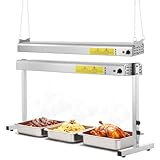

Quick comparison: which heat-lamp setup fits your buffet?
| Setup | Typical bulb | Useful coverage | Height adjustment | Best for | Main limitation |
|---|---|---|---|---|---|
| Single countertop lamp | 175–250 W infrared PAR38 | 1 half-size pan or 1 small serving dish | About 18–28 in | Small cafés, carving stations, occasional catering | Uneven coverage on wide pans |
| Two-lamp gantry | 2 × 175–250 W PAR38 | 1 full-size pan or 2 half-size pans | About 18–30 in | Restaurants and regular buffet service | Higher electrical load and counter footprint |
| Three-lamp or four-lamp line | 175–250 W per lamp | 2–4 full-size pans, depending on spacing | Fixed or adjustable, commonly 18–32 in | Hotels, banquet service, institutional dining | Requires careful balancing across the whole line |
| Decorative pendant lamp | Infrared bulb, commonly 175–250 W | One small serving zone per lamp | Usually fixed after installation | Front-of-house displays and carving stations | Less flexible when the menu or pan layout changes |
Bulb type: infrared PAR38 is the practical default
Infrared incandescent bulbs
Infrared incandescent bulbs are the most common choice for commercial food warming. A PAR38 shape produces a directional beam, and common commercial ratings range from 175 to 250 watts. Red bulbs reduce the visual harshness of bright white light and can make roasted or fried foods look more appealing. Clear or frosted bulbs provide a more neutral appearance but may look less decorative.
The key advantage is serviceability: when a bulb fails, the operator replaces the bulb rather than replacing the complete fixture. Keep spare bulbs on site, but use the exact wattage and base specification approved for the lamp. Installing a higher-wattage bulb than the fixture allows can overheat the socket, reflector, or wiring.
Ceramic heat emitters
Ceramic heat emitters produce infrared heat without visible light. They can suit bakeries, open kitchens, and displays where colored lighting would distort the appearance of food. Their heat pattern depends heavily on reflector design and mounting distance, so they are less of a universal choice for a mixed buffet.
They can also create a deceptively cool-looking station: staff may increase the output or lower the emitter to compensate, potentially drying the surface of delicate foods. Use a thermometer and food-quality checks rather than judging performance by appearance alone.
Quartz or radiant strip heaters
Quartz and overhead radiant strip heaters are useful when a long, continuous counter needs even warming. They avoid the “hot spot under each bulb” effect, but they normally require more permanent installation and careful electrical planning. They make more sense for a fixed serving line than for a catering operation that changes layouts frequently.
Height and coverage matter more than maximum wattage
A powerful lamp mounted too close to food can create a dry crust, scorched garnish, or a hot center with cool edges. A lower-powered lamp mounted too high may leave food below the desired holding temperature. Adjustable height lets the operator tune the radiant intensity without changing the bulb.
As a starting point, position a PAR38 lamp about 18 to 24 inches above the food, then check the center and outer edges after the station has stabilized. Move the lamp higher if the surface dries quickly or the center becomes noticeably hotter than the edges. Move it lower only when the food is losing heat and the coverage remains even.
Spacing is equally important. One lamp directly over the center of a full-size hotel pan often produces a warm middle and cooler corners. Two lamps spaced across the pan usually give more uniform coverage, even if each bulb runs at a lower setting or is mounted slightly higher.
A simple coverage calculation
Suppose a buffet uses two half-size pans, each approximately 12 by 10 inches. Their combined serving area is about 240 square inches. A single lamp with an effective heated footprint of roughly 120 to 160 square inches will not cover both pans consistently. Two lamps, each centered over one pan, provide better coverage than one 250-watt lamp placed between them.
This is why adding wattage is not always the answer. Two 175-watt lamps use 350 watts in total, but they can distribute heat more evenly than one 250-watt bulb. Better distribution may reduce the need to keep the fixture very close to the food, helping limit drying.
Decision matrix for buying
| Your situation | Recommended choice | What to prioritize |
|---|---|---|
| Budget-conscious, occasional use | Single adjustable countertop lamp | Replaceable 175–250 W bulb, guarded socket, stable base |
| Daily restaurant buffet | Two-lamp gantry | Independent switches, height adjustment, cleanable reflector |
| Large banquet or hotel line | Three- or four-lamp modular system | Separate controls, consistent spacing, serviceable wiring |
| Limited counter depth | Wall-mounted or overhead strip heater | Low-profile installation and safe clearance from guests |
| Highly changeable catering layouts | Portable adjustable gantry | Quick setup, manageable weight, protected power cord |
| Delicate foods that dry easily | Lower-wattage lamps with two-point coverage | Fine height control and a cover or lid for the food pan |
Features worth paying for
- Independent switches: Turn off lamps over empty pans instead of heating the entire line.
- Continuous height adjustment: A sliding arm or telescoping post is more useful than two or three preset positions.
- Protective bulb guards: A guard helps contain fragments if a hot bulb breaks and reduces accidental contact during service.
- Metal or ceramic heat-resistant construction: These materials tolerate repeated heating and cooling better than thin plastic housings near the socket.
- Replaceable components: Confirm that bulbs, sockets, switches, and power cords can be replaced individually.
- Weighted, stable base: A tall adjustable fixture should not become unstable when staff reach beneath it for serving utensils.
- Readable controls: Clearly marked switches reduce mistakes during busy service, especially when several lamps are mounted together.
How to set up a heat lamp without drying the food
- Start with the pan layout. Place the pans exactly as they will appear during service. Do not tune the lamp over an empty counter and assume the same result will apply once food is loaded.
- Center each lamp on a serving zone. For a full-size pan, use two lamps when one creates a pronounced central hot spot.
- Begin at the higher end of the adjustment range. Lower the lamp gradually rather than starting close to the food. This gives the surface time to warm without immediately forming a dry layer.
- Check several points. Compare the center, corners, and exposed top surface. If only the center is hot, raise the lamp or improve spacing.
- Use lids and moisture strategically. Covered pans retain moisture and heat more effectively than exposed food. Avoid relying on the lamp to compensate for an uncovered pan that is losing moisture rapidly.
- Recheck after refilling. A shallow pan, a freshly filled deep pan, and a nearly empty pan absorb radiant heat differently. Adjust the height or operating lamps as the food level changes.
Heat lamps are for holding and presentation, not for rapidly heating cold food. Follow your local food-safety procedures for hot-holding temperatures, time limits, pan depth, and temperature checks. A lamp can make the surface feel hot while the lower portion of a deep pan remains cooler.
Ownership costs and maintenance
Bulb replacement is the main consumable. For example, running two 250-watt lamps for six hours uses 3 kilowatt-hours of electricity per service day. At an electricity rate of $0.15 to $0.30 per kilowatt-hour, that is approximately $0.45 to $0.90 per day, before bulb replacement and other operating costs. Using two 175-watt bulbs for the same period reduces consumption to 2.1 kilowatt-hours, but only if the lower output still provides adequate coverage.
The parts that commonly wear first are the bulb socket, switch, power cord, height-locking mechanism, and reflector finish. Grease and steam can cloud reflectors and reduce output. Clean the fixture only after it has been unplugged and fully cooled, using a lightly damp cloth and the manufacturer’s approved cleaner. Do not spray liquid into the socket, switch, ventilation openings, or bulb base.
Inspect the cord for softening, cracks, or discoloration, and stop using the unit if the plug or socket shows heat damage. Do not touch infrared bulbs with bare, greasy hands when installing them; residue can create uneven heating and shorten bulb life. Keep replacement bulbs dry and stored where they cannot roll or strike one another.
Bottom line
For most commercial buffet lines, buy an adjustable two-lamp gantry with guarded PAR38 sockets and 175–250 watt infrared bulbs. Choose a single lamp when the serving zone is genuinely small, and choose a strip heater or modular multi-lamp system when the counter is long and permanently arranged. Prioritize even coverage, independent controls, and replaceable parts over the highest wattage. The right height and spacing will keep food warmer more evenly while reducing the drying that comes from concentrating too much heat in one spot.