What's inside
- Quick picks by playing situation
- Boss Katana comparison: wattage, speakers, and practical features
- Best Boss Katana amp for bedroom practice: Katana-50 Gen 3
- Best for wireless practice: Katana-Air EX
- Best compact option: Katana Mini
- Best for rehearsal and gigging: Katana-100 Gen 3
- Best for broad stage coverage: Katana-100/212 Gen 3
- Best premium Katana: Katana-Artist Gen 3
- Decision matrix: match the amp to your routine
- Recording and setup advice
- Ownership realities and common mistakes
- Final verdict
- Quick picks by playing situation
- Boss Katana comparison: wattage, speakers, and practical features
- Best Boss Katana amp for bedroom practice: Katana-50 Gen 3
- Best for wireless practice: Katana-Air EX
- Best compact option: Katana Mini
- Best for rehearsal and gigging: Katana-100 Gen 3
- Best for broad stage coverage: Katana-100/212 Gen 3
- Best premium Katana: Katana-Artist Gen 3
- Decision matrix: match the amp to your routine
- Recording and setup advice
- Ownership realities and common mistakes
- Final verdict
As an Amazon Associate I earn from qualifying purchases. This post may contain affiliate links at no extra cost to you.
The best Boss Katana amps for most players are the Katana-50 Gen 3 for home use, the Katana-100 Gen 3 for rehearsals and smaller gigs, and the Katana-100/212 Gen 3 when you need wider sound and greater stage headroom.
As an Amazon Associate we earn from qualifying purchases at no extra cost to you.

Sections
- Quick picks by playing situation
- Boss Katana comparison: wattage, speakers, and practical features
- Best Boss Katana amp for bedroom practice: Katana-50 Gen 3
- Best for wireless practice: Katana-Air EX
- Best compact option: Katana Mini
- Best for rehearsal and gigging: Katana-100 Gen 3
- Best for broad stage coverage: Katana-100/212 Gen 3
- Best premium Katana: Katana-Artist Gen 3
- Decision matrix: match the amp to your routine
- Recording and setup advice
- Ownership realities and common mistakes
- Final verdict
Quick picks by playing situation
- Bedroom practice on a sensible budget: Boss Katana-50 Gen 3
- Quiet practice with no mains cable: Boss Katana-Air EX
- Small rooms, lessons, and travel: Boss Katana Mini
- Home recording and regular rehearsal: Boss Katana-50 Gen 3 or Katana-100 Gen 3
- Band practice and smaller stages: Boss Katana-100 Gen 3
- Larger venues or maximum clean headroom: Boss Katana-100/212 Gen 3
- Players who want the most refined speaker and controls: Boss Katana-Artist Gen 3
The central buying decision is not simply “more watts is better.” Wattage affects available clean headroom and volume, while speaker size, cabinet design, output connections, attenuation, and portability determine whether an amp fits your room and routine.
Boss Katana comparison: wattage, speakers, and practical features
| Model | Rated power | Speaker configuration | Approx. weight | Best fit |
|---|---|---|---|---|
| Katana Mini | 7 W | One 4-inch speaker | 3.0 kg | Portable practice and very small rooms |
| Katana-50 Gen 3 | 50 W | One 12-inch speaker | 11.6 kg | Home use, recording, lessons, and occasional rehearsal |
| Katana-Air EX | 35 W stereo battery-powered operation; 20 W with the included adapter | Two 5-inch speakers | 8.8 kg | Wireless home practice and convenient stereo effects |
| Katana-100 Gen 3 | 100 W | One 12-inch speaker | 14.8 kg | Rehearsal and small-to-medium gigs |
| Katana-100/212 Gen 3 | 100 W | Two 12-inch speakers | 19.8 kg | Broad, room-filling stage sound |
| Katana-Artist Gen 3 | 100 W | One 12-inch Waza speaker | Approximately 19 kg | Players prioritising speaker character, control, and gigging features |
Published dimensions and weights can vary slightly by market and revision, so confirm the local specification before buying a case or stand. The useful comparison is clear: the 50-watt and 100-watt models use a conventional 12-inch guitar speaker, while the Air EX prioritises wireless convenience and stereo playback, and the 100/212 trades portability for acoustic spread.
Best Boss Katana amp for bedroom practice: Katana-50 Gen 3
The Boss Katana-50 Gen 3 is the strongest all-round choice for a guitarist who mainly plays at home but does not want to outgrow a tiny practice amp. Its 12-inch speaker produces a fuller low end and more natural projection than the Katana Mini, while the five amplifier characters, onboard effects, USB audio, headphone output, and power control cover practice and basic recording.
Its 50 watts can be reduced with the power-control setting, making it more practical at home than the headline number suggests. The amp also accepts Boss Tone Studio editing, so you can fine-tune effects and save sounds rather than relying only on the front-panel controls.
The main limitation is expansion: the Katana-50 Gen 3 does not provide the same foot-controller and external-speaker flexibility as the larger models. Choose it when you want one self-contained combo, not a stage system you intend to expand.
Best for wireless practice: Katana-Air EX
The Katana-Air EX is the convenient option for players who practise frequently and dislike setting up cables. Its wireless guitar system, stereo speakers, Bluetooth audio, rechargeable-battery operation, and effects make it especially useful for playing along with backing tracks around the house.
Its two 5-inch speakers give music playback a wider stereo presentation than a typical single-speaker combo. However, it is not the best value if your priorities are maximum guitar volume, a traditional 12-inch speaker response, or the simplest recording setup. Wireless systems also require charging and introduce another component to maintain.
Best compact option: Katana Mini
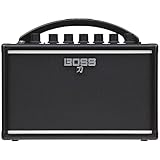
The Katana Mini is a 7-watt, battery-powered practice amp with a 4-inch speaker and three amp sections. It is easy to carry, inexpensive compared with the larger Katana range, and well suited to a desk, lesson room, or occasional unplugged location.
Its small speaker is the trade-off. It will not deliver the low-frequency authority, volume, or spacious effects of a 12-inch Katana. Select it because portability matters more than recording depth, not because it is a smaller version of the 50-watt models.
Best for rehearsal and gigging: Katana-100 Gen 3
The Katana-100 Gen 3 is the practical step up when a 50-watt combo is nearly suitable but you need more clean headroom and stage flexibility. It retains the Katana platform’s amp types and effects, adds a more substantial 12-inch cabinet, and supports features such as an effects loop, external speaker connection, and foot-control options that are more useful in a live setup.
At roughly 14.8 kg, it remains manageable for one person. For most pub, rehearsal-room, and small-stage applications, one 12-inch speaker is easier to transport and mic than the 100/212. The extra power will not automatically make it sound better at bedroom volume, so it is a poor upgrade if you never rehearse with a drummer or perform live.
Best for broad stage coverage: Katana-100/212 Gen 3
The Katana-100/212 Gen 3 uses two 12-inch speakers. Compared with a single-speaker Katana, it moves more air and spreads sound more broadly across a room. That can help a guitarist hear the amp onstage without aiming a narrow beam directly at their legs.
The cost is nearly 20 kg of cabinet weight and a larger footprint. Two speakers also do not double the amplifier’s wattage; the model is still rated at 100 watts. Choose it for coverage and fullness, not because it is twice as loud as the Katana-100.
Best premium Katana: Katana-Artist Gen 3
The Katana-Artist Gen 3 targets players who care about cabinet response and fine control as much as raw output. Its Waza speaker, larger cabinet approach, variable power control, advanced tone-shaping features, and additional front-panel control make it the more complete single-speaker Katana for regular performers.
It is heavier and more expensive than the Katana-100 Gen 3, with general market pricing commonly landing in the upper-midrange to premium combo-amp bracket. The upgrade makes sense when you will use the extra controls and speaker character every week. For a beginner playing at low volume, the Katana-50 Gen 3 offers better value.
Decision matrix: match the amp to your routine
| Your situation | Recommended model | Why | What to accept |
|---|---|---|---|
| Under 30 minutes of practice, limited storage | Katana Mini | Small, light, battery powered | Less bass and fewer connections |
| Daily home playing and occasional recording | Katana-50 Gen 3 | 12-inch speaker, USB audio, power control | No full-size stage expansion |
| Daily wireless practice with backing tracks | Katana-Air EX | Wireless guitar, Bluetooth, stereo sound | Higher cost and battery management |
| Weekly band rehearsal or small gigs | Katana-100 Gen 3 | More headroom and live connections | More weight and higher price |
| Large stage sound from one cabinet | Katana-100/212 Gen 3 | Two 12-inch speakers and broad projection | Nearly 20 kg to carry |
| Experienced player wanting maximum refinement | Katana-Artist Gen 3 | Waza speaker and deeper control | Premium price and heavier cabinet |
Recording and setup advice
For home recording, begin with the Katana-50 Gen 3 or Katana-100 Gen 3 connected by USB. This avoids placing a microphone in a room with unwanted reflections and lets you record at a controlled level. Use the amp’s speaker-emulated or recording output according to the software and firmware instructions, then monitor through headphones if neighbours are a concern.
For a live rig, save separate patches for clean, rhythm, lead, and ambient sounds before rehearsal. Set patch volumes by perceived loudness rather than by identical numerical settings: a distorted patch with compressed mids can seem louder than a clean patch even when both display the same level.
Ownership realities and common mistakes
- Keep the speaker grille and control panel dust-free: use a dry, soft cloth and avoid spraying cleaner into switches, jacks, or ventilation openings.
- Do not block ventilation: especially when the combo is placed against a wall or inside furniture.
- Protect the jacks and power cable: repeated transport stresses sockets before the amplifier electronics usually fail.
- Update and back up patches carefully: Tone Studio and firmware changes can alter workflows, so keep important tones saved on a computer.
- Do not buy watts for bedroom volume: a 100-watt amp is not automatically more suitable at low volume than a 50-watt model.
- Budget for transport: a padded cover helps protect the grille, handles, and corners, particularly on the heavier 100/212 and Artist models.
Final verdict
For the widest range of home, recording, and occasional rehearsal needs, choose the Boss Katana-50 Gen 3. Move to the Katana-100 Gen 3 when you regularly play with a drummer or need live connections. Choose the Katana-100/212 Gen 3 for room coverage, the Katana-Air EX for wireless convenience, and the Katana-Artist Gen 3 when premium speaker response and deeper control justify the extra weight and cost.