What's inside
As an Amazon Associate I earn from qualifying purchases. This post may contain affiliate links at no extra cost to you.
Sections
Our Top Picks
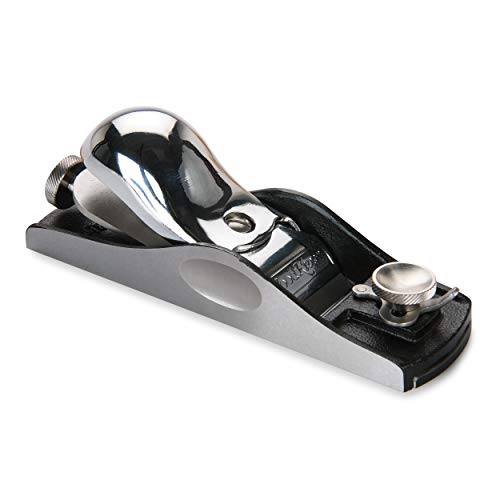 Woodriver Low Angle Block Plane With Adjustable Mouth7.85 x 3.15 x 2.75 Inches2.04 poundsCheck on Amazon

Why Adjustable Mouth Matters for Skirting
Trimming end grain on skirting is where a fixed-mouth block plane falls down. MDF skirting with a wrap or primed finish will crumble and chip if the mouth is wide open, and solid timber like oak or pine will tear out at the back edge if the blade isn’t properly supported. An adjustable mouth lets you close the gap in front of the blade to a fraction of a millimetre, which does two things: it supports the wood fibres right up to the cutting edge and it acts as a chip breaker on a very short shaving.
For skirting work you are almost always taking 0.05mm to 0.15mm shavings off end grain to sneak up on a mitre or a scribed joint. You don’t need a deep cut, you need a clean, supported cut. A mouth opening of around 0.5-1.0mm for finish trimming versus 2-3mm for heavier chamfering or softwood softening is the practical range. Without an adjustable toe plate, you are stuck with one compromise setting that does neither job well.
As an Amazon Associate we earn from qualifying purchases at no extra cost to you.

What to Look For in a Block Plane for End Grain
Not all adjustable-mouth block planes are equal on site. Weight, sole flatness, and how the mouth adjustment actually locks are more important than marketing.
First, check the mouth mechanism. The best designs use a knurled screw or lever that moves the front toe plate forward and back without tools, and it stays put under vibration. Cheaper planes use a single small screw that loosens after a few passes, letting the mouth creep open. If the toe doesn’t lock solid, you lose the whole advantage.
Second, look at blade bedding. For end grain you want a low angle. Most low-angle block planes bed the blade at 12 to 13 degrees, bevel-up. With a standard 25-degree bevel, that gives an effective cutting angle of 37-38 degrees, which shears end grain rather than scraping it. A standard-angle block plane beds at 20 degrees, giving a 45-degree cutting angle with the same bevel. It will work, but it takes noticeably more force on hard MDF and on oak skirting, and it dulls faster on abrasive MDF dust.
Third, sole length and width. A 150mm to 165mm long sole (the classic 60 1/2 size) is ideal for skirting. It’s long enough to register on a 90-120mm wide board and keep square, but short enough to use one-handed when you’re coping or fitting in place. A full-size bench plane is overkill here.
Fourth, adjuster quality. A lateral adjuster and a decent depth wheel that moves the blade in 0.05mm increments without backlash saves a lot of time. On cheap planes you end up tapping the blade with a hammer, which is slow and inaccurate when you are trying to close a mitre by 0.2mm.
Low Angle vs Standard Angle: The Trade-Off
For pure end-grain trimming, a low-angle, bevel-up plane wins. It requires 20-30% less pushing force and leaves a cleaner surface on MDF and softwoods. The trade-off is that the low cutting angle is more fragile. If you hit a hidden staple or grit in reclaimed skirting, a 37-degree edge will nick or roll more easily than a 45-degree edge.
You can change the effective angle by swapping the bevel. Grinding a second blade to 38 degrees gives you a 50-degree cutting angle (12 + 38) for tricky grain or for when you need to plane with the grain along the top edge of the skirting. Many joiners who do a lot of skirting keep two blades: one at 25 degrees for end grain and MDF, one at 38-40 degrees for general work. That is cheaper than buying two planes and more practical than regrinding on site.
If you only buy one low angle block plane with adjustable mouth and keep it sharp, it will handle 90% of skirting tasks, including easing the top edge and fitting scribes.
Comparison: What You Get at Each Price Point
For skirting, you don’t need the most expensive plane, but you do need a mouth that locks and a sole that is flat within 0.03mm over its length. Here is how the tiers compare in practice:
| Category | Mouth Control | Sole & Build | Blade Steel | Best For |
|---|---|---|---|---|
| Budget Cast Iron (£25-£45) | Adjustable toe, often single-screw lock. Prone to slipping under load. | Often needs flattening on 120-grit on glass. Paint-filled mouth can stick. | Thin carbon steel, 2-3mm. Sharpens quickly, dulls quickly on MDF. | Occasional DIY skirting, soft pine/MDF if you are willing to fettle it for an hour. |
| Mid-Range Cast Iron / Ductile Iron (£60-£110) | Lever or twin-screw toe lock. Holds 0.5-1mm setting reliably. | Ground flat from factory. Heavier (800-900g), stable one-handed. | Thicker A2 or O1, 3-3.5mm. Holds 25-degree edge longer. | Site carpentry and frequent skirting/flooring work. Best value for most. |
| Premium Low-Angle (£160-£280) | Precise screw adjustment with zero play. Mouth stays set. | Milled ductile iron or bronze, fully flat, tighter tolerances on blade seat. | A2, PM-V11 or similar, 3.5-4mm. Excellent edge retention on MDF. | Daily use, hardwoods, and if you want to swap blades without re-setting. |
A mid-range adjustable mouth block plane that is properly sharpened will outperform a premium plane with a dull blade. Spend the difference on a simple honing guide and a 1000/6000 grit stone if you don’t already have them. A flat sole matters more than brand.
Setting Up for Clean End Grain
For skirting mitres, set the mouth tight first, then set the blade. Close the toe until there is about 0.8mm in front of the blade when it is retracted. Then advance the blade until it just peeks through. You should be able to take a shaving that is translucent and 10-15mm wide on softwood end grain without the plane chattering.
If shavings jam in the mouth, you are too tight or trying to take too deep a cut. Open the mouth to 1.2mm and reduce depth. For MDF, keep the mouth tighter than for pine – MDF dust packs and will clog a wide mouth faster than it seems. Wax the sole with paraffin or a candle stub; it cuts pushing force on MDF by half.
Sharpen at 25 degrees and add a 2-degree micro-bevel at 27 degrees if you want a more durable edge without increasing cutting resistance much. Hone to at least 6000 grit. On end grain, a burr or a 1000-grit edge will crush fibres and leave a fuzzy, open joint that shows after painting. A polished edge leaves a burnished surface that takes caulk and paint cleanly.
Check squareness. Many block planes have some lateral play. After setting depth, sight down the sole and adjust the lateral lever until the blade projection looks even. Take a test cut on scrap skirting and measure the shaving thickness with calipers if you are chasing a tight mitre – 0.1mm off the length of a 120mm mitre is the difference between a gap-free joint and one that needs filler.
Technique for Skirting Joints on Site
Never plane unsupported end grain to the line in one pass. The unsupported fibres at the far edge will blow out. Either plane from both edges toward the middle, or clamp a sacrificial offcut tightly behind the skirting piece to support the exit side. This one habit prevents 80% of chipped mitres.
For internal scribed joints, use the block plane to back-trim the profile after coping. Keep the mouth at about 1mm and use the side of the sole to ride the face of the skirting while you pare the back. The plane gives you far more control than a chisel for the long, straight sections of the scribe.
For external mitres, shoot for a tight fit dry, then ease the sharp top edge with one light, full-length pass at 45 degrees with the mouth opened to 2mm. That micro-chamfer prevents the sharp MDF edge from crumbling when it gets knocked, and paint stays on better.
Failure modes to watch for: if the plane suddenly skates and leaves a shiny burnish without cutting, the blade has dulled on MDF glue and needs honing. If you get chatter marks (wavy lines across the cut), the blade is not seated tight – check the lever cap tension and ensure there is no dust under the blade. If the mouth plate shifts while planing, add a tiny drop of threadlock or tighten the toe screw with a screwdriver rather than fingers and re-set.
You don’t need a full kit. A single, well-set mid-range plane, one spare blade, and five minutes of sharpening every two to three rooms of skirting will keep mitres tight and save more time than any filler can. If you are only fitting a single room and own a fixed-mouth block plane, you can get by by taking very fine cuts and supporting the exit edge, but anyone fitting skirting regularly will save hours and get cleaner joints with an adjustable block plane for end grain that locks solid and holds a low cutting angle.