
Our Short List of 3

- Best for: Electricians and daily professional use.
- True RMS, 6000-count display
- Non-contact voltage detection (VoltAlert)
- AutoVolt automatic AC/DC selection, LoZ low-impedance mode
- AC/DC voltage to 600V
- Best for: Best all-round value for workshop and automotive work.
- True RMS, 6000-count auto-ranging display
- DC voltage to 1000V, AC voltage to 750V
- AC/DC current to 10A, resistance to 60 MΩ
- Temperature, capacitance, frequency, duty-cycle, diode, continuity

- Best for: Budget true RMS for home workshops and electronics benches.
- True RMS, 6000-count auto-ranging display
- DC voltage to 1000V, AC voltage to 750V
- DC current 600µA to 10A; resistance to 60 MΩ
- Capacitance to 60 mF; frequency to 60 MHz
All 5 Picks at a Glance
| Product | Specs | Action |
|---|---|---|
| Fluke 117 |
| Check price on Amazon |
| KAIWEETS HT118A |
| Check price on Amazon |
| AstroAI DM6000AR |
| Check price on Amazon |
 Fluke 115 |
| Check price on Amazon |
 Klein MM400 |
| Check price on Amazon |
Key takeaways
- Compare five digital multimeters that test voltage, current and continuity for workshop and home repairs, with auto-ranging, true RMS and tough cases.
What's inside
As an Amazon Associate I earn from qualifying purchases. This post may contain affiliate links at no extra cost to you.
A good multimeter is the one tool a workshop reaches for almost every day. It checks whether a circuit is live, whether a battery still holds a charge, whether a fuse has blown, and whether a wire run is continuous from end to end. The right meter answers those questions in seconds, with a clear display and a safety class that matches the work in front of you.
This guide compares five handheld digital multimeters that suit workshop and garage work. Two come from Fluke, the brand most electricians trust for daily use. The other three cover the same core measurements at lower cost, with auto-ranging, true RMS readings, and CAT III 600V safety class. Each pick below lists its specs from the Amazon listing, so you can match the meter to the jobs you actually do.
Sections
Quick Picks
As an Amazon Associate we earn from qualifying purchases
| Product | Best for | Key spec |
|---|---|---|
| Fluke 117 | Electricians and daily pro use | True RMS, 6000 counts, non-contact voltage detection |
| KAIWEETS HT118A | Best all-round value | True RMS, 6000 counts, 1000V DC, temperature mode |
| AstroAI DM6000AR | Budget true RMS | True RMS, 6000 counts, capacitance to 60 mF |
| Fluke 115 | Compact field service | True RMS, 6000 counts, Min/Max/Average recording |
| Klein MM400 | Home DIY and light pro work | Auto-ranging, 600V AC/DC, temperature mode |
How to Choose
True RMS or average responding
Most workshop circuits today carry loads that distort the waveform, from variable-speed motors to LED drivers and dimmers. An average-responding meter reads those waveforms low, which can send you chasing a fault that does not exist. A true RMS meter measures the real heating value of the waveform, so its reading stays honest on distorted signals. All five meters in this guide are true RMS except the Klein MM400, which uses average responding on AC. If your work involves motors, inverters, or dimmed lighting, true RMS is worth having. For plain household circuits and battery checks, an average-responding meter still gives useful readings.
Safety class and CAT level
A meter is only as safe as the circuits it is built to measure. The CAT level tells you how much transient energy the meter can absorb without failing. CAT III 600V covers distribution panels, fixed installations, and hard-wired equipment, which is the right level for most workshop and garage work. CAT IV covers the utility connection point and is more than a home workshop needs. Check the marking on the meter itself, not just the box, and confirm the test leads carry the same CAT level. A meter with a lower CAT level than the circuit you probe can fail violently, even if its voltage range looks adequate.
Display count and resolution
The count tells you how finely a meter can resolve a reading. A 6000-count display shows up to 5999 before it changes range, which gives you an extra digit of detail on low-voltage measurements. A 4000-count display is coarser but still fine for most household and automotive checks. Count matters most when you measure small voltages, such as sensor outputs or battery drain, where the difference between two readings can decide the diagnosis. Auto-ranging saves time by picking the range for you, but a manual override helps when the reading jumps between ranges. A backlit display is worth having for work under a car or inside a dark cabinet.
Functions beyond voltage
Voltage alone rarely solves a workshop problem. Continuity tells you whether a wire is broken, capacitance helps you check a motor capacitor, and frequency helps you confirm a signal is present. A temperature mode with a thermocouple turns the meter into a quick check for overheating connections and HVAC work. Diode mode checks one-way current flow in electronics, and duty-cycle mode helps with pulse-width signals. Decide which of these you will actually use before you buy. A meter loaded with modes you never touch costs more and adds buttons you must learn, while a meter missing one mode you need forces a second purchase later.
The 5 Best Options
Fluke 117
- Best for: Electricians and daily professional use.
- True RMS, 6000-count display
- Non-contact voltage detection (VoltAlert)
- AutoVolt automatic AC/DC selection, LoZ low-impedance mode
- AC/DC voltage to 600V
Electricians and daily professional use.
No temperature mode, so you will need a separate thermometer for heat checks.
The Fluke 117 is the meter most electricians reach for first, and the specs explain why. It combines true RMS readings with non-contact voltage detection, so you can check for live voltage before you touch a probe to a terminal. AutoVolt picks AC or DC for you, and the LoZ mode blocks ghost voltage that can fool a high-impedance meter. The 6000-count display is large and backlit, and the meter covers resistance, continuity, frequency, capacitance, and Min/Max/Average recording. Its CAT III 600V safety class suits panel work and fixed installations.
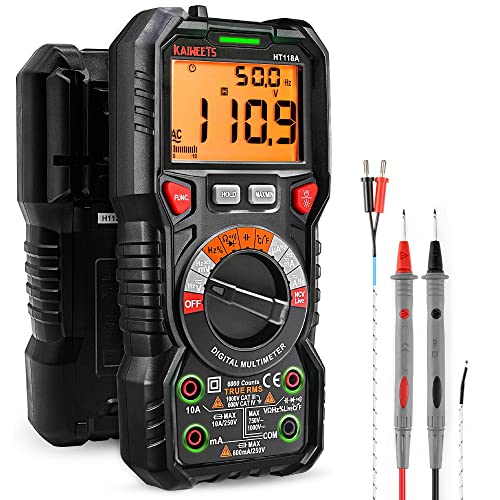
KAIWEETS HT118A
- Best for: Best all-round value for workshop and automotive work.
- True RMS, 6000-count auto-ranging display
- DC voltage to 1000V, AC voltage to 750V
- AC/DC current to 10A, resistance to 60 MΩ
- Temperature, capacitance, frequency, duty-cycle, diode, continuity
Best all-round value for workshop and automotive work.
Confirm the listing shows the HT118A model, since KAIWEETS sells several similar meters under nearby model numbers.
The KAIWEETS HT118A gives you nearly the same feature set as meters costing several times more. It is a true RMS meter with a 6000-count auto-ranging display, and it measures voltage to 1000V DC and 750V AC, current to 10A, and resistance to 60 megohms. Temperature, capacitance, frequency, duty-cycle, diode, and continuity modes cover the jobs a workshop throws at it, and non-contact voltage detection adds a quick safety check. The backlit display stays readable in dim corners of a garage.
AstroAI DM6000AR
- Best for: Budget true RMS for home workshops and electronics benches.
- True RMS, 6000-count auto-ranging display
- DC voltage to 1000V, AC voltage to 750V
- DC current 600µA to 10A; resistance to 60 MΩ
- Capacitance to 60 mF; frequency to 60 MHz
Budget true RMS for home workshops and electronics benches.
The Amazon listing has shown no featured offers at times, so confirm it is in stock before ordering.
The AstroAI DM6000AR is the cheapest true RMS meter in this guide, and it covers nearly every function a workshop needs. It measures DC voltage to 1000V and AC voltage to 750V, current from 600 microamps to 10A, resistance to 60 megohms, capacitance to 60 millifarads, and frequency to 60 megahertz. Temperature mode with the included K-type thermocouple handles overheating checks, and the 6000-count display is backlit for dark work areas. The meter is rated CAT III 600V, so it suits panel and outlet work as well as bench electronics.
Fluke 115
- Best for: Compact field service and daily carry.
- True RMS, 6000-count backlit display
- AC/DC voltage to 600V, AC/DC current to 10A
- Resistance, continuity, frequency, capacitance, diode, Min/Max/Average
- CAT III 600V safety class
Compact field service and daily carry.
The Amazon listing has shown no featured offers at times, so confirm it is in stock before ordering. It also lacks the 117’s non-contact voltage detection.
The Fluke 115 is the compact field-service meter in the Fluke 11X line, built for technicians who carry a meter all day. It keeps true RMS readings, a 6000-count backlit display, and the same 600V AC/DC and 10A ranges, plus resistance, continuity, frequency, capacitance, and Min/Max/Average recording. It drops the non-contact voltage detection and AutoVolt modes of the 117, which keeps the controls simple for core field measurements. It still carries a CAT III 600V safety class, and the holster, 9V battery, and silicone test leads come in the box.
Klein MM400
- Best for: Home DIY and light professional work on a budget.
- Auto-ranging digital multimeter
- AC/DC voltage to 600V, AC/DC current to 10A
- Resistance to 40 MΩ
- Capacitance, frequency, duty-cycle, diode, continuity, temperature
Home DIY and light professional work on a budget.
The maker has ended production on this model, so confirm stock before ordering and keep the manual and leads safe, since replacements may get harder to find.
The Klein MM400 is the budget pick from a brand electricians already trust for hand tools. It is an auto-ranging meter that measures AC/DC voltage to 600V, current to 10A, and resistance to 40 megohms, with capacitance, frequency, duty-cycle, diode, continuity, and temperature modes included. The CAT III 600V safety class covers panel and outlet work, and the meter runs on the same core functions as meters costing much more. Its compact body fits easily in a tool bag, and the included thermocouple adds temperature checks without a second tool.
Which One Fits Your Situation
You work on panels and fixed wiring every day
Pick the Fluke 117. Its non-contact voltage detection lets you check for live voltage before you probe, and AutoVolt plus LoZ mode cut down false readings from ghost voltage. The 6000-count true RMS display and CAT III 600V safety class match panel work, and the meter is built to survive daily use on a job site. It is the most capable meter in this guide for professional electrical work.
You want one meter for home repairs and car work
Pick the KAIWEETS HT118A. It covers voltage, current, resistance, capacitance, frequency, and temperature in one auto-ranging meter, and the true RMS readings stay honest on modern household loads. The 1000V DC range handles automotive and solar checks, and non-contact voltage detection adds a quick safety check before you touch a wire. It is the most complete meter here for mixed home and garage jobs.
You need a meter for electronics and bench work
Pick the AstroAI DM6000AR. Its microamp ranges and 60-megahertz frequency range suit circuit boards and sensor work, and the 60-millifarad capacitance range handles large capacitors that cheaper meters cannot measure. The backlit 6000-count display is easy to read on a bench, and the included thermocouple and multi-function socket cover extra checks without buying accessories.
You carry a meter in a tool bag all day
Pick the Fluke 115 or the Klein MM400. The 115 gives you Fluke build quality and true RMS readings in a compact body with a holster, while the MM400 gives you the same core measurements at a lower cost from a trusted hand-tool brand. Both cover the daily checks a technician runs, and both fit easily beside pliers and screwdrivers. Choose the 115 for field service work and the MM400 for home DIY.
Common Mistakes
- Measuring voltage on a circuit with the leads in the current jacks, which can blow the meter fuse or damage the meter.
- Probing a panel with a meter rated below the circuit CAT level, which risks a violent failure even when the voltage range looks fine.
- Trusting a reading from a meter with a weak battery, which can drift low and hide a live circuit.
- Forgetting to check continuity with the power off, which gives false readings and can damage the meter.
- Buying a meter for one job and ignoring the modes you will need next, such as capacitance or temperature.
Frequently Asked Questions
Do I need a true RMS multimeter for home use?
Not always. A true RMS meter matters when you measure circuits with distorted waveforms, such as dimmers, variable-speed motors, and LED drivers. For plain household checks like outlet voltage, battery voltage, and continuity, an average-responding meter gives useful readings. If you work on motors or modern lighting, true RMS is worth having, and four of the five meters in this guide include it.
What does CAT III 600V mean on a multimeter?
CAT III 600V is a safety class that says the meter can handle the transient energy found in fixed installations, such as distribution panels, hard-wired equipment, and large appliances. It tells you where the meter is safe to use, not just how much voltage it can measure. For workshop and garage work, CAT III 600V is the right level, and every meter in this guide carries it.
Can one multimeter measure both voltage and current?
Yes. Every digital multimeter in this guide measures AC and DC voltage plus AC and DC current, along with resistance and continuity. The difference is the range and the extra modes: some add capacitance, frequency, temperature, and diode checks. Move the leads to the correct jacks before you switch from voltage to current, since the wrong jack can blow the meter fuse.
Why does my meter show a small voltage on a dead circuit?
That reading is usually ghost voltage, a small induced voltage that appears on a wire running beside a live one. A high-impedance meter picks it up on a dead circuit. The Fluke 117 has a LoZ mode that loads the circuit slightly and clears ghost voltage, giving you a true zero. If your meter lacks that mode, confirm the reading with a different check before you touch the wire.
Related guides
More from Amazon
Programs that pair well with the guide above. Offers and eligibility are set by Amazon and may change.
A free business account with business pricing and bulk-buying tools for work, shop or home office.
Create a business accountFree shipping on eligible items, Prime Video and more. Eligible new members can start with a free trial.
Start a Prime free trialAudiobooks and podcasts to listen to on the go. Eligible new members can start with a free trial.
Try Audible freeAd-free music streaming. Eligible new subscribers can start with a free trial.
Try Music Unlimited freeAs an Amazon Associate we earn from qualifying purchases.






Write Your Review
No reviews yet. Be the first to share your experience!