What's inside
- Quick comparison of 120 volt garage heater types
- The 120 volt ceiling: why 1,500 watts is the limit
- Best for spot heating: infrared radiant heaters
- Best for closed small rooms: ceramic fan heaters
- Best for steady, quiet heat: oil-filled radiators
- Best for larger garages without 240 volts: propane radiant heaters
- How to size a 120 volt heater
- How to choose
- Cost to run
- Frequently Asked Questions
As an Amazon Associate I earn from qualifying purchases. This post may contain affiliate links at no extra cost to you.
The best 120 volt garage heaters top out at 1,500 watts, about 5,100 BTU per hour, because a standard 15-amp outlet cannot safely deliver more, so they suit a single-car garage or a small workshop corner rather than a whole two-car space. For spot heating a bench, an infrared model such as the Dr. Infrared DR-968 warms you and your work directly; for heating a closed, insulated room, a 1,500 watt fan or oil-filled unit is the safer choice; and for larger spaces without a 240 volt circuit, a vented gas heater is the better path. This guide explains the limits, then compares the types by what they can honestly do.
As an Amazon Associate we earn from qualifying purchases at no extra cost to you.

Sections
- Quick comparison of 120 volt garage heater types
- The 120 volt ceiling: why 1,500 watts is the limit
- Best for spot heating: infrared radiant heaters
- Best for closed small rooms: ceramic fan heaters
- Best for steady, quiet heat: oil-filled radiators
- Best for larger garages without 240 volts: propane radiant heaters
- How to size a 120 volt heater
- How to choose
- Cost to run
- Frequently Asked Questions
Quick comparison of 120 volt garage heater types
| Type | Example | Power | Heat output | Realistic coverage (insulated) | Best for | Price range |
|---|---|---|---|---|---|---|
| Infrared radiant | Dr. Infrared DR-968 class | 1,500 W, 120 V | About 5,100 BTU/hr | One work zone, 8 to 10 ft distance | Spot heating at a bench | Budget to mid-range |
| Ceramic fan heater | 1,500 W portable shop fan heaters | 1,500 W | About 5,100 BTU/hr | Up to about 150 sq ft | Fast warm-up of a small closed space | Budget |
| Oil-filled radiator | 1,500 W oil-filled units | 1,500 W | About 5,100 BTU/hr | Up to about 150 sq ft | Quiet, steady heat for a small, closed shop | Budget to mid-range |
| Propane radiant (no electricity) | Mr. Heater Buddy, Big Buddy | None | 4,000 to 18,000 BTU/hr | Up to 450 sq ft for the larger model (maker figure) | Larger garages without a 240 V line, with ventilation | Mid-range |
Output is converted at about 3.412 BTU per watt. Coverage figures are conservative planning estimates for insulated spaces with an 8-foot ceiling and a modest temperature rise; they are not measurements.
The 120 volt ceiling: why 1,500 watts is the limit
Standard residential outlets sit on 15-amp circuits at 120 volts, which is 1,800 watts. Electrical codes treat any load that runs for three hours or more as continuous and limit it to 80 percent of the circuit, which is 1,440 watts. Plug-in heaters are therefore built at 1,500 watts or lower. A garage circuit also tends to share a breaker with lights, a door opener, and sometimes other tools. If you run a 1,500 watt heater alongside a 10-amp tool on the same circuit, you will trip the breaker.
That 1,500 watts equals about 5,100 BTU per hour. For comparison, many garage-specific 240 volt heaters deliver between 17,000 and 25,000 BTU. A 120 volt heater will take the chill off a small insulated garage and keep a workbench zone comfortable, but it will struggle to lift a cold uninsulated two-car garage by more than a few degrees.
Best for spot heating: infrared radiant heaters
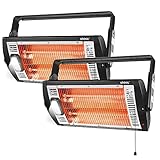
Infrared heaters warm objects and people rather than the air, so they feel effective even with a roll-up door that leaks. Dr. Infrared’s DR-968 is a well-known 1,500 watt, 120 volt portable carbon infrared model, per the brand’s listings. Other makers sell quartz and carbon infrared panels at the same wattage. Aim the heater at your bench from about 6 to 10 feet and you will feel the difference within a few minutes.
The trade-offs: the warmth is directional, so it fades when you move away or turn your back to the heater; the surface gets hot, so keep it clear of sawdust, finishes, and solvents. Do not use it near stacked lumber.
Best for closed small rooms: ceramic fan heaters
Ceramic fan heaters raise air temperature quickly in a small closed space. In a single-car garage insulated to a modest standard, a 1,500 watt unit can bring a 150 square foot area up to a working temperature once the doors are shut. They are inexpensive and portable, and many have tip-over shutoff and overheat protection. Their drawbacks are noise and the fact that they pull in dusty air; clean the intake grille regularly in a woodworking shop.
Best for steady, quiet heat: oil-filled radiators
Oil-filled radiators warm slowly and keep radiating after the thermostat shuts off. They do not blow dust or sawdust around and have no exposed glowing element, which is a point in their favor in a woodshop. They take more time to warm up than a fan heater and take longer to move from room to room. For a small insulated shop you occupy for several hours at a time, they are a calm, safe choice.
Best for larger garages without 240 volts: propane radiant heaters
If you do not have a 240 volt circuit and your space is bigger than 150 square feet, a propane radiant heater avoids the electrical limit. Mr. Heater’s Buddy and Big Buddy portable heaters are designed for indoor-safe use with an oxygen depletion sensor and tip-over shutoff, according to the maker, with outputs of 4,000 to 9,000 BTU for the Buddy and 4,000, 9,000, and 18,000 BTU for the Big Buddy. They still need fresh air: follow the manual’s ventilation guidance, keep a carbon monoxide alarm in the garage, and never run them while sleeping or while finishing with solvents.
How to size a 120 volt heater
A commonly used rule of thumb for electric heaters is about 10 watts per square foot for a well-insulated space with an 8-foot ceiling, and 15 to 20 watts per square foot for a poorly insulated one. Using that rule:
- A 120 square foot corner of a garage that is well insulated needs about 1,200 watts. A 1,500 watt heater is a match.
- A 200 square foot single-car garage that is well insulated needs about 2,000 watts, so one 1,500 watt heater will be marginal on a very cold day.
- A 400 square foot two-car garage that is well insulated needs about 4,000 watts, which is nearly three 120 volt heaters, so a 240 volt or gas heater is the correct tool.
These estimates are for modest temperature rises, such as lifting the air from the mid-30s to the mid-50s Fahrenheit. Larger temperature differences require proportionally more power.
How to choose
Match the heater type to the work
If you stand in one place at a bench, infrared makes sense. If you move around a small closed room, a fan or oil-filled heater warms the air. For a big garage, plan for a 240 volt or gas heater instead.
Check the safety features
Look for tip-over shutoff, overheat protection, and a cord rated for the load. Avoid extension cords whenever possible; if one is unavoidable, use a heavy-gauge cord rated for at least 15 amps and keep it uncoiled.
Plan for dust
Woodworking dust is combustible and settles on heaters. Keep heaters clear of dust, vacuum intakes regularly, and never place a heater near finish rags or open solvent cans.
Consider insulation first
Sealing the garage door bottom, insulating the door, and adding weatherstripping often does more for comfort than doubling heater wattage. Heat saved is better than heat bought.
Thermostat control
A built-in thermostat cycles the heater and avoids overheating. A small mechanical thermostat is fine; a digital one with a tight range is better for finishing in cold months.
Cost to run
A 1,500 watt heater uses 1.5 kilowatt-hours per hour at full output. At an electric rate of 16 cents per kilowatt-hour, that is 24 cents an hour, or about 1 dollar for a four-hour session. Use the rates on your own bill to adjust the calculation. Thermostat cycling cuts the cost since the heater is not always running.
Frequently Asked Questions
Can a 120 volt heater heat a two-car garage?
Not well. A 1,500 watt heater supplies about 5,100 BTU per hour, which is far below what a typical two-car garage requires in cold weather. Use a 240 volt electric or a gas heater for that job, or confine your heating to a work zone.
Is it safe to run a space heater in a woodworking shop?
It can be, if you keep the heater clear of dust and flammable materials, use a model with tip-over and overheat protection, and never leave it unattended. A radiant unit with exposed elements needs extra clearance from sawdust.
Do I need a dedicated circuit for a garage heater?
A dedicated circuit is the safest approach for a 1,500 watt heater. If you share the circuit, expect a tripped breaker when the heater and a power tool run together.
Is infrared heat better than fan heat?
Infrared is better for warming people at a workstation, and fan heat is better for warming a small closed room. Neither beats insulation for retaining heat.
Can I use an extension cord with a space heater?
Avoid it. If you must, use a heavy-gauge cord rated for the load and check that the plug does not get warm. A warm plug or cord is a warning sign to stop using it.