What's inside
- Best Switch Open World Games: Top Picks for 2026
- Quick Comparison: Best Switch Open World Games at a Glance
- Best Overall: The Legend of Zelda: Tears of the Kingdom
- Best for Story and Side Quests: The Witcher 3 — Complete Edition
- Best for Scale: Xenoblade Chronicles 3
- Best for Handheld Comfort: Skyrim (Anniversary Edition)
- Best Budget Pick: Immortals Fenyx Rising
- Best for Short Sessions: Assassin’s Creed IV: Black Flag
- How to Choose: Four Numbers That Decide It
- Durability and Ownership Realities
- Frequently Asked Questions
- Best Switch Open World Games: Top Picks for 2026
- Quick Comparison: Best Switch Open World Games at a Glance
- Best Overall: The Legend of Zelda: Tears of the Kingdom
- Best for Story and Side Quests: The Witcher 3 — Complete Edition
- Best for Scale: Xenoblade Chronicles 3
- Best for Handheld Comfort: Skyrim (Anniversary Edition)
- Best Budget Pick: Immortals Fenyx Rising
- Best for Short Sessions: Assassin’s Creed IV: Black Flag
- How to Choose: Four Numbers That Decide It
- Durability and Ownership Realities
- Frequently Asked Questions
As an Amazon Associate I earn from qualifying purchases. This post may contain affiliate links at no extra cost to you.
Sections
- Best Switch Open World Games: Top Picks for 2026
- Quick Comparison: Best Switch Open World Games at a Glance
- Best Overall: The Legend of Zelda: Tears of the Kingdom
- Best for Story and Side Quests: The Witcher 3 — Complete Edition
- Best for Scale: Xenoblade Chronicles 3
- Best for Handheld Comfort: Skyrim (Anniversary Edition)
- Best Budget Pick: Immortals Fenyx Rising
- Best for Short Sessions: Assassin’s Creed IV: Black Flag
- How to Choose: Four Numbers That Decide It
- Durability and Ownership Realities
- Frequently Asked Questions
Best Switch Open World Games: Top Picks for 2026
The best Switch open-world games for most players in 2026 are The Legend of Zelda: Tears of the Kingdom for exploration freedom, The Witcher 3: Wild Hunt — Complete Edition for narrative depth, and Xenoblade Chronicles 3 for sheer scale. If handheld performance and short sessions matter more than raw size, Skyrim and Assassin’s Creed IV: Black Flag remain the smoothest picks. The deciding factor is rarely the game’s Metacritic score — it is how well each title survives the Switch’s 720p handheld screen, its ~3–7 hour battery window, and its 32 GB of internal storage.
Quick Comparison: Best Switch Open World Games at a Glance
| Game | Best for | Approx. install size | Handheld performance | Typical main-story hours | Price range (new) |
|---|---|---|---|---|---|
| Zelda: Tears of the Kingdom | Exploration freedom | ~16–18 GB | Stable 30 fps, dynamic resolution | 50–70 | $50–70 |
| The Witcher 3 — Complete Edition | Story + side quests | ~28–32 GB (with DLC) | 30 fps docked, dips to ~20–25 in cities | 100–130 | $30–50 |
| Xenoblade Chronicles 3 | Scale and combat depth | ~15 GB | 30 fps handheld, soft image | 60–90 | $40–60 |
| Skyrim (Anniversary Edition) | Handheld comfort | ~10–14 GB | Locked 30 fps, very consistent | 30–50 | $40–60 |
| Assassin’s Creed IV: Black Flag | Short sessions | ~9–12 GB | 30 fps, occasional drops in sea battles | 20–30 | $30–40 |
| Pokémon Scarlet/Violet | Family / casual open world | ~7–10 GB | Unstable 25–30 fps, visible pop-in | 25–35 | $50–60 |
| Immortals Fenyx Rising | Beginners / lighter tone | ~15–18 GB | 30 fps, good handheld clarity | 25–40 | $20–40 |
Sizes are approximate and vary by region and update history; check the eShop listing before buying a microSD card. Prices are general 2026 market ranges for new physical or digital copies, not sale prices.
As an Amazon Associate we earn from qualifying purchases at no extra cost to you.
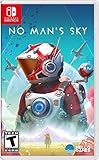

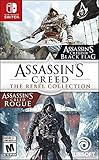

Best Overall: The Legend of Zelda: Tears of the Kingdom
Who it suits: players who want the freedom to solve problems however they like, and who don’t mind 30 fps.
Tears of the Kingdom is the strongest all-round answer to “best Switch open world games” because it treats traversal itself as the content. Its three-layer map — sky islands, surface Hyrule, and the Depths — gives you roughly three times the vertical space of Breath of the Wild, and the Ultrahand and Fuse systems mean almost every object in the world is a potential tool. According to Nintendo’s official product page, the game supports both docked and handheld play with no mode restrictions, and save data transfers cleanly between the two.
Main trade-off: it asks a lot of the Switch’s aging hardware. Frame rates hold near 30 fps most of the time, but dense settlements and heavy Ultrahand constructions can cause visible stutter. If you play exclusively in handheld mode, budget for the smaller text and fiddly precision building.
Best for Story and Side Quests: The Witcher 3 — Complete Edition
Who it suits: players who want a mature, dialogue-heavy world and are willing to accept performance compromises.
The Switch port is the only way to play The Witcher 3 with the Hearts of Stone and Blood and Wine expansions and full portability at the same time. The catch is storage: the complete package can push past 30 GB once patches are applied, which is most of a 32 GB base console or roughly a third of a 128 GB microSD card. Performance is the other compromise — CD Projekt Red’s port targets 30 fps but drops into the low 20s in Novigrad and during heavy weather.
Main trade-off: install size and city frame rates. If you mainly play docked, a PC or current-gen console version looks dramatically better; the Switch version earns its place through handheld convenience, not fidelity.
Best for Scale: Xenoblade Chronicles 3
Who it suits: players who want a 60+ hour world with a deep combat system and don’t mind a softer image.
Xenoblade Chronicles 3 delivers some of the largest contiguous environments on the platform, with regions that take several real-world minutes to cross on foot. Its class-changing combat system keeps the loop fresh far longer than most open-world games manage. The official eShop listing confirms a file size around 15 GB, which is manageable on a standard microSD card.
Main trade-off: handheld image quality. The dynamic resolution can drop noticeably in busy areas, and the art style’s fine detail suffers on the 720p screen. It is also the least forgiving pick for short sessions — the story and combat both reward long sittings.
Best for Handheld Comfort: Skyrim (Anniversary Edition)
Who it suits: anyone who wants a dependable 30 fps world that pauses cleanly when you put the console to sleep.
Skyrim remains the most technically comfortable open-world game on Switch. Its scope is smaller than the newer releases, but a near-locked 30 fps and low, stable 10–14 GB install size make it the pick that never fights the hardware. The Anniversary Edition bundles the three official add-ons plus the Creation Club content, so there is no DLC shopping to do afterward.
Main trade-off: age. Combat, movement, and quest design feel dated next to Tears of the Kingdom, and mod support is far more limited than on other platforms.
Best Budget Pick: Immortals Fenyx Rising
Who it suits: players new to open-world games, or anyone who wants a bright, puzzle-forward world without a 60-hour commitment.
Immortals Fenyx Rising regularly sits in the $20–40 range in 2026 and offers a compact, well-paced open world built around vault puzzles and stamina-gated climbing. It runs at a fairly consistent 30 fps with good handheld clarity, and the main story lands in the 25–40 hour bracket — roughly half of Tears of the Kingdom.
Main trade-off: less emergent freedom. The world is more checklist than sandbox, so players who want to break the game’s rules will find fewer opportunities. It is also a Ubisoft-published title, so online features may eventually change.
Best for Short Sessions: Assassin’s Creed IV: Black Flag
Who it suits: commuters and parents who play in 20–40 minute windows.
Black Flag’s structure is unusually friendly to handheld play: naval encounters, island raids, and tavern activities are all self-contained, and the game saves aggressively. At roughly 9–12 GB it is one of the smallest full open worlds on the platform, and its 20–30 hour main story is achievable in a month of casual play. Sea battles can drop frames during heavy cannon fire, per the port’s known performance behavior.
Main trade-off: the Assassin’s Creed formula (tail, eavesdrop, repeat) shows its age. If you have played a recent entry in the series, the mission design will feel thin.
How to Choose: Four Numbers That Decide It
Instead of reading rankings, run your own storage and time budget first.
- Storage math: a 128 GB microSD card gives roughly 119 GB usable after formatting. Subtract Tears of the Kingdom (17 GB), The Witcher 3 (30 GB), and Xenoblade 3 (15 GB) and you have used ~62 GB, leaving ~57 GB — enough for three or four more mid-sized games. A 256 GB card roughly doubles that headroom for about $10–15 more.
- Session math: main-story hours divided by your realistic weekly playtime. At 5 hours a week, a 70-hour game takes about 14 weeks; a 30-hour game takes 6. If you abandon long games, weight the shorter picks.
- Battery math: Switch’s launch model runs roughly 2.5–4.5 hours on demanding games, while the OLED and 2019+ revised models run about 4.5–7 hours. An open-world game with a dynamic resolution scaler will usually land at the lower end because the GPU stays busy.
- Frame-rate tolerance: if drops to the low 20s bother you, avoid The Witcher 3 and Pokémon Scarlet/Violet in favor of Skyrim and Immortals Fenyx Rising.
Durability and Ownership Realities
The hardware, not the game card, is what wears out first. The Switch’s microSD slot and the card’s contacts are the most common failure point — always eject via the system menu rather than pulling the card, and keep at least 10–15% of the card free, because full cards slow down and corrupt more often. The internal battery degrades over years of full charge cycles; keeping the console between 20% and 80% when docked for long periods meaningfully extends its useful life. Joy-Con drift remains the platform’s best-known long-term issue and affects all genres equally, though open-world games with precise aiming and analog-heavy movement tend to expose it faster. Physical game cards rarely fail, but they do not hold patches — if you rely on a physical copy and lose your save data, you may need to re-download multi-gigabyte updates before the game is playable again.
Frequently Asked Questions
What is the best Switch open world game overall in 2026?
Tears of the Kingdom is the best overall pick. It offers the most exploration freedom of any Switch-exclusive open world, with three stacked map layers and a physics-driven building system. The trade-off is a 30 fps target and occasional stutter in dense areas, which most players accept for the freedom it provides.
Which Switch open-world games run best in handheld mode?
Skyrim and Assassin’s Creed IV: Black Flag hold the steadiest frame rates in handheld mode, both targeting a near-locked 30 fps. Immortals Fenyx Rising is close behind with good image clarity. The Witcher 3 and Pokémon Scarlet/Violet are the weakest performers in handheld, with drops into the low 20s and visible pop-in respectively.
How much storage do I need for open-world games on Switch?
Plan for 10–30 GB per game. Tears of the Kingdom and Xenoblade Chronicles 3 sit near 15–18 GB, Skyrim and Black Flag sit near 10–12 GB, and The Witcher 3 Complete Edition can exceed 30 GB with patches. A 128 GB card comfortably holds four to six large open-world titles, while 256 GB is the safer long-term choice.
Are open-world games good for short play sessions on Switch?
It depends on the structure, not the genre. Black Flag and Skyrim both save frequently and let you complete a meaningful task in 20–30 minutes. Xenoblade Chronicles 3 and The Witcher 3 reward longer sittings because their cutscenes and quest chains are harder to break into short chunks.
Do I need the expansions for The Witcher 3 on Switch?
The Complete Edition includes Hearts of Stone and Blood and Wine, both of which are widely regarded as among the best expansions in the genre. They add roughly 40 hours of content but also push the install past 30 GB. If storage is tight, the base game alone still stands on its own.
Which open-world Switch game is best for younger or newer players?
Pokémon Scarlet and Violet are the most accessible for families despite their technical shortcomings, since the format is familiar and the stakes are low. Immortals Fenyx Rising is the better choice for teens and adults new to open-world games, thanks to its clear objectives and lighter difficulty curve.