What's inside
- Quick picks by yard and use case
- Which of the best wireless dog containment systems fits a large yard?
- Signal range and terrain: the specifications that matter
- Collar fit and correction settings
- Battery life and ownership costs
- A decision matrix for choosing a system
- Setup steps that prevent common failures
- Durability and mistakes to avoid
- Bottom line
- Quick picks by yard and use case
- Which of the best wireless dog containment systems fits a large yard?
- Signal range and terrain: the specifications that matter
- Collar fit and correction settings
- Battery life and ownership costs
- A decision matrix for choosing a system
- Setup steps that prevent common failures
- Durability and mistakes to avoid
- Bottom line
As an Amazon Associate I earn from qualifying purchases. This post may contain affiliate links at no extra cost to you.
The best wireless dog containment systems for large yards are GPS-based fences when you need more than about ¾ acre, while radio-based systems remain the simpler, lower-cost choice for a smaller, open yard.
As an Amazon Associate we earn from qualifying purchases at no extra cost to you.


Sections
- Quick picks by yard and use case
- Which of the best wireless dog containment systems fits a large yard?
- Signal range and terrain: the specifications that matter
- Collar fit and correction settings
- Battery life and ownership costs
- A decision matrix for choosing a system
- Setup steps that prevent common failures
- Durability and mistakes to avoid
- Bottom line
Quick picks by yard and use case
| Situation | Best system type | Typical working area | Typical cost range | What to know first |
|---|---|---|---|---|
| Open yard up to roughly ¾ acre | Radio wireless fence | About 105 ft radius from the indoor transmitter | $200–$400 | Fast setup, but the boundary is circular and can be affected by metal and terrain |
| Several acres or an irregular property | GPS boundary collar | Commonly 10–1,000+ acres, depending on the model | $400–$1,000 plus possible subscription fees | Boundary can follow property lines, but GPS accuracy varies |
| Frequent travel or multiple properties | GPS collar with saved fences | Usually configurable in an app | $500–$1,000 plus service costs on some models | Requires charging, satellite reception, and phone/app setup |
| Budget-conscious first-time owner | Radio system with one collar | Up to about ¾ acre in favorable conditions | $200–$350 | Lowest ownership complexity, but least flexible layout |
Which of the best wireless dog containment systems fits a large yard?
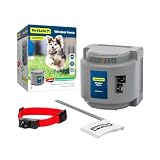
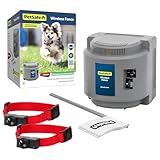
Best for a simple, open lawn: PetSafe Wireless Pet Fence
PetSafe’s conventional Wireless Pet Fence is a practical choice when the house sits near the center of a relatively flat, open yard. Its indoor transmitter creates a circular boundary, commonly adjustable to approximately 105 feet in every direction. That works out to roughly 0.75 acre at the maximum radius, although usable area is smaller if you need a safety margin around roads, ponds, or neighboring property.
The collar normally provides tone and static stimulation levels that can be selected for the individual dog. It is waterproof, rechargeable or battery-powered depending on the specific package, and compatible versions are available for additional dogs. The main limitation is geometry: it cannot draw a boundary that follows an L-shaped lot, and placing the transmitter in a corner wastes much of the signal.
Best for larger or irregular properties: GPS containment collars
GPS systems such as SpotOn GPS Fence, Halo Collar, and SportDOG Brand GPS Fence products are better suited to several acres, long properties, and boundaries that do not form a circle. You create a virtual perimeter using the collar or a mobile app, then the collar warns the dog as it approaches the boundary.
These systems avoid burying wire, but they are not equivalent to a physical fence. GPS position can drift by several feet, particularly near dense trees, steep slopes, buildings, or poor-sky-view areas. A boundary drawn close to a road, cliff, or water should therefore include a generous setback. For a large yard, GPS is usually the more capable option, not automatically the safer option.
Signal range and terrain: the specifications that matter
Radio systems measure distance from a transmitter, not distance along your property line. A stated 105-foot radius has a theoretical diameter of 210 feet. The area of that circle is approximately:
3.14 × 105 × 105 = 34,650 square feet, or about 0.80 acre.
Manufacturers commonly advertise usable coverage closer to ¾ acre after accounting for adjustment tolerances and installation conditions. Metal sheds, vehicles, reinforced concrete, foil-backed insulation, and large appliances can distort or block the radio field. Keep the transmitter indoors but away from large metal objects, breaker panels, and thick masonry.
GPS systems cover much larger areas, but their accuracy depends on satellite visibility and the quality of the receiver. Dense woodland, narrow valleys, and tall buildings can make the collar’s reported position less stable. Do not create a virtual boundary with only a few feet of clearance from a hazard.
Collar fit and correction settings
A containment collar must be snug enough for the contact points to touch the skin through the coat without being tight. You should usually be able to slide two fingers beneath the strap. Check the fit after the dog runs, swims, or grows a thicker seasonal coat.
- Small dogs: Choose a collar explicitly rated for the dog’s neck size and weight. A large receiver can be uncomfortable even if the strap fits.
- Medium and large dogs: Prioritize receiver stability, waterproofing, and a strap that will not rotate when the dog pulls or runs.
- Thick-coated dogs: Look for longer contact points or a manufacturer-approved long-haired accessory. Do not improvise with excessively long or sharp contacts.
- Puppies: Follow the manufacturer’s minimum age and neck-size requirements, and reassess fit frequently as the dog grows.
Start with the lowest effective correction setting. Many systems provide warning tone, vibration, and multiple static levels. Tone or vibration may be enough for a responsive dog; a highly distracted dog may need a different setting, but stronger is not automatically better. The dog must first learn the boundary through supervised training, flags, rewards, and short sessions. A wireless collar should not be used as a substitute for recall training.
Battery life and ownership costs
Battery performance depends on GPS activity, correction frequency, temperature, and how often the collar communicates with an app. Radio collars commonly last several weeks to several months on replaceable batteries, while rechargeable GPS collars often require charging every one to three days under active use. Treat the advertised maximum as an ideal figure rather than a planning guarantee.
| Component | Typical service interval | Replacement or running cost | Ownership issue |
|---|---|---|---|
| Rechargeable GPS collar battery | Often 1–3 days per charge during active use | Usually a replacement battery or service after several years | Forgetting to charge removes containment capability |
| Replaceable radio collar battery | Often 1–3 months, model dependent | About $10–$30 per year per collar | Keep spare batteries available |
| GPS cellular service | Monthly or annual billing on some models | Roughly $5–$30 per month when required | Check whether live tracking and fence features depend on a subscription |
| Contact points and collar strap | Inspect monthly; replace when worn | Usually $10–$40 for accessories | Dirty contacts and stretched straps cause unreliable operation |
A decision matrix for choosing a system
| Your situation | Recommended choice | Reason |
|---|---|---|
| Under ¾ acre, flat grass, transmitter near the center | Radio wireless fence | Lowest cost and simplest boundary |
| One to several acres with an irregular outline | GPS fence | Virtual boundary can follow the property more closely |
| Dense woods or a steep valley | Physical fencing or carefully surveyed hybrid solution | Radio and GPS performance can both be inconsistent in difficult terrain |
| Dog escapes when distracted by wildlife | System with adjustable warning and correction settings, plus training | Containment depends on behavior as well as signal |
| Multiple dogs of different sizes | System offering size-appropriate collars and independent settings | One correction level and receiver size may not suit every dog |
| Frequent travel | GPS system with multiple saved fences | More portable than installing wire or carrying a transmitter |
Setup steps that prevent common failures
- Map hazards first. Mark roads, gates, ponds, driveways, steep drops, and areas where the dog must never approach. Set the boundary well inside the safe area.
- Test the signal before training. Walk the perimeter with the collar or boundary flag. For a radio unit, test in every direction because obstructions can create uneven coverage.
- Install boundary flags. Flags give the dog a visible learning aid. Remove them gradually only after the dog reliably turns away from the warning zone.
- Train in short sessions. Walk toward the boundary on a leash, retreat when the warning begins, and reward the retreat. Practice from different angles and with realistic distractions.
- Check collar contact and battery. Inspect before every early training session and at least weekly thereafter.
- Recheck after landscape changes. New sheds, parked trailers, tree growth, snow, and moved metal equipment can alter radio performance. GPS boundaries should be rechecked after app or firmware changes.
Durability and mistakes to avoid
The collar strap and charging contacts usually wear before the electronics. Mud, salt, sunscreen, and wet grass can foul charging ports and contact points, so rinse the collar with clean water when the manufacturer permits and dry it thoroughly. Never charge a visibly damaged battery or a wet connector.
Common mistakes include placing a radio transmitter in a basement, setting the boundary too close to a road, assuming a GPS line is exact, leaving a collar on continuously without skin checks, and increasing correction strength before teaching the dog what the warning means. Also remember that wireless containment does not keep other dogs, wildlife, or people out of the yard.
Bottom line
Choose a radio wireless fence for a modest, open, roughly circular yard where low cost and simple operation matter most. Choose a GPS system for a genuinely large or irregular property, provided the location has dependable satellite reception and you are comfortable charging the collar and, where applicable, paying for cellular service. Whichever system you buy, allow a generous safety buffer, fit the collar correctly, and treat supervised boundary training as an essential part of the system rather than an optional extra.