What's inside
As an Amazon Associate I earn from qualifying purchases. This post may contain affiliate links at no extra cost to you.
Sections
Best Graphics Cards GPUs for Mining Crypto: The Short Answer
The best graphics cards GPUs for mining crypto in 2026 are usually used, efficient cards such as the GeForce RTX 4070 Super or Radeon RX 7800 XT—but only if your electricity is cheap and the specific coin still supports GPU mining. There is no dependable universal winner: coin prices, network difficulty, mining algorithms, and power rates can turn a profitable-looking card into a loss. Treat any earnings estimate as a moving snapshot, not a promise.
Before buying, check that the target coin is mineable with a GPU, estimate power at the wall rather than relying on the card’s advertised wattage, and compare the card’s likely resale value with its purchase cost. Ethereum is no longer GPU-mineable, so calculations based on old Ethereum mining profitability are obsolete.
As an Amazon Associate we earn from qualifying purchases at no extra cost to you.

GPU Comparison for Mining and Ownership
The figures below are representative stock specifications, not guaranteed mining performance. Hash rate varies substantially by algorithm, driver, tuning, memory configuration, and software version. Verify current benchmarks for the particular coin before spending money.
| GPU | Memory | Typical board power | Approx. hash-rate range* | Used-market price range | Ownership and resale outlook |
|---|---|---|---|---|---|
| NVIDIA GeForce RTX 4070 Super | 12 GB GDDR6X | 220 W | 45–75 MH/s | $450–$650 | Good efficiency and broad gaming demand; 12 GB may limit some future workloads. |
| AMD Radeon RX 7800 XT | 16 GB GDDR6 | 263 W | 50–90 MH/s | $400–$600 | More memory; resale depends on local gaming demand and the coin algorithm. |
| NVIDIA GeForce RTX 4060 Ti 16GB | 16 GB GDDR6 | 165 W | 30–55 MH/s | $350–$500 | Low power and useful memory capacity, but modest throughput per card. |
| NVIDIA GeForce RTX 3080 10GB | 10 GB GDDR6X | 320 W | 65–110 MH/s | $300–$500 | Can offer strong used-card value; heat, age, and high power draw need careful checks. |
| AMD Radeon RX 6600 | 8 GB GDDR6 | 132 W | 20–40 MH/s | $130–$220 | Low-cost entry point, but lower capacity and performance can narrow coin choices. |
*Illustrative ranges across selected GPU-mineable algorithms; not directly comparable across different coins. Prices are broad used-market estimates and vary by region, condition, and availability.
Which Card Fits Your Situation?
- You want the simplest one-card experiment: Consider an RTX 4070 Super or RX 7800 XT if local power is inexpensive and you also value gaming or compute resale. Their non-mining use can help preserve an exit option.
- Your power rate is the main constraint: Look first at the RTX 4060 Ti 16GB or RX 6600, then compare actual algorithm-specific output per watt. A slower card can lose less money while idle or unprofitable.
- You have a strict purchase budget: A used RTX 3080 or RX 6600 may cost less upfront, but inspect condition and include any likely fan, thermal-pad, or power-supply expense.
- You need flexibility for memory-heavy workloads: Favor 16 GB models, while remembering that more VRAM does not automatically mean a higher mining hash rate.
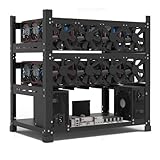
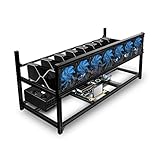
- You are building a multi-card rig: Prioritize stable power delivery, spacing, airflow, and circuit capacity over maximum hash rate in a tightly packed case. Add the cost of risers, frame, and cooling to the GPU budget.
Estimate Break-Even Before Buying
A useful first pass is to separate operating cost from uncertain mining revenue. Suppose a card draws 200 W at the wall and runs continuously. Daily energy use is 0.2 kW × 24 hours, or 4.8 kWh. At $0.12 per kWh, electricity costs about $0.58 per day, or $17.28 per 30-day month. This excludes cooling, pool fees, downtime, and the rest of the computer.
For a rough break-even calculation, divide the all-in purchase cost by estimated daily net income: break-even days = purchase cost ÷ (estimated daily mining revenue − daily electricity and other operating costs). If the denominator is zero or negative, there is no operating break-even at that estimate. For example, a $500 card earning an estimated $1.00 per day before power, with $0.58 in daily electricity and $0.05 in other costs, would have estimated net income of $0.37 per day. Simple payback would be about 1,351 days—before considering resale value, difficulty changes, or repairs. That is a fragile forecast, not a likely guaranteed return.
A better ownership estimate subtracts expected resale proceeds from the purchase cost, but resale is uncertain. A card with strong gaming demand may be easier to sell than a mining-focused purchase with no remaining warranty. Conversely, heavy use, missing accessories, damaged fans, or a market flood of used GPUs can reduce resale value.
Profitability Sensitivity: What Changes the Result?
- Electricity price: This is often the clearest lever. Calculate using your actual tariff and the complete system’s wall draw, not just the GPU’s rated board power.
- Coin price and network difficulty: A coin’s price can rise while your share of mining rewards falls as more hash power joins. Both can move independently.
- Algorithm and software: Hash rates are coin- and configuration-specific. A benchmark for one algorithm is not a reliable proxy for another.
- Cooling overhead: Exhausting heat from a room can increase household cooling costs. A GPU drawing 200 W ultimately releases roughly 200 W of heat into the space.
- Fees and downtime: Pool fees, rejected shares, internet interruptions, driver crashes, and maintenance reduce realized returns.
Run low, middle, and high scenarios rather than relying on a single calculator result. If a small rise in power price or drop in coin revenue makes the project unprofitable, the purchase is speculation with a short margin for error. Do not buy on the assumption that a future coin price increase will rescue the numbers.
Cooling, Wear, and Resale Checks
Mining can keep a GPU under sustained load for long periods. Fans are a common wear item; bearings may become noisy or fail, and dust-clogged heatsinks can raise temperatures. On some used cards, dried thermal paste or worn thermal pads can also contribute to high memory or hotspot temperatures. These issues are not inevitable, but they make a seller’s operating history and the card’s condition important.
Before buying used, check the exact model and warranty terms, inspect the fans and heatsink, and ask to see a stable load test with temperatures and clock behavior. Avoid cards with unexplained artifacts, unstable performance, corrosion, or signs of poor repair. After installation, clean dust with the system powered down, keep intake and exhaust paths clear, and monitor temperatures and rejected shares. Do not compensate for inadequate airflow by pushing voltage or fan speed without understanding the added heat, noise, and wear.
Bottom Line
For a buyer who also wants a capable gaming card, the RTX 4070 Super and RX 7800 XT are balanced candidates; for lower power use, the RTX 4060 Ti 16GB deserves a look; and a used RTX 3080 may suit someone comfortable inspecting an older, hotter card. The best choice depends on the coin, power rate, purchase price, and exit value—not the highest headline hash rate. Calculate the full cost first, and be prepared for the possibility that mining will not repay the GPU.