What's inside
- Best welders for aluminum and steel: the quick answer
- Compare the processes by material and thickness
- Choose by your job, not by the process label
- Match output and duty cycle to your power and workload
- Setup cost and ownership: what the sticker price misses
- Decision guide
- Preparation and upkeep that affect weld quality
- Best welders for aluminum and steel: the quick answer
- Compare the processes by material and thickness
- Choose by your job, not by the process label
- Match output and duty cycle to your power and workload
- Setup cost and ownership: what the sticker price misses
- Decision guide
- Preparation and upkeep that affect weld quality
As an Amazon Associate I earn from qualifying purchases. This post may contain affiliate links at no extra cost to you.
Sections
- Best welders for aluminum and steel: the quick answer
- Compare the processes by material and thickness
- Choose by your job, not by the process label
- Match output and duty cycle to your power and workload
- Setup cost and ownership: what the sticker price misses
- Decision guide
- Preparation and upkeep that affect weld quality
Best welders for aluminum and steel: the quick answer
The best welder for aluminum and steel depends mainly on aluminum thickness and how often you’ll switch materials: choose an AC/DC TIG machine for precise work on thin aluminum and steel, a MIG welder with a compatible spool gun for faster work on thicker aluminum and steel, or a multiprocess machine if you need one power source for several jobs and accept some compromises.
For aluminum, confirm that the machine provides AC output for TIG or supports a spool gun for MIG; a conventional DC-only TIG setup is not the right choice for typical aluminum welding. For steel, both DC TIG and MIG work well. Match rated output and duty cycle to your material, power supply and expected session length—not just the maximum amperage printed on the front panel.
As an Amazon Associate we earn from qualifying purchases at no extra cost to you.
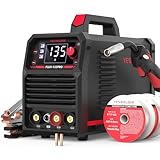


Compare the processes by material and thickness
| Process and setup | Aluminum suitability | Steel suitability | What to check before buying | Typical added setup cost |
|---|---|---|---|---|
| AC/DC TIG, roughly 200 A | Best control on clean sheet and plate around 0.8–6 mm; more output or multiple passes may be needed on thicker sections | Excellent for thin sheet through moderate plate, with careful heat control | AC balance and frequency controls, foot pedal, torch, gas regulator, and stated duty cycle | About $150–$500 for useful accessories if not included; gas cylinder and fill extra |
| MIG with a spool gun, roughly 180–250 A | Practical for about 1.5–6 mm; thicker material depends on output, joint design and number of passes | Fast and productive on sheet, tubing and plate within the machine’s capacity | Spool-gun compatibility, included gun versus optional gun, wire diameter, drive rolls and polarity settings | About $200–$500 for an optional spool gun; gas and consumables extra |
| Multiprocess, roughly 200 A | Works only if it offers AC TIG or supports aluminum MIG with a suitable spool gun | Usually offers DC TIG and MIG; check whether the processes are full-featured | Which processes are included, whether TIG is AC/DC, and whether a spool gun is sold separately | About $200–$700 for missing torches, guns and controls; gas and consumables extra |
| DC TIG or standard MIG without aluminum provisions | Not a suitable general-purpose choice for aluminum TIG; standard MIG can struggle with long wire-feed paths | Good option when steel is the only material | Do not infer aluminum capability from the word “multiprocess” or from maximum amperage alone | Low initial cost, but conversion may require equipment the machine cannot support |
These thicknesses are planning ranges, not guaranteed capacities. Alloy, joint shape, fit-up, position, preparation and operator skill all affect penetration. Check the manufacturer’s material-capacity guidance, especially for a single-pass weld or structural work.
Choose by your job, not by the process label
For thin aluminum, clean welds or detailed repairs: AC/DC TIG
AC TIG is the most controllable option for thin aluminum, small parts and visible welds. AC helps break up the oxide layer on aluminum while allowing the weld to form; DC TIG is the usual choice for steel. A machine that offers both polarities can handle both materials with the appropriate tungsten, filler and shielding gas.
Expect a steeper learning curve and slower deposition than MIG. Budget for a TIG torch, pedal or other current control, argon, regulator and suitable tungsten if they are not bundled. AC balance and frequency adjustments can help tailor the arc, but simple controls are often enough for a new user making routine repairs.
For faster fabrication and repeated aluminum work: MIG with a spool gun
MIG is typically faster than TIG for longer seams and production-style work. Aluminum wire is soft and can buckle or bird-nest when pushed through a long conventional MIG liner. A spool gun keeps the wire feed close to the work, reducing that problem. Confirm that the welder accepts the specific gun; “spool-gun ready” may mean the gun is an extra purchase.
For steel, the same machine can usually use its standard MIG gun and steel wire. A spool gun adds cost and weight at the torch, and its short wire capacity means more frequent spool changes. If you only make occasional aluminum repairs, compare the gun’s cost with the value of renting equipment or paying a welding shop.
For a mixed home shop: multiprocess, with a careful feature check
A multiprocess unit can reduce shop clutter and cover steel MIG, steel TIG and stick welding. It is a sensible compromise when those processes are genuinely useful. But multiprocess does not automatically mean AC TIG or aluminum-ready MIG. Before buying, verify the exact process list, output on each process, included accessories and compatible spool guns. Some units also require you to change leads or settings when switching processes.
Match output and duty cycle to your power and workload
Amperage is not a standalone thickness rating. A 200 A machine may be a good all-round size for a small shop, but its ability to sustain that output depends on voltage, input power and duty cycle. Duty cycle is the share of a ten-minute period a welder can operate at a stated output before it needs to cool. For example, a 30% duty cycle at 200 A means up to three minutes welding, followed by seven minutes cooling at that rating. At lower amperage, the permitted duty cycle may be higher.
- Occasional repairs: A 120 V MIG unit may suit thin steel and short jobs, but check its output limit before planning aluminum work.
- Regular mixed-material work: A 200–250 A machine with a 240 V input is a more flexible target. Confirm the required circuit amperage and plug before purchase.
- Long seams or production: Prioritize a higher duty cycle at the amperage you will actually use, reliable cooling and readily available consumables.
Do not size from the maximum rating alone: compare duty-cycle figures at the same amperage across machines. A welder that reaches a high peak briefly may be less useful for a long repair than one with a lower rating it can sustain. Also account for input power. A machine that needs a 240 V circuit will not deliver its full rated output from an ordinary 120 V outlet.
Setup cost and ownership: what the sticker price misses
Entry-level MIG machines often have the lowest initial cost, while AC/DC TIG and full-featured multiprocess machines usually cost more. As broad U.S. market ranges, basic MIG welders commonly fall around $300–$800, AC/DC TIG machines around $600–$1,500, and multiprocess machines around $500–$1,500 or more. These ranges vary with output, included accessories and current market pricing; treat them as planning estimates, not quotes.
Then add the equipment needed to weld your materials safely and reliably: a gas cylinder and fills, regulator, torch or spool gun, helmet, gloves, filler metal, wire, tungsten, contact tips and replacement liners. The cylinder, gas and electrical work can materially change the real cost. A cheaper machine that needs an expensive proprietary gun may not be the cheaper setup.
For a rough comparison, suppose you expect ten aluminum repair sessions a year and an optional spool gun costs $300. That is $30 per planned session in gun cost during the first year, before gas and wire. If aluminum work is rare, the purchase may be hard to justify; if the gun saves even half an hour per session, the time savings may matter more than the initial price. Use your own session count and labor value rather than treating this example as a universal break-even point.
Decision guide
| Your situation | Best starting point | Why |
|---|---|---|
| Beginner, mostly thin steel, occasional small repairs | Simple MIG welder sized for the available circuit | Relatively quick to learn; defer aluminum capability unless it is a real need |
| Experienced user, thin aluminum or appearance-critical parts | AC/DC TIG with pedal and adjustable AC controls | Precise heat and puddle control; suitable for both aluminum and steel |
| Frequent aluminum fabrication and longer seams | MIG machine with a compatible spool gun | Faster deposition and a shorter, more reliable aluminum wire-feed path |
| Limited shop space, varied steel jobs and occasional aluminum | Multiprocess machine only after checking AC TIG or spool-gun support | One power source can cover several jobs, but accessories and process limits matter |
| Thick plate, long welds or frequent daily use | Higher-output machine with a strong duty cycle, selected for the process | Less waiting for thermal shutdown; confirm circuit capacity and material rating |
Preparation and upkeep that affect weld quality
Aluminum needs especially careful cleaning: remove oil, then use a dedicated stainless-steel brush to remove oxide immediately before welding. Keep that brush separate from tools used on steel. Contamination and surface oxide can cause poor fusion, porosity and unstable starts even with a capable welder. For steel, remove paint, rust, oil and scale from the weld area as appropriate.
On MIG aluminum, keep the liner and drive rolls matched to the wire and follow the gun maker’s setup guidance; excessive roller pressure can deform soft wire. On TIG, select tungsten and filler for the material and application, and maintain clean, dry shielding-gas connections. Inspect leads, torch parts, contact tips and gas hoses regularly. Consumables wear, and dirty or damaged feed components can cause trouble that looks like a machine fault.
For load-bearing, pressure-containing or safety-critical parts, use a qualified welding procedure and an appropriately qualified professional. A machine’s advertised thickness range is not proof that a particular weld will meet a design requirement.