What's inside
As an Amazon Associate I earn from qualifying purchases. This post may contain affiliate links at no extra cost to you.
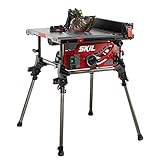
The best entry-level table saw for most new woodworkers is the SKIL TS6307-00: it pairs a useful 25½-inch rip capacity with a rack-and-pinion fence, a folding stand, and a relatively approachable price. Choose the compact DEWALT DWE7485 if storage and portability matter more than cutting full-size sheet goods; spend more on the Bosch 4100XC-10 if you want a wheeled stand for frequent setup and teardown.
These picks prioritize the factors that matter at the start: price, usable rip width, fence adjustment, safety equipment, and how much room and effort the saw demands. Prices are approximate U.S. market ranges and vary with sales and included stands. Verify the exact model and package before buying, since accessories can differ.
As an Amazon Associate we earn from qualifying purchases at no extra cost to you.

Sections
Quick comparison
| Saw | Approx. price | Rip capacity | Blade | Approx. weight | Best fit |
|---|---|---|---|---|---|
| SKIL TS6307-00 | $250–$350 | 25½ in. right of blade | 10 in. | About 51 lb. | First saw, occasional furniture and shop projects |
| DEWALT DWE7485 | $350–$500 | 24½ in. right of blade | 8¼ in. | About 54 lb. | Small shops and portable jobsite use |
| Bosch 4100XC-10 | $550–$750 | 30 in. right of blade | 10 in. | About 94 lb. with stand | Frequent use, larger cuts, wheeled storage |
| RIDGID R4518 | $400–$550 | 30 in. right of blade | 10 in. | About 90 lb. | More capacity without moving to a contractor saw |
Published specifications can change between model revisions and packages. Rip capacity is the maximum distance from the blade to the fence, not a guarantee that a saw can safely support a full sheet by itself. For large panels, plan on a helper or stable outfeed and side support.
Best picks by situation
Best value for a first shop saw: SKIL TS6307-00
The SKIL is a sensible starting point when you want a 10-inch blade and a stand without paying for a larger, heavier machine. Its rack-and-pinion fence adjustment is especially useful for beginners: turning a knob moves the fence in a controlled way, reducing the fiddling common with simpler fences. The 25½-inch capacity handles many cabinet panels and narrower sheet-goods cuts, though it falls short of a full 4-by-8-foot sheet width.
Its folding stand helps reclaim floor space, but setup still requires room to move stock in front of and behind the blade. The saw is a good match for weekend projects; if you expect frequent wide-panel work, budget for support stands or choose a wider-capacity model.
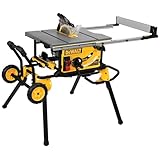
Best for a small space: DEWALT DWE7485
The DWE7485 is compact and has a rack-and-pinion fence, making it easier to transport or stow than many 10-inch saws. Its 8¼-inch blade is a trade-off: it is capable for common ripping and crosscutting tasks, but has less depth of cut than a 10-inch model. The 24½-inch rip capacity is adequate for many boards and narrower panels.
Pick it when you need to carry the saw, store it on a shelf, or work in a garage that serves other purposes. It is less attractive if your projects regularly require deep cuts or wide sheet goods. “Portable” also does not mean the saw can be operated safely on an unstable surface; use a firm, level stand or workbench.
Best for frequent setup and teardown: Bosch 4100XC-10
The Bosch costs more and is substantially heavier, but its gravity-rise wheeled stand makes moving and deploying the saw more manageable than lifting a machine of this size by hand. A 30-inch rip capacity provides more room for panel work, and the 10-inch blade suits a broad range of shop cuts.
This is the better choice if the saw will be used often but cannot stay set up permanently. It still needs a clear work zone, and the stand’s wheels do not remove the need to secure the machine and support long or wide stock. For someone making only occasional small projects, the added cost and bulk are difficult to justify.
Best for extra rip width at a midrange price: RIDGID R4518
The R4518 offers a 30-inch rip capacity and a 10-inch blade in a portable-saw format. That extra width is valuable for breaking down panels, but the saw takes more floor space than a compact model and is heavy enough that moving it is a two-handed job. Compare the fence movement and locking action on the exact unit or package available to you; a wide capacity is useful only if the fence locks square and stays put.
What matters more than the headline specs
- Fence reliability: A fence that moves parallel to the blade and locks consistently is more useful than a small increase in motor power. Before a cut, check the fence alignment against the miter slot and confirm both ends are locked.
- Safety equipment: Look for a blade guard, riving knife, anti-kickback pawls, and a large, easy-to-reach power switch. Keep the guard installed for through-cuts; use the riving knife and appropriate protection for operations where the guard must be removed.
- Support and clearance: Measure the whole working area, not just the saw footprint. A 30-inch rip capacity does not mean you need only 30 inches of room: stock must be supported as it enters and exits the blade.
- Blade and dust collection: The included blade is often a general-purpose compromise. A suitable sharp blade can improve cut quality, while a shop vacuum or dust extractor helps control buildup. Neither replaces a dust mask or good housekeeping where needed.
Choose by budget, space, and workload
| Your situation | Best starting point | Why |
|---|---|---|
| Under $350; occasional small projects | SKIL TS6307-00 | 10-inch blade, folding stand, and controlled fence adjustment at an entry-level price |
| Storage space is tight; saw must be carried | DEWALT DWE7485 | Compact footprint and manageable portability, with a smaller blade as the compromise |
| Weekly use; panels wider than 25½ inches | Bosch 4100XC-10 or RIDGID R4518 | 30-inch rip capacity; Bosch favors wheeled mobility, while RIDGID is a less costly alternative |
| Beginner with no dedicated outfeed support | Compact saw plus support equipment | Stable infeed and outfeed support can matter more than buying maximum rip capacity |
Setup and ownership: the details beginners often miss
Allow time for assembly and calibration before making project cuts. Set the saw on a level surface, install the blade and guard according to the manual, and verify that the blade is square to the table at 90 degrees. Then check that the fence is parallel to the blade or miter slot. A small alignment error can cause poor cuts and increase the risk of binding, so follow the manufacturer’s adjustment procedure rather than compensating by pushing harder.
Keep the tabletop and adjustment mechanisms free of sawdust and pitch. Dust can interfere with fence travel and elevation adjustments; resin buildup can make stock drag. Unplug the saw before cleaning or changing a blade, and use the cleaning products recommended by the manufacturer. Inspect the power cord, guard, riving knife, and fence lock periodically. The included blade is a wear item: dull or damaged teeth can leave rough cuts and encourage feeding with excessive force, so replace it when cleaning and sharpening no longer restore performance.
For a new woodworker, the safest useful setup is often not the widest saw but the one that fits the space, has a dependable fence, and can be operated with proper stock support. If you cannot support a cut safely, break the material down with an appropriate alternative method or get help rather than improvising around the saw.