What's inside
As an Amazon Associate I earn from qualifying purchases. This post may contain affiliate links at no extra cost to you.
The right siding nailer depends almost entirely on what you’re fastening: fiber cement demands precise depth control and stainless fasteners, vinyl needs a gentle nose that won’t crack panels, and cedar rewards a coil nailer with enough capacity to keep you off the ladder reloading. Here’s how to match the tool to the material.
As an Amazon Associate we earn from qualifying purchases at no extra cost to you.



Sections
What a Siding Nailer Needs to Do Differently
A framing nailer can’t substitute here. Siding nailers are built around three requirements that siding imposes:
- Wire- or plastic-collated coil nails in the 1¼”–2½” range — long enough to penetrate sheathing plus stud, short enough to avoid pipes.
- Depth-of-drive adjustment you can trust, because fiber cement cracks if overdriven and vinyl buckles if the nail is driven tight.
- Coil capacity of 200+ nails, since a whole-house job means thousands of fasteners and every reload on a scaffold costs time.
Top Picks by Material
Fiber Cement: Metabo HPT NV65AH2
Fiber cement (HardiePlank and similar) is the most demanding material. The NV65AH2 (formerly sold under the Hitachi name) drives 1½”–2½” wire- and plastic-collated nails, weighs about 4.8 lbs, and offers tool-free depth adjustment that’s easy to dial in on scrap before touching the wall. Its selective actuation lets you switch between sequential and contact firing — useful when you want precision on corners and speed on open runs. Pair it with ring-shank stainless or hot-dipped galvanized nails; smooth-shank electro-galv fasteners are the most common failure point in fiber-cement jobs, not the nailer.
Cedar and Wood Siding: Bostitch N66C
The N66C is the veteran of this category — roughly 4.9 lbs, 1¼”–2½” nail range, and a 300-nail magazine that suits the sheer volume of cedar shingle and clapboard work. Its adjustable exhaust and soft foot help keep the nose from denting soft cedar. Cedar’s forgiving surface means slightly more depth variance is acceptable, so this nailer’s speed and capacity matter more than micro-precision.
Vinyl: A Lighter-Pressure Setup
Vinyl siding is conventionally hand-nailed or fastened with a siding nailer set deliberately shallow — the rule is leaving about 1/32″ of play so panels can expand and contract. No nailer “locks” a panel better; the tool just needs a consistent, shallow drive and a no-mar tip. The Makita AN613 and Senco’s SCN series work well here because their depth control stays consistent at lower PSI (run toward the bottom of the 70–120 PSI operating range and test on offcuts).
Spec Comparison
| Model | Nail Length | Capacity | Weight | Operating PSI | Best For |
|---|---|---|---|---|---|
| Metabo HPT NV65AH2 | 1½”–2½” | ~200–300 | ~4.8 lbs | 70–120 | Fiber cement, precision depth |
| Bostitch N66C | 1¼”–2½” | ~300 | ~4.9 lbs | 70–120 | Cedar, whole-house volume |
| Makita AN613 | 1¼”–2½” | ~300 | ~5.1 lbs | 65–120 | Mixed materials, vinyl at low PSI |
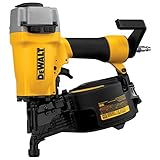
| DeWalt DW66C-1 | 1¼”–2½” | ~300 | ~4.9 lbs | 70–120 | General siding, existing DeWalt kits |
Decision Matrix
| Your Situation | Recommended Choice | Why |
|---|---|---|
| Mostly fiber cement jobs | Metabo HPT NV65AH2 | Depth control and selective actuation prevent cracking |
| Cedar shingles, large areas | Bostitch N66C | High capacity, fast cycling, soft nose |
| One nailer for everything | Makita AN613 | Consistent drive across the full PSI range |
| Occasional DIY residing | Any 15° coil siding nailer in the $150–$250 range | Pay for depth adjustment, not pro-grade durability |
| Already own a compressor + DeWalt tools | DeWalt DW66C-1 | Shared fittings, familiar service network |
Ownership Realities Listings Don’t Mention
What wears first: the driver blade and nose o-rings, typically after tens of thousands of nails. Rebuild kits run under $30 and take under an hour. If the nailer starts double-firing or leaving nails proud, check o-rings before blaming the compressor.
Fastener math: fiber cement at ~6 nails per plank and ~25 planks per 100 sq ft means roughly 1,500 nails per square — a 300-nail coil buys you five reloads per square instead of fifteen with a 100-nail stick nailer.
Common mistakes: running max PSI “to be sure” (cracks fiber cement), nailing vinyl tight (panels warp in heat), and using electro-galvanized nails on cedar (tannin staining and rust streaks within a season).
Maintenance: two drops of pneumatic oil daily unless the model is oil-free, and drain the compressor tank — moisture in the line is what kills o-rings early.
FAQ
Can I use a roofing nailer for siding?
No. Roofing nailers max out around 1¾” and lack the depth precision siding needs — and their nails are too short to reach framing.
Wire or plastic collation?
Wire for most siding. Plastic collation can leave debris under nail heads, which matters on fiber cement where flush seating is critical.
What compressor size do I need?
A 6-gallon pancake compressor handles a single nailer fine; siding nailers draw roughly 0.03–0.05 CFM per cycle at 90 PSI — modest, but a tank under 4 gallons will cycle constantly on fast work.