What's inside
As an Amazon Associate I earn from qualifying purchases. This post may contain affiliate links at no extra cost to you.
For short joinery measurements, a folding rule and a steel tape measure can both produce accurate work. They do not behave the same way, though. A tape is compact, quick, and useful when dimensions run beyond a few feet. A folding rule is stiffer, easier to read at the bench, and usually better for transferring a measurement directly to a workpiece.
The right choice depends less on maximum length than on how the measurement is taken. Measuring the inside of a cabinet, checking a board’s width, and laying out a hinge are different jobs. For most bench joinery, control and repeatability matter more than having a long blade.
As an Amazon Associate we earn from qualifying purchases at no extra cost to you.


Sections
Our Top Picks
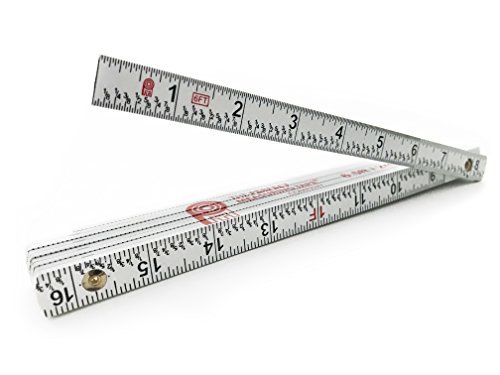 Perfect Measuring Tape Co. FR-72 Carpenter's Folding Rule2 m9.5 x 1.5 x 0.5 inches0.3 poundsCheck on Amazon


Where a folding rule works better
A folding rule is made from several rigid sections, commonly 6 or 8 inches long, joined by hinges. Opened fully, it typically measures 6 feet. Because the sections stay straight, you can place the rule against an edge without the blade sagging or bowing.
That stiffness is useful for short measurements. If you need to mark 3-7/16 inches across a rail, the rule can sit flat on the work while you mark the dimension. It is also easy to use as a short straightedge for checking a chisel cut, a shoulder, or the position of a mortise.
The markings are generally large and visible, with measurements printed on both faces or on opposing edges. Some rules include a slide or extension at the end. That feature is useful for measuring inside cabinet openings: hook the end against one side, extend the slide to the other, and read the result without bending a flexible blade.
For joinery, a folding rule is especially good at:
- Marking repeated short dimensions on rails, stiles, and drawer parts.
- Checking board width and stock thickness.
- Measuring inside openings up to a few feet.
- Transferring dimensions from a plan or story stick.
- Working around a bench where a loose tape blade gets in the way.
Look for a wooden folding rule if you want a traditional, easy-to-read bench tool. A plastic rule costs less and will not rust, but its hinges and sections may flex more. Wooden rules can swell or shrink slightly with moisture, so they should not be treated as precision gauges.
Where a steel tape works better
A steel tape is the more versatile general-purpose tool. A 12- or 16-foot tape is small enough for a tool belt and covers most furniture parts, sheet goods, and site work. It is faster when you need several measurements in succession, especially if the dimensions are more than 6 feet.
The spring-loaded blade also gives a tape a useful feature: the hook can catch an outside edge. Measure the length of a board by hooking the end and pulling the blade straight. Many tapes have a movable hook that shifts by approximately its own thickness. This compensates for whether the hook is pushed against an inside surface or pulled from an outside edge.
That hook is also a source of errors. A bent, loose, or clogged hook can change a short measurement by 1/32 inch or more. On a cabinet carcass, that error may be insignificant. On a tight drawer or mortise-and-tenon layout, it can matter. A tape blade can also bow between its hook and the mark, particularly when measuring only 2 or 3 inches at an angle.
A compact 12-foot steel tape measure is often enough for a hand-tool bench. Choose one with clear 1/16-inch markings, a smooth lock, and a blade that returns under control. A 25-foot model is useful on a building site but is bulkier and usually less pleasant for delicate bench work.
Folding rule versus steel tape
| Feature | Folding rule | Steel tape |
|---|---|---|
| Short bench measurements | Excellent; rigid and easy to position | Good, but the blade can bow |
| Measurements over 6 feet | Requires resetting or another tool | Excellent, especially with a 12- or 16-foot tape |
| Inside dimensions | Very good with an end slide | Good, but requires accounting for the case or hook |
| Reading at a glance | Usually clear, large markings | Varies; crowded blades are slower to read |
| One-handed belt use | Awkward when folded or extended | Excellent |
| Common failure | Loose hinges, damaged sections, swollen wood | Bent hook, worn markings, kinked blade |
| Typical cost | Low to moderate | Low to moderate |
Accuracy problems that matter in joinery
Neither tool automatically gives precision. The main mistake with a folding rule is reading from the wrong edge or opening the sections slightly out of line. Check that every joint is fully open and that the rule sits against the reference edge. Do not use a damaged hinge as a stop.
With a tape, keep the blade flat against the work and pull it straight. For a short measurement, pressing the blade down with a finger near the mark reduces bowing. If the hook is visibly loose, do not compensate by guessing. Replace the tape or measure from the body using a known reference point.
For measurements under 12 inches, transferring the dimension with a marking knife, combination square, or pencil is often more reliable than trying to read a tape in midair. A combination square set to 3-1/2 inches can then mark every matching part without repeatedly interpreting the scale. That is how you avoid accumulating small reading errors across a project.
Also remember that a measurement is only as good as the reference surface. A rough-sawn edge, a chipped board end, or a layer of dried glue can add more error than the difference between a good folding rule and a good tape. Plane or trim the reference edge when the fit depends on a fraction of an inch.
What should you buy?
Buy a folding rule first if your work is mostly hand-tool joinery, furniture repair, drawer building, or marking parts at a bench. It is particularly worthwhile if you often measure between 1 and 24 inches and want a rigid tool that doubles as a short straightedge.
Buy a steel tape first if you are building cabinets, working from sheet goods, measuring rough lumber, or moving between the shop and a job site. The cheaper option is fine when measurements are coarse, parts will be trimmed to a line, or you already check critical dimensions with a square.
Many woodworkers eventually keep both: a small steel rule for fine layout, a folding rule for controlled short measurements, and a tape for long work. If you want one inexpensive starting setup, choose a clear 12-foot tape and add a folding rule when you find yourself fighting blade sag, cramped readings, or repeated short measurements.
A practical measurement routine
Use the tape for the rough dimension, then establish the final size with a rule, square, or marking gauge. When parts must match, measure one accurately made reference piece and transfer it to the others rather than measuring each one from a plan. This reduces cumulative error.
For a drawer side, for example, use the tape to check the opening, confirm the folding rule or steel rule setting, and mark both sides from the same reference end. Test-fit before cutting the mating part. The tool choice helps, but a consistent reference and a controlled marking process are what produce a tight joint.