What's inside
As an Amazon Associate I earn from qualifying purchases. This post may contain affiliate links at no extra cost to you.
Chisel handle shape matters most when the work involves hundreds of mallet blows rather than a few light paring cuts. The wrong handle can create a hot spot in the palm, force your wrist into a bent position, or let the chisel twist when the edge meets a knot. A comfortable shape does not remove fatigue, but it spreads impact and gives you better control over the cut.
For repeated chopping, compare the handle’s diameter, length, grip profile, end treatment, and material together. A round handle may feel comfortable initially but rotate under load. A faceted or oval handle usually gives better orientation. The best choice also depends on whether you hold the chisel near the blade for control or at the butt for maximum mallet force.
As an Amazon Associate we earn from qualifying purchases at no extra cost to you.


Sections
Our Top Picks
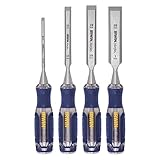
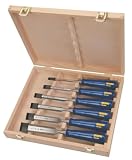
 IRWIN Tools Marples High-Impact Chisel Set3 Piece12.63 x 5.75 x 1.3 inches2.05 poundsCheck on Amazon


The main handle shapes
| Handle shape | Comfort during mallet work | Control and drawbacks | Best use |
|---|---|---|---|
| Round | Even pressure and no sharp edges | Can rotate; less reliable orientation | Light chopping and general shop work |
| Oval | Good palm contact with fewer pressure points | Can still turn if the sides are too smooth | Repeated chopping and mixed work |
| Octagonal or faceted | Spreads impact while reducing roll | Edges may feel aggressive if poorly finished | Heavy bench-chisel work |
| Bulb or teardrop | Supports a relaxed grip near the butt | Less nimble for close control; can feel large | High-volume mortising and chopping |
| Flat-sided or socket-style | Stable in the hand and easy to orient | May concentrate pressure along corners | Firm, directional mallet strikes |
Round handles: comfortable until they start turning
A round wooden handle has no ridges to press into the palm, which makes it pleasant during moderate work. It is also easy to manufacture and replace. For occasional hinge recesses, cleaning out a stopped dado, or fitting a lock plate, a round handle is usually fine. There is no strong reason to pay more simply to avoid it.
The problem appears when the edge hits uneven grain. The chisel can rotate a few degrees, and your fingers tighten to correct it. Repeatedly doing that over 30 or 45 minutes produces more fatigue than the impact itself. A smooth round handle is especially prone to twisting if your hands are oily or you wear thin gloves.
If you already own round-handled chisels, a simple fix is to add a flat with a rasp or carefully sand two opposing sides. Do not remove so much material that the handle becomes weak. A shallow oval is enough to improve indexing while retaining the comfortable feel.
Oval and faceted handles are the safest general choice
For most woodworkers doing repeated mallet work, an oval or modestly faceted handle is the best compromise. The broad sides distribute force over more of the palm than a narrow round grip, while the narrower sides tell you which way the cutting edge is facing. That matters when chopping a square corner or paring close to a layout line.
Look for a handle roughly 25 to 35 millimeters across its broad dimension. Smaller handles suit users with smaller hands or lighter chisels, but a very thin grip makes you squeeze harder. Handles above about 40 millimeters can reduce pressure in the palm, yet may force a small hand to stretch around the grip. Measure your hand around the knuckles if you are buying online, and compare that measurement with the maker’s stated handle size when available.
Facets should be rounded, not left as sharp arrises. A handle with eight broad, softened sides generally feels better than one with deep, crisp corners. If a facet leaves a red line across your palm after ten minutes, it will become a blister during a full morning of mortising.
A practical place to start is a wood chisel set with octagonal handles. The cheaper sets are acceptable for softwood and occasional repairs, provided the striking ends are sound and the edges are easy to resharpen.
Bulb and teardrop handles favor power over finesse
A bulb-shaped handle is wider toward the striking end and narrower near the blade. It gives the palm something substantial to push against and lets you hold the chisel loosely near the butt while striking. This is useful when cutting mortises, waste pockets, and deep joinery where the chisel takes repeated blows.
The trade-off is reduced sensitivity. A large bulb handle makes it harder to choke up close to the blade, and the extra mass can feel clumsy when trimming a hinge recess. It can also catch on a bench or tool belt pocket. Choose this shape when the job is predominantly chopping, not when one chisel must handle every paring and fitting task.
For high-volume work, consider bevel-edge bench chisels with substantial wood handles. A moderate-sized set is often more useful than one oversized mortising chisel, since you can match the blade width to the cut and avoid levering a narrow blade sideways.
The striking end affects comfort and durability
A flat, slightly rounded striking end is easier on both the mallet and your hand than a sharp-edged cap. The end should be large enough that an ordinary 60 to 90 millimeter mallet face lands consistently. If you regularly miss the end, the handle is either too small for the mallet or you are gripping it too far from the centerline.
Wooden handles absorb some vibration and are easy to reshape. Their failure mode is mushrooming, splitting, or loosening around the tang. Inspect the end before each extended session. A mushroomed rim can break off under a hard blow; a split around the tang means the chisel should be repaired or replaced, not simply wrapped with tape.
Plastic and composite handles resist moisture and splitting, and many have an impact cap. They are sensible for site work, damp sheds, and users who do not want to maintain wooden handles. However, hard plastic can transmit more shock through the grip, particularly when striking a dull edge or cutting hardwood. A softer overmold may feel better, but it can tear, become slippery, or deform after years of heavy blows.
Fit the handle to the work, not just the catalog
Hold the chisel as you would during a cut and make 20 to 30 light practice strikes. Your wrist should remain close to straight, your thumb should not press hard against one facet, and the handle should not roll when the edge contacts the timber. If your palm feels compressed at the butt, try a larger bulb or oval shape. If your fingers cannot close comfortably, step down in diameter.
Do not use a steel hammer on a standard wooden-handled bench chisel unless the maker specifically allows it. The harder impact accelerates mushrooming and can split the handle. Use a wooden or soft-faced mallet for ordinary bench chisels; reserve heavier impact tools for chisels designed for it.
A woodworking carpenter’s mallet with a 450 to 700 gram head is sufficient for most bench-chisel work. Heavier is not automatically better: it increases wrist load and encourages overstriking. If the chisel stops moving, sharpen it or clear the waste rather than simply hitting harder.
For occasional household jobs, a basic round or oval-handled set is enough. For repeated mortising, choose an oval or softened faceted handle with a diameter that fills your palm without stretching your fingers. Spend extra on the handle only when you are doing enough mallet work for twisting, vibration, or hot spots to become a real limitation.