
Our Short List of 3
All 3 Picks at a Glance
| Product | Specs | Action |
|---|---|---|
 1. Mastercool 72485-PRC Universal Hydraulic Flaring Tool Set | Check price on Amazon | |
 2. Mastercool 72475-PRC Universal Hydraulic Flaring Tool Set | Check price on Amazon | |
 3. Mastercool 72480 37-Degree Hydraulic Flaring Tool Set | Check price on Amazon |
Key takeaways
- Find the best steel hydraulic line flaring tool for clean, leak-free flares on steel tubing. Compare hydraulic flaring kits by flare types, tubing sizes, and build.
What's inside
- Our Top Picks
- Steel Hydraulic Line Flaring Tool Comparison
- Why Steel Lines Need a Hydraulic Flaring Tool
- How a Hydraulic Flaring Tool Works
- What to Look for in a Steel Hydraulic Line Flaring Tool
- 1. Mastercool 72485-PRC Universal Hydraulic Flaring Tool Set
- 2. Mastercool 72475-PRC Universal Hydraulic Flaring Tool Set
- 3. Mastercool 72480 37-Degree Hydraulic Flaring Tool Set
- Preparing Steel Tubing for a Clean Flare
- Common Mistakes When Flaring Steel Lines
- Steel Line Flaring: 45-Degree, 37-Degree, or Bubble
- Frequently Asked Questions
- Final Thoughts
As an Amazon Associate I earn from qualifying purchases. This post may contain affiliate links at no extra cost to you.
Steel hydraulic lines do not forgive a bad flare. A flare that is off-center, cracked at the edge, or formed at the wrong angle will weep fluid under pressure, and the leak usually shows up at the worst possible moment. A hydraulic flaring tool exists to solve exactly that problem. Instead of asking your arms to force a cone into hard steel tubing, a hydraulic ram applies smooth, controlled pressure, and the die set shapes the flare the same way every time.
This guide covers hydraulic flaring tools built for steel lines: how they work, which flare types matter, what to check before buying, and three kits that cover the most common jobs.
Sections
- Our Top Picks
- Steel Hydraulic Line Flaring Tool Comparison
- Why Steel Lines Need a Hydraulic Flaring Tool
- How a Hydraulic Flaring Tool Works
- What to Look for in a Steel Hydraulic Line Flaring Tool
- 1. Mastercool 72485-PRC Universal Hydraulic Flaring Tool Set
- 2. Mastercool 72475-PRC Universal Hydraulic Flaring Tool Set
- 3. Mastercool 72480 37-Degree Hydraulic Flaring Tool Set
- Preparing Steel Tubing for a Clean Flare
- Common Mistakes When Flaring Steel Lines
- Steel Line Flaring: 45-Degree, 37-Degree, or Bubble
- Frequently Asked Questions
- Final Thoughts
Our Top Picks
- Mastercool 72485-PRC Universal Hydraulic Flaring Tool Set — Best overall. The widest flare range in this guide, with seven flare types and dies for fuel, transmission, brake, and hydraulic lines.
- Mastercool 72475-PRC Universal Hydraulic Flaring Tool Set — Best universal hydraulic kit. The original patented hydraulic design, covering the core flare types most workshops need, in a slightly lighter package.
- Mastercool 72480 37-Degree Hydraulic Flaring Tool Set — Best for AN fittings. A dedicated 37-degree flaring kit for AN-style connections on steel, stainless steel, and aluminum tubing.
Steel Hydraulic Line Flaring Tool Comparison
| Tool | Flare Types | Tubing Sizes | Weight | Included Cutter |
|---|---|---|---|---|
| Mastercool 72485-PRC | 45-degree single and double, push connect, GM fuel line, ISO bubble, GM transmission cooling line | 3/16, 1/4, 5/16, 3/8, 1/2 inch; metric bubble 4.75, 6, 8, 10 mm | 12 pounds | Mini tube cutter included |
| Mastercool 72475-PRC | 45-degree single and double, push connect, GM fuel line, ISO bubble, transmission line | 3/16, 1/4, 5/16, 3/8, 1/2 inch; metric bubble 4.75, 6, 8, 10 mm | 11.86 pounds | Mini tube cutter included |
| Mastercool 72480 | 37-degree single and double for AN fittings | Five tubing sizes | Not listed | Check the listing |
Why Steel Lines Need a Hydraulic Flaring Tool
Steel tubing is harder and springier than copper or aluminum. When you form a flare in steel, the metal resists, and it takes real force to move it evenly. A manual flaring tool relies on a screw and a T-handle, which means the force depends on your grip, your stance, and how tired your hands are by the third flare of the afternoon. Uneven force is how flares end up lopsided, thin on one side, or cracked at the rim.
A hydraulic flaring tool replaces arm strength with a small hydraulic ram. You pump a handle, pressure builds smoothly, and the forming cone advances at a steady rate. The result is a flare with even wall thickness all the way around, which is what makes a fitting seal under pressure. The hydraulic mechanism also matters for consistency: the tenth flare of the day looks like the first one, because the ram does the same work every time.
There is a second reason hydraulic tools suit steel. Steel work-hardens as it is formed. A slow, steady push lets the metal flow without the sudden spikes that start cracks. A jerky manual advance is far more likely to split the edge of a flare. If you flare steel lines more than occasionally, the hydraulic mechanism pays for itself in fewer ruined pieces of tubing.
How a Hydraulic Flaring Tool Works
The basic design is the same across the kits in this guide. A yoke or frame holds a die block, and the die block grips the tubing at the correct stick-out length. An adapter and forming cone sit above the tube end. When you work the hydraulic pump handle, the ram drives the cone into the tube, folding the metal outward into the die cavity to form the flare. Releasing the pressure lets the ram retract so you can remove the finished tube.
The die set is what determines the flare. Different dies produce different flare angles and profiles: a 45-degree double flare for standard automotive brake and hydraulic connections, a 37-degree flare for AN fittings, an ISO bubble flare for European vehicles, and push-connect or GM fuel-line profiles for specific factory connections.
Most hydraulic kits also include a mini tube cutter. A clean, square cut matters as much as the flare itself, because a crooked cut becomes a crooked flare. Cutting with the included cutter keeps the whole job in one case, which is convenient when the work happens under a vehicle rather than at a bench.
What to Look for in a Steel Hydraulic Line Flaring Tool
Flare types covered
Start by listing the connections you actually make. A standard 45-degree double flare covers most domestic automotive brake and hydraulic line work. If you work on European vehicles, metric bubble flares matter. If you build custom lines with AN fittings, you need a 37-degree flare, and a 45-degree kit cannot substitute. Buying a kit that covers one flare type more than you need is usually better than discovering mid-job that your kit cannot make the flare in front of you.
Tubing size range
Check the smallest and largest tube diameters the kit supports. The kits in this guide cover common sizes from 3/16 inch up to 1/2 inch, plus metric sizes for bubble flares. If your work involves larger hydraulic lines, confirm the kit reaches that size before ordering. A kit that stops at 3/8 inch will not help with a 1/2-inch line.
Die and body construction
The dies do the forming, so they take the most punishment. Look for hardened steel dies with clean, precise machining. The tool body should be a reinforced steel frame rather than a casting that flexes under load. Flex in the frame shows up as an uneven flare, because the cone no longer meets the tube squarely. A rigid body is one of the main differences between a tool that lasts and one that starts producing poor flares after a season of use.
Hydraulic ram quality
The ram should move smoothly through its full stroke without sticking or leaking. A kit with a magnetic adapter holder is a small detail that saves real frustration, because the adapters are small and easy to lose on a cluttered bench. Check whether the kit includes a storage case that holds each die in its own slot; a jumbled case leads to chipped dies and wasted time sorting parts.
Steel and stainless steel capability
Not every flaring tool handles steel well, and fewer handle stainless steel. The product listing should state steel compatibility directly. For stainless steel, note the difference between light stainless and heavy-wall stainless: some kits are rated for light stainless only. If your hydraulic lines are standard steel, any of the kits in this guide will serve.
1. Mastercool 72485-PRC Universal Hydraulic Flaring Tool Set
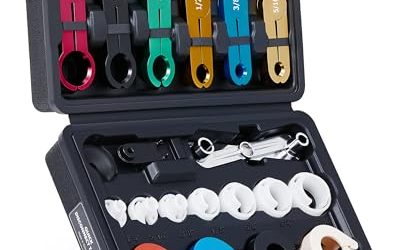
The Mastercool 72485-PRC is the most capable kit in this guide. It creates seven flare types: 45-degree single and double flares, push-connect flares, GM fuel line flares, ISO bubble flares, and GM transmission cooling line flares. That range makes it the right choice when one kit has to cover brake lines, fuel lines, transmission cooling lines, and general hydraulic tubing.
The kit fabricates push-connect flares in 1/4, 5/16, and 3/8 inch, GM fuel line flares, brake lines and transmission lines in 5/16 and 3/8 inch, single and double flares in 3/16, 1/4, 5/16, 3/8, and 1/2 inch, and metric bubble flares in 4.75, 6, 8, and 10 mm. It also includes 3/8-inch and 1/2-inch GM transmission cooling line die and adapter sets, which is the feature that separates it from the 72475-PRC below.
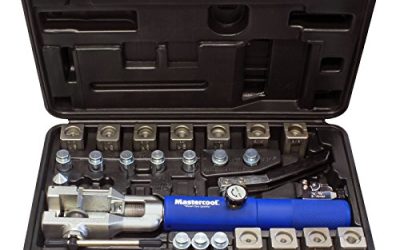
Construction is a reinforced high-strength steel body with precision-formed dies. The hydraulic ram is the original Mastercool Hydra-Flare design, and the kit includes the Mastercool 70027 mini tube cutter, a magnetic adapter holder, and a custom molded storage case. The listed weight is 12 pounds, and the listed dimensions are 14 by 12 by 4 inches, so this is a bench-and-garage kit rather than something you carry in a pocket. The listing states the tool is not discontinued by the manufacturer.
Choose the 72485-PRC when your work spans several line types and you want one kit to cover them. The extra transmission cooling line dies are the deciding factor: if you service GM transmission cooling lines, this is the kit that includes those dies rather than asking you to buy them separately.
2. Mastercool 72475-PRC Universal Hydraulic Flaring Tool Set
The Mastercool 72475-PRC is the original patented universal hydraulic flaring tool from the same maker, and it covers the core flare types most workshops use every week. It fabricates push-connect flares in 1/4, 5/16, and 3/8 inch, GM fuel line flares, brake lines and transmission lines in 5/16 and 3/8 inch, single and double flares in 3/16, 1/4, 5/16, 3/8, and 1/2 inch, and metric bubble flares in 4.75, 6, 8, and 10 mm.
The difference from the 72485-PRC is the transmission cooling line coverage: the 72475-PRC does not include the 3/8-inch and 1/2-inch GM transmission cooling line die and adapter sets. Everything else in the flare range is the same. For brake, fuel, and general hydraulic line work, that difference may never matter. For a shop that regularly services transmission cooling lines, it matters a great deal.
The kit uses the same reinforced high-strength steel body and hydraulic ram design, with a mini tube cutter, magnetic adapter holder, and custom molded case. The listed weight is 11.86 pounds and the listed dimensions are 15 by 10.6 by 3.5 inches. The hydraulic mechanism removes the physical strain of forming flares in steel by hand.
Choose the 72475-PRC when you want the full universal flare range without paying for transmission cooling line dies you will not use. It is the practical pick for general automotive and hydraulic line work, and the lighter weight makes it slightly easier to move around the shop.
3. Mastercool 72480 37-Degree Hydraulic Flaring Tool Set
The Mastercool 72480 is a specialist. Where the two kits above form 45-degree flares, the 72480 forms 37-degree single and double flares for AN fittings. AN fittings are common in motorsports, aviation, and high-performance automotive work, and in custom hydraulic plumbing where a 37-degree flare is the specified connection. A 45-degree tool cannot make a 37-degree flare, so this kit fills a gap the universal kits leave open.
The listing states the kit works with steel, light stainless steel, aluminum, and soft metals across five tubing sizes, and that it uses a hydraulic hand pump for the forming force. If your hydraulic lines terminate in AN fittings, this is the tool built for that job.
Choose the 72480 when your lines use AN fittings. It is not a general-purpose replacement for a 45-degree kit, and it should not be bought as one. Paired with a 45-degree universal kit, it covers both common flare standards, and the hydraulic mechanism gives the same steady, even forming force on steel.
Preparing Steel Tubing for a Clean Flare
A good flare starts before the tool touches the tube. Cut the tubing square with a proper tube cutter, not a hacksaw, and leave the cut end clean. After cutting, deburr both the inside and the outside of the tube end. A burr left on the inside edge becomes a weak point that can split when the cone expands the metal, and a burr on the outside keeps the tube from seating fully in the die.
Measure the stick-out carefully. The die block sets how much tubing extends above the die face, and that length determines the size of the finished flare. Too little stick-out produces a small, weak flare that may not seal. Too much produces an oversized flare that will not fit the fitting nut. Follow the height gauge or the instructions that come with the kit, and check the first flare of a session before running through a whole set of lines.
Clean the tube end before flaring. Dirt, rust, and cutting residue can mark the flare surface and interfere with the seal. A quick wipe with a clean cloth is usually enough. For lines removed from a vehicle, check the tubing for corrosion near the flare point; a corroded tube should be replaced rather than flared, because the thinned wall will not hold pressure.
Common Mistakes When Flaring Steel Lines
The most common mistake is skipping the deburring step. It takes seconds, and skipping it is the fastest route to a split flare. The second is over-tightening the die block. The dies need to grip the tube firmly enough that it does not push through during forming, but crushing the tube in the die damages the tubing and can mark the flare.
A third mistake is forming the flare in one fast pump of the handle. Steel responds better to steady pressure. Pump smoothly, let the ram advance at an even rate, and give the metal a moment to flow. Rushing the stroke is how cracks start, especially on cold steel.
Finally, do not flare tubing that is kinked, flattened, or corroded near the flare point. The flare concentrates stress at the tube end, and damaged tubing fails there first. Cut back to sound metal and flare the fresh end.
Steel Line Flaring: 45-Degree, 37-Degree, or Bubble
Choosing the right flare type is a matter of matching the fitting, not preference. A 45-degree double flare is the standard for most domestic automotive brake and hydraulic connections, where the double fold adds strength to the flare lip. A 45-degree single flare is used where the fitting and the application call for it, but it is less common on steel lines because the single fold is thinner.
A 37-degree flare belongs to AN fittings. The angle is different, the fitting seat is different, and the two are not interchangeable. If a line ends in an AN fitting, it needs a 37-degree flare, full stop.
An ISO bubble flare is the standard on many European vehicles. It looks different from a 45-degree flare: the tube end is formed into a rounded bubble rather than a cone. A bubble flare made with a 45-degree die will not seal in a bubble-flare fitting, and the reverse is also true. When you are unsure which flare a vehicle uses, check the fitting seat before forming anything. The shape of the seat tells you the flare it expects.
Frequently Asked Questions
Can a hydraulic flaring tool flare stainless steel lines?
Some hydraulic flaring tools are rated for light stainless steel, and the Mastercool 72480 listing states light stainless steel compatibility. Standard steel is within the rated range of all three kits in this guide. Heavy-wall stainless steel is harder to form and may exceed what a given kit is built for, so check the listing for the specific material and wall thickness before ordering.
What is the difference between a single flare and a double flare?
A single flare folds the tube end outward once, forming a cone. A double flare folds the tube end inward first and then outward, creating a doubled lip that is stronger and more resistant to cracking. Double flares are the standard for steel brake and hydraulic lines, because the extra fold adds strength where the fitting clamps down.
Why does my flare crack at the edge?
Cracking usually comes from one of three causes: a burr left on the tube end, forming the flare too quickly, or tubing that is work-hardened, corroded, or too hard for the tool. Deburr the tube, pump the ram smoothly, and check that the tubing is sound and within the kit’s rated materials. If cracks keep appearing on fresh tubing, the die or cone may be damaged.
How do I know which flare type my fitting needs?
Look at the seat inside the fitting. A 45-degree seat takes a 45-degree flare, a 37-degree seat takes a 37-degree flare, and a bubble-flare seat has a rounded profile. When in doubt, check the vehicle or equipment manual for the line specification. Guessing the flare type is how leaks happen.
Final Thoughts
The best steel hydraulic line flaring tool is the one that makes the flare your fittings require, in the sizes you work with, with a hydraulic ram that forms steel evenly instead of by force of arm. For most workshops, the Mastercool 72485-PRC covers the widest range of jobs, including transmission cooling lines. The Mastercool 72475-PRC covers the same core flare types without the transmission cooling dies, at a slightly lower weight. For AN fittings, the Mastercool 72480 adds the 37-degree capability the universal kits do not offer.
Whichever kit you choose, the habits around it matter as much as the tool: cut square, deburr every end, measure the stick-out, and pump the ram smoothly. A hydraulic flaring tool does the hard work, but a clean, well-prepared tube end is what turns that work into a flare that seals and stays sealed.
Disclosure: As an Amazon Associate, we earn from qualifying purchases.
Related guides
More from Amazon
Programs that pair well with the guide above. Offers and eligibility are set by Amazon and may change.
A free business account with business pricing and bulk-buying tools for work, shop or home office.
Create a business accountFree shipping on eligible items, Prime Video and more. Eligible new members can start with a free trial.
Start a Prime free trialAudiobooks and podcasts to listen to on the go. Eligible new members can start with a free trial.
Try Audible freeAd-free music streaming. Eligible new subscribers can start with a free trial.
Try Music Unlimited freeAs an Amazon Associate we earn from qualifying purchases.
Write Your Review
No reviews yet. Be the first to share your experience!