
Key takeaways
- Find the best fuel line flare tool for clean, leak-free fuel line flares. Compare hydraulic, vise-mounted, and double-flare kits for home and shop use.
What's inside
As an Amazon Associate I earn from qualifying purchases. This post may contain affiliate links at no extra cost to you.
A fuel line that leaks is not a small annoyance. It is a fire risk, a drivability problem, and a repair that will come back until the flare at the end of the tube is formed correctly. The flare is the seal: when it is uneven, cracked, off-center, or formed at the wrong angle, the fitting cannot seat, and fuel finds a way out.


The best fuel line flare tool for most home mechanics and small shops is the Mastercool 72475-PRC Hydraulic Brake and Fuel Line Flaring Kit, because it is built around GM fuel line flares and push-connect flares as well as standard 45-degree single and double flares, and its hydraulic ram forms each flare with steady, even pressure. If that kit is more tool than your work calls for, a good double-flare kit covering the common fuel line sizes will handle most jobs, as long as you match the flare type and tubing size to the fitting on your vehicle.
Every product below forms flares on metal fuel line tubing. Three of the four are general-purpose brake and fuel line kits rather than fuel-line-only tools, and each section says so plainly.
Sections
Quick Picks
Our Short List of 3
All 3 Picks at a Glance
| Product | Specs | Action |
|---|---|---|
| Mastercool 72475-PRC Hydraulic Brake and Fuel Line Flaring Kit (B01NCYKQSN) | Check price on Amazon | |
| OTC 6502 Master Brake Flaring Tool Kit (B0075XHDHI) | Check price on Amazon | |
 SEGELPRO Automotive Double Flaring Tool Kit (B0BMQ5VJV8) | Check price on Amazon |
How to Choose
Match the flare type to the fitting
Fuel lines use several flare shapes, and the shape must match the fitting it seats against. The most common is the 45-degree double flare, which folds the tube wall back on itself for a strong, leak-resistant seat. Single 45-degree flares appear on some softer tubing. Bubble flares, also called ISO flares, are common on imported vehicles. GM fuel line flares and push-connect flares are a separate family used on many General Motors fuel systems, where the tube end must accept a quick-connect fitting rather than a threaded flare nut.
Before you buy, look at the fitting on your vehicle. If you are replacing a GM fuel line with a push-connect end, a standard double-flare kit alone will not finish the job; you need a kit that lists GM fuel line and push-connect dies by name. On an imported vehicle, check for a bubble flare requirement first, because a kit that only makes 45-degree flares cannot form one.
Match the tubing size, in inches and in millimetres
Fuel lines on passenger cars and light trucks are most often 1/4, 5/16, or 3/8 inch outside diameter. Smaller 3/16 inch line appears on some applications, and 1/2 inch line on larger trucks and performance fuel systems. Metric sizes such as 4.75, 6, 8, and 10 mm appear on imported vehicles and on some domestic models with metric plumbing.
A kit covering 3/16 inch through 1/2 inch in SAE sizes and 4.75 mm through 10 mm in metric sizes covers nearly every fuel line a home mechanic will meet. Check the die list, not just the headline range: some kits cover a wide range for single flares but a narrower one for double flares, and the double-flare range matters most for fuel work.
Check the tubing material the tool can form
Fuel lines are made from steel, stainless steel, copper-nickel alloy, copper, brass, and aluminum. A tool rated only for copper, brass, and aluminum will struggle with steel fuel line and may not form a clean flare in stainless steel at all.
Tools made for steel and stainless tubing tend to have heavier bars, stronger yokes, and harder dies. Lighter kits are fine for soft tubing, but they can flex or slip on hard steel, and a slipped tube produces a lopsided flare. If your work is mostly steel fuel line, choose a kit whose listing names steel and stainless steel explicitly.
Choose the forming method that fits your hands and your workspace
Manual bar-style kits use a flaring bar to clamp the tube and a yoke with a screw feed to press the flare cone into the tube end. They are compact and easy to carry to the vehicle, but they demand steady hand pressure. Vise-mounted turret tools clamp into a bench vise and use a lever to drive the die, giving more leverage on steel tubing, but they need a bench and a vise, and they are not practical under a vehicle.
Hydraulic kits use a small hydraulic ram to drive the flare, removing most of the physical effort and producing a very even flare on hard tubing. They are heavier and larger than manual kits, but for a shop that flares lines every week, the reduction in effort and rework is the point. For a single driveway replacement, a manual kit is usually enough; for repeated work, or stainless steel line, a vise-mounted or hydraulic tool earns its place.
Look for a cutter and a deburring tool in the kit
A flare is only as good as the tube end it starts from. The cut must be square, and the inside and outside edges must be deburred before flaring. A rough or angled cut folds unevenly, and a burr inside the tube becomes a weak point. Kits that include a tubing cutter and a deburring tool save a separate purchase and keep the whole job in one case; if your kit lacks them, buy them separately and use them on every cut.
Check how the tube is clamped
The flaring bar or die set must hold the tube firmly without crushing it. Split dies that wrap the tube, and bars with a deep, well-machined groove for each size, hold better than a shallow clamp. A tube that slips produces a flare thin on one side and thick on the other, and that flare will not seal. Set the tube end flush with the face of the die or bar, at the height the instructions specify for the flare type: too much stick-out makes a flare too large, and too little makes one too small to seat. Practice on scrap tubing before you flare the line that goes on the vehicle.
The Best Fuel Line Flare Tool Reviewed
Mastercool 72475-PRC Hydraulic Brake and Fuel Line Flaring Kit (B01NCYKQSN)
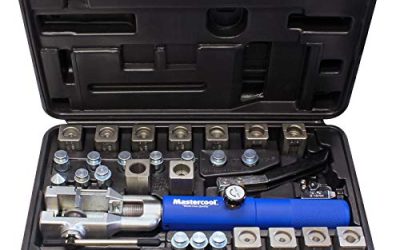
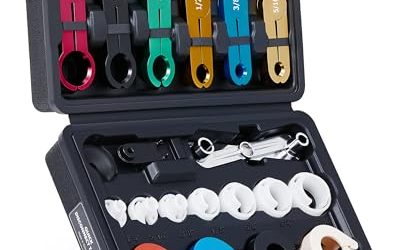
The Mastercool 72475-PRC is the closest fit in this roundup to the keyword itself, because its listing names GM fuel line flares and push-connect flares alongside 45-degree single and double flares and ISO bubble flares. A small hydraulic ram drives the flare instead of a hand screw, giving even pressure on steel and stainless fuel line. The kit covers 45-degree and double flares in 3/16 through 1/2 inch tubing, push-connect and GM fuel line flares in 1/4, 5/16, and 3/8 inch tubing, and metric bubble flares in 4.75, 6, 8, and 10 mm sizes. A mini tube cutter is included, along with a magnetic adapter holder that keeps the dies in place.
The body is built from reinforced steel, and the kit is supplied in a storage case with the hydraulic ram and the cutter. At 11.86 pounds, with case dimensions of 15 by 10.6 by 3.5 inches, it belongs on a bench or in a shop cabinet rather than in a small roadside tool roll. It does not list 37-degree flares, so if your fuel system uses 37-degree fittings, this is not the kit for that job.
Who it suits: a home mechanic or small shop that works on GM fuel lines, or that flares steel and stainless fuel lines often enough that hydraulic forming is worth the size and weight. Who should skip it: anyone who needs only one or two flares a year on soft tubing, anyone who needs 37-degree flares, and anyone who must work under a vehicle with no bench nearby.
OTC 6502 Master Brake Flaring Tool Kit (B0075XHDHI)
The OTC 6502 is a general-purpose flaring kit that covers brake lines, fuel lines, and air conditioning lines, and it is included here because its breadth makes it useful for fuel line work across a mixed fleet. It forms single, double, and bubble flares in SAE and metric sizes: single flares from 3/16 to 5/8 inch and 4 to 14 mm, double flares from 3/16 to 1/2 inch and 4 to 10 mm, and bubble flares from 3/16 to 1/2 inch and 4.75 to 10 mm.
The kit includes a flaring bar, an arbor press, adapters, a tube cutter, a deburring tool, and a hard case. The bar-and-press design is a familiar manual system that works on copper, aluminum, and steel tubing, and the case keeps the many adapters organized. The trade-off is that it is a manual kit, so forming a double flare in steel line takes steady pressure and a careful setup, and the tube must be clamped firmly to prevent slipping.
Who it suits: a mechanic with a mixed driveway of domestic and imported vehicles who wants one kit for fuel, brake, and air conditioning lines in many sizes. Who should skip it: anyone who needs GM fuel line or push-connect flares specifically, since this kit is a general single, double, and bubble flare kit, and anyone who wants hydraulic forming for frequent steel line work.
Eastwood Professional Brake Tubing Flaring Tool (B07PN6GL14)
The Eastwood Professional Brake Tubing Flaring Tool is a vise-mounted turret tool that forms 45-degree single, double, and bubble flares. It is included here because Eastwood states that it can also be used on fuel lines and transmission cooler lines. The included split dies cover 3/16, 1/4, 5/16, and 3/8 inch and 4.75 mm tubing, and the tool is rated for steel, 304 stainless steel, and soft metal tubing.
The tool mounts in a bench vise, and a rotating die head carries the operation 1 and operation 2 dies for each size. The first operation forms a bubble flare, and the second folds it into a 45-degree double flare. A lever handle drives the die, giving more leverage than a hand screw and helping produce a uniform flare in steel and stainless tubing. The kit includes the tool, lever handle, rotating die head, split die sets, and a blow-molded case.
It needs a vise and a bench, so it is not a tool for flaring a line while it is still attached to the vehicle. It does not make push-connect flares, and its die range stops at 3/8 inch, so it will not cover 1/2 inch fuel line.
Who it suits: a home mechanic with a bench vise who fabricates fuel lines from steel or stainless tubing before installation. Who should skip it: anyone without a bench vise, anyone who must flare a line on the vehicle, anyone who needs push-connect flares, and anyone working with 1/2 inch fuel line.
SEGELPRO Automotive Double Flaring Tool Kit (B0BMQ5VJV8)
The SEGELPRO Automotive Double Flaring Tool Kit is a manual double-flaring kit for brake and fuel pipes, and it is the budget pick in this roundup. It includes a flare bar, a flaring cone, seven flare adapters, a tubing cutter, and a carrying case, along with a replacement blade and a reamer for deburring. The seven dies cover 3/16 inch through 5/8 inch tubing, and the kit forms 45-degree double and single flares in copper, brass, aluminum, and soft steel tubing.
That material list is the key limit: the kit is rated for soft steel and soft metals, not hard steel or stainless steel fuel line, so it suits copper-nickel and soft steel replacement line rather than stainless line. It is a manual bar-style kit, so the result depends on a square cut, a clean deburr, a firm clamp, and steady pressure on the cone. For occasional repair on soft line, it covers the common sizes, and the included cutter and reamer keep the job in one case.
Who it suits: a home mechanic who needs an occasional 45-degree double flare on soft fuel line tubing and wants a compact kit with a cutter included. Who should skip it: anyone flaring stainless steel fuel line, anyone who needs bubble, GM fuel line, or push-connect flares, and anyone who flares lines often enough to want hydraulic or vise-mounted leverage.
What to Check Before You Buy
Start with the fitting. Identify the flare type and tubing size on your vehicle before you order, and confirm that the kit you choose lists both by name. A kit that makes excellent double flares is the wrong kit if your fuel line needs a push-connect end.
Next, confirm the material. If your replacement line is stainless steel, choose a tool rated for stainless steel. If your line is copper-nickel, most kits rated for soft steel and soft metals will handle it. Then check what is in the case: a kit without a cutter and a deburring tool is incomplete for fuel line work. Count the dies against the sizes you need.
Finally, think about where the work happens: a hydraulic or vise-mounted tool is better on a bench, and a manual bar kit is better under a vehicle or in a driveway. Before you flare the line that goes on the vehicle, practice on scrap tubing of the same size and material, and test-fit the flare in the fitting by hand. A practice flare costs a few inches of tubing; a failed flare on the installed line costs the whole job.
Work in a ventilated space, keep fuel away from ignition sources, relieve fuel system pressure before you open a line, and check every connection for leaks with the engine running and the vehicle stationary before you drive.
FAQ
What flare type do most fuel lines use?
Most fuel lines use a 45-degree double flare, a single 45-degree flare, or a push-connect end, depending on the vehicle. GM fuel systems often use GM fuel line flares and push-connect fittings, while many imported vehicles use bubble flares. Check the fitting on your vehicle first, because the flare type must match the fitting.
Can a brake line flaring tool be used on fuel lines?
Yes, in many cases, because brake and fuel lines often use the same tubing sizes and the same 45-degree double flare. The tool must still match the flare type, tubing size, and tubing material of the fuel line, so read the die list rather than the product name.
What size flare tool do I need for a fuel line?
Most passenger car and light truck fuel lines are 1/4, 5/16, or 3/8 inch outside diameter. A kit covering 3/16 through 1/2 inch in SAE sizes, plus 4.75 through 10 mm in metric sizes, covers nearly every fuel line a home mechanic will meet.
Is a hydraulic flare tool better than a manual one?
A hydraulic tool forms flares with steadier pressure and less effort, which helps on steel and stainless tubing and on repeated jobs. A manual bar kit is lighter and easier to carry, and it is enough for occasional flares on soft tubing.
Why does my new flare leak?
A new flare usually leaks because the cut was not square, the tube end was not deburred, the tube slipped in the clamp, the tube stuck out too far or not far enough from the die, or the flare type does not match the fitting. A cracked flare, often caused by flaring a tube too hard for the tool, will also leak. Cut a fresh end, deburr it, set the stick-out to the instructions, and form a new flare on a practice piece first.
Bottom Line
The best fuel line flare tool is the one that matches your fitting, tubing size, and tubing material, and that you can set up correctly every time. For GM fuel line and push-connect work, the Mastercool 72475-PRC is the strongest fit, because those flare types are named in its kit. For broad SAE and metric coverage, the OTC 6502 covers the most sizes in one case. For bench fabrication in steel and stainless line, the Eastwood tool gives leverage a manual bar kit cannot. For occasional double flares on soft fuel line, the SEGELPRO kit covers the common sizes in a compact case.
Whichever kit you choose, do not rush the setup. Cut the tube square, deburr the edges, clamp the tube firmly, set the stick-out to the instructions, and practice on scrap tubing before you flare the line that goes on the vehicle. A careful flare, formed once, seals. A hurried flare, formed twice, usually leaks.
Disclosure: As an Amazon Associate, we may earn from qualifying purchases.
Related guides
More from Amazon
Programs that pair well with the guide above. Offers and eligibility are set by Amazon and may change.
A free business account with business pricing and bulk-buying tools for work, shop or home office.
Create a business accountFree shipping on eligible items, Prime Video and more. Eligible new members can start with a free trial.
Start a Prime free trialAudiobooks and podcasts to listen to on the go. Eligible new members can start with a free trial.
Try Audible freeAd-free music streaming. Eligible new subscribers can start with a free trial.
Try Music Unlimited freeAs an Amazon Associate we earn from qualifying purchases.
Write Your Review
No reviews yet. Be the first to share your experience!