What's inside
As an Amazon Associate I earn from qualifying purchases. This post may contain affiliate links at no extra cost to you.
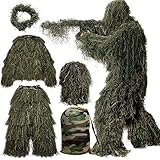
The best ghillie suits for most users in 2026 are the Arcturus 3D Leafy Suit for lightweight breathability and mobility, the North Mountain Gear Woodland Ghillie Suit for maximum full-body concealment in dense forest, and the Bushrag Ghillie Suit for durable, military-spec layering — your choice should come down to terrain, heat tolerance, and how much natural vegetation you plan to add.
As an Amazon Associate we earn from qualifying purchases at no extra cost to you.


Sections
How to Choose a Ghillie Suit: 7 Decision Criteria
Ghillie suits are not one-size-fits-all camouflage. The right pattern and construction can make you disappear at 10 yards, while the wrong one will make you overheat, snag, or shine on infrared. Evaluate these factors before buying:
1. Camouflage Pattern vs. Terrain
- Woodland / Mossy: Mix of dark greens, browns, and black jute/burlap threads. Best for eastern hardwoods, Pacific Northwest, and dense underbrush in spring/summer. Breaks up human outline in dappled light.
- Mossy Oak / Kryptek / Realtree-style Leafy: Printed 3D leaf shapes on polyester mesh. More effective in mixed terrain with moderate vegetation. Less effective in open dry grass where the leaf silhouette looks unnatural.
- Desert / Arid: Tans, light browns, and sage. Uses sparse, wispy jute. Essential for prairie, high desert, and late-season dry grass. A woodland suit in this terrain stands out more than solid khaki.
- Snow / Alpine: White/cream base with sparse grey threads. Highly specialized; a white suit in woodland is as conspicuous as blaze orange.
Rule of thumb: Match the dominant color at your typical engagement distance (30-50 yards), not up close. A suit that looks perfect at 3 feet often looks too dark at distance.
2. Fabric Weight and Breathability
Jute/burlap suits are heaviest and hottest but provide the best 3D depth. Synthetic thread (flame-retardant synthetic jute) and 3D leaf suits are lighter and cooler but flatter. For warm-weather hunting or airsoft, breathability outweighs depth. For stationary concealment in cool weather, weight is an advantage — it hangs and moves less in wind.
3. Layering Room and Sizing
A ghillie must fit over your base clothing, not instead of it. Most suits are sized to be worn over clothes, but chest and inseam measurements vary wildly. If you plan to wear insulated layers underneath for late-season hunting, size up one. Look for elastic cuffs, adjustable waist, and an open-front jacket design that doesn’t restrict shouldering a rifle or drawing a bow.
4. Vegetation Attachment Points
The best suits are a base for natural vegetation. Check for:
- Netted mesh outer shell with 1-2 inch webbing loops
- Elastic loops or tie strings every 4-6 inches on back, shoulders, hood, and limbs
- Reinforced stitching at attachment points so added twigs and grasses don’t tear the base fabric
Without these, you are stuck with the factory color and cannot adapt to micro-terrain. Jute thread suits excel here; slick leafy ponchos often have few tie-in points.
5. Noise Level
Stiff synthetic leaves can rustle loudly when stalking. Jute is nearly silent but can snag. Polyester leaf suits fall in the middle. If you need to crawl or stalk within 50 yards of wildlife, prioritize soft, quiet fabrics and avoid plastic-feel leaves that crinkle with every step.
6. Durability and Fire Resistance
Untreated jute is highly flammable and rots if stored damp. Many modern suits use fire-retardant treated jute or synthetic thread. Check for double-stitched seams, reinforced knees/elbows, and mesh that won’t melt near a camp heater. Durability is less about the outer threads and more about the base BDU or mesh suit underneath.
Spec Comparison: Top Ghillie Suit Types in 2026
These represent the most common categories on the market, with examples from established manufacturers. Specs are based on standard Large/XL sizes.
| Model / Type | Material | Weight (Jacket + Pants) | Breathability | Noise Level | Best Terrain |
|---|---|---|---|---|---|
| Arcturus 3D Leafy Suit | Polyester leaf over mesh base | 1.8 – 2.2 lbs (0.8 – 1.0 kg) | Very High – open mesh | Low-Moderate | Mixed woodland, warm weather, mobile hunting |
| North Mountain Gear Full Ghillie (Jute/Synthetic Blend) | Fire-retardant jute blend on BDU base | 4.5 – 5.8 lbs (2.0 – 2.6 kg) | Low – dense fibers trap heat | Very Low (silent) | Dense forest, stationary concealment, wildlife photography |
| Red Rock Outdoor Gear Ghillie Suit | Synthetic thread on mesh BDU | 3.5 – 4.2 lbs (1.6 – 1.9 kg) | Moderate | Very Low | All-around hunting, sniper training, temperate zones |
| Bushrag Lightweight Ghillie (Military Spec) | Treated jute on ripstop BDU | 6.0 – 7.5 lbs (2.7 – 3.4 kg) | Low | Very Low | Military simulation, long-duration prone, cool climates |
| GhillieSuitShop Ultra-Light Leaf Poncho | 3D polyester leaf, pullover poncho | 1.2 – 1.5 lbs (0.5 – 0.7 kg) | Very High | Moderate (rustle risk) | Scouting, turkey hunting, high mobility / high heat |
Decision Matrix: Which Suit Fits Your Situation
| Your Situation | Recommended Type | Why |
|---|---|---|
| Hot weather (70°F+), active stalking, needs packability | 3D Leafy Suit (Arcturus-style) | Lightest weight, open mesh ventilation, packs to size of a rain jacket |
| Cool weather, stationary hunting/photography in dense woods | Full Jute/Synthetic Blend (North Mountain Gear) | Maximum breakup at close range, silent, excellent natural vegetation holding |
| Beginner on a budget, occasional use | Synthetic Thread Suit (Red Rock) | Lower price range ($80-$150), fire-retardant, no rotting or shedding, easy to wash |
| Needs to layer over heavy clothing or plate carrier | Bushrag or Oversized BDU-Based Ghillie | Generous cut with room for layers, reinforced shoulders/elbows, durable base uniform |
| Need quick on/off for run-and-gun or bow hunting | Leaf Poncho / Cape | One-piece pullover, no pants to snag, allows full arm freedom for drawing a bow |
| Dry grassland, prairie, or arid terrain | Desert/Arid Synthetic Ghillie | Tan/sage palette prevents dark blob effect; sparse threading matches thin cover |
Worked Example: Sizing and Heat Load Calculation
A common mistake is buying a ghillie that fits like a normal jacket. Do this instead:
1. Measure over clothes: Put on the thickest base layer you will wear in the field (e.g., fleece + hunting jacket). Measure chest circumference. Add 4-6 inches for a ghillie. For example, a 44-inch chest over layers needs a suit rated for 48-50 inches. Most L/XL ghillies list a 48-52 inch chest to allow this drape.
2. Estimate heat load: A full jute ghillie adds approximately 10-15°F of perceived temperature due to trapped air and limited evaporation. If the air temperature is 65°F, expect to feel like 75-80°F while moving. In 85°F+ heat, a full jute suit can raise core temperature quickly. For any hunt over 70°F where you will walk more than 500 yards, choose a leafy mesh suit or poncho that reduces heat load by roughly 60% compared to full jute.
3. Check coverage gap: Sit, kneel, and shoulder your rifle. Have someone check for exposed areas: back of neck, wrists between glove and sleeve, and ankle gap above boots. A good suit should cover these with elastic cuffs or extended length. Many hunters add separate ghillie sleeves or a rifle wrap to close these gaps.
Durability and Ownership Realities
A ghillie suit is not a buy-and-forget item. Here’s what actually wears out:
- What fails first: The mesh base at the crotch, inner elbows, and knees. Threads themselves rarely tear, but the stitching that holds them to the base pulls out after crawling. Reinforced BDU bases last 3-5 seasons; cheap mesh ponchos may last one hard season.
- Shedding and tangling: Jute sheds fibers for the first 2-3 uses. Store it hanging, not compressed. Synthetic thread sheds less but tangles if stuffed wet into a bag. Shake out and air dry after each use.
- Cleaning: Never machine wash a jute ghillie — it will mat and felt. Hand rinse with cold water only, no detergent, and hang dry completely before storage to prevent mildew and rot. Leafy polyester suits can be machine washed on gentle/cold and hung dry.
- Fire and storage: Keep untreated jute away from campfires, heaters, and sparks; it ignites quickly. Store in a breathable cotton bag or hung in a closet. Sealed plastic totes trap moisture and cause odor and fiber degradation.
- Common mistakes: Spraying with scent-cover sprays that contain oils (degrades jute), adding too much vegetation so the suit becomes heavy and noisy, and cutting threads to shorten the suit — this creates bald spots that are obvious at distance. Instead, tuck and tie excess.
Cost per use: As a general market range, leafy suits run $60-$120, synthetic thread suits $80-$170, and full BDU-based jute suits $150-$350. If you hunt 10 days per season for three seasons, a $180 synthetic suit costs about $6 per use, while a $90 poncho that lasts one season of heavy use costs $9 per use. Durability often makes the higher initial price cheaper long-term.
Setup Tips for Better Concealment
- Break in a new jute suit by dragging it lightly on dirt and leaves — factory-fresh jute has a uniform color and slight sheen that looks artificial. A light dusting dulls it.
- Attach local vegetation within 30 minutes of setting up. Use 30% added natural material, 70% suit — too much green wilts and changes color within hours.
- Wear a mesh face veil or add jute to your hat/hood. An exposed face is the most recognizable human feature even when the body is perfectly concealed.
- For rifle hunters, wrap the rifle and optic with matching strips or use a separate gun ghillie. A black rifle barrel sticking out of natural camouflage instantly gives you away.
Frequently Asked Questions
Do ghillie suits work for bow hunting?
Yes, but choose a leafy or short-thread synthetic suit with open or elastic cuffs and a cropped jacket length. Full, long-string jute will interfere with the bowstring. Many bow hunters prefer a ghillie poncho or a jacket-only setup with leafy sleeves.
Are ghillie suits waterproof?
No. Jute absorbs water and becomes very heavy when wet, and mesh bases offer no rain protection. Wear a waterproof base layer underneath and treat the ghillie as an outer concealment layer, not rain gear. Some hunters carry a lightweight waterproof ghillie shell for wet conditions.
Can I use one ghillie suit for all terrains?
A woodland ghillie in desert or snow will make you more visible, not less. If you can only own one, choose a synthetic suit in an intermediate olive/brown and adapt it heavily with local vegetation for the specific area you are in. Swapping vegetation is more effective than swapping the whole suit.