
Our Short List of 3

- Best for: DuPont and JST open-barrel pins on electronics benches.
- Brand: IWISS
- Model: SN-28B 28-18AWG
- Wire range: AWG 28-18
- Terminals: DuPont 2.54 mm, JST XH 2.5 mm, JST VH 3.96 mm open-barrel pins

- Best for: Ferrules for panels, terminal blocks, and control enclosures.
- Brand: Sopoby
- Crimp profile: quadrilateral, four-sided
- Wire range: AWG 28-7 (0.08 to 10 sq mm)
- Overall length: 175 mm (6.89 inches)
- Best for: Insulated nylon terminals on appliance and automotive wiring.
- Brand: Wirefy
- Model: Wirefy-CRMP-01
- Wire range: AWG 22-10
- Terminals: insulated nylon connectors
All 5 Picks at a Glance
| Product | Specs | Action |
|---|---|---|
| iCrimp SN-28B Open Barrel Crimping Tool |
| Check price on Amazon |
| Sopoby Ferrule Crimping Tool Kit |
| Check price on Amazon |
| Wirefy Crimping Tool |
| Check price on Amazon |
 Klein Tools 1005 Cutting and Crimping Tool |
| Check price on Amazon |
 Knipex 97 52 36 PreciForce Crimping Pliers |
| Check price on Amazon |
Key takeaways
- Compare the best crimping pliers for workshop wiring, from ratchet ferrule crimpers to terminal tools, with jaw sizes, dies and grips that hold firm.
What's inside
As an Amazon Associate I earn from qualifying purchases. This post may contain affiliate links at no extra cost to you.
A crimp is a joint with a large job. When it holds, current flows, a terminal stays put through vibration, and a panel stays tidy. When it fails, a wire slips free, a connection heats up, or a pin backs out of its housing. The difference is the tool: matched dies, even force, and a full cycle that finishes what it begins. These five crimping pliers cover the work a home workshop meets most, from fine open-barrel pins to insulated terminals and panel ferrules.
No tool in this set does everything, and that is the point. A ferrule crimper will not close a DuPont pin, and a micro crimper will not seat a heavy insulated lug. Pick by the terminal you crimp most often, check the wire range, and let grip and jaw access settle the tie. The five tools below run from an open-barrel ratchet to a factory-calibrated German plier, with a ferrule kit, an insulated-terminal ratchet, and a manual plier in between.
Sections
Quick Picks
As an Amazon Associate we earn from qualifying purchases
| Product | Best for | Key spec |
|---|---|---|
| iCrimp SN-28B | DuPont and JST open-barrel pins | AWG 28-18, three double-crimp stations |
| Sopoby Ferrule Crimping Tool Kit | Ferrules for panels and terminal blocks | AWG 28-7, 1800 ferrules included |
| Wirefy Crimping Tool | Insulated nylon terminals | AWG 22-10, ratcheting double-indent die |
| Klein Tools 1005 | Quick manual crimps and tight spaces | AWG 10-22, crimper and cutter in one |
| Knipex 97 52 36 PreciForce | Insulated terminals, plug and butt connectors | 0.5 to 6 sq mm, factory-calibrated ratchet |
How to Choose
Match the die to the terminal
The die decides the joint. Open-barrel pins need a die that folds two sets of wings, one around the conductor and one around the insulation, in a single cycle. Insulated terminals need a nest that presses the barrel without cutting the sleeve. Ferrules need a square or four-sided profile that packs the strands into a solid block for a terminal block screw. A die made for one family will mangle another, so read the terminal type on the box before you read anything else about the tool. If your work spans two families, keep two tools rather than forcing one die to do both jobs.
Check the wire range before the brand
Every crimper in this guide lists a wire range, and that range is a hard limit. A tool built for AWG 28 to 18 will not close a 10 AWG lug, and a tool built for 10 AWG will crush a 28 AWG pin. Match the range to the wire on your bench, not to the wire you might buy one day. Pay attention to the ends of the range as well: the finest and heaviest sizes are where cheap dies show their weakness. If your wiring runs from fine sensor leads to heavier appliance cable, you need more than one tool, or a tool whose range truly spans both ends.
Ratchet or manual action
A ratchet holds the handles shut until the crimp is complete, which removes guesswork and keeps every joint the same. That consistency matters when you crimp dozens of terminals in a row, and it matters more when the terminal hides inside a housing where you cannot see the result. A manual plier is faster for one-off jobs and fits where a ratchet body will not, but it leans on your hand to judge the force. Choose the ratchet for repeat work and for terminals you cannot inspect easily, and keep the manual plier for quick repairs and tight corners.
Grip, length, and jaw access
Handle shape decides how your hand feels after an hour of crimping. Wide, cushioned grips spread the load, while narrow handles suit smaller hands and tight panels. Length is leverage: a longer tool closes heavy terminals with less effort, and a shorter tool reaches into crowded boxes where a long body cannot turn. Jaw access matters just as much. Side-loading dies let you feed a ferrule straight into a panel, while a front-loading nose works better on a bench. Hold the tool if you can before you buy, and favor the one that lets you keep your wrist straight.
The 5 Best Options
iCrimp SN-28B Open Barrel Crimping Tool
- Best for: DuPont and JST open-barrel pins on electronics benches.
- Brand: IWISS
- Model: SN-28B 28-18AWG
- Wire range: AWG 28-18
- Terminals: DuPont 2.54 mm, JST XH 2.5 mm, JST VH 3.96 mm open-barrel pins
DuPont and JST open-barrel pins on electronics benches.
Fine pins only; it will not close insulated terminals or ferrules.
The SN-28B earns its place on an electronics bench. It crimps DuPont 2.54 mm pins and JST XH and VH housings, the connectors inside 3D printers, radio-control servos, battery balancers, and small control boards. Three double-crimp stations fold the conductor wings and the insulation wings in one squeeze, so each pin grips the wire and its sleeve at the same time. The ratchet holds the handles shut until the cycle is complete, and a quick-release lever frees the tool when a pin seats badly. For fine open-barrel work, this is the most useful shape in the set.
Sopoby Ferrule Crimping Tool Kit
- Best for: Ferrules for panels, terminal blocks, and control enclosures.
- Brand: Sopoby
- Crimp profile: quadrilateral, four-sided
- Wire range: AWG 28-7 (0.08 to 10 sq mm)
- Overall length: 175 mm (6.89 inches)
Ferrules for panels, terminal blocks, and control enclosures.
Ferrules only; it will not crimp insulated terminals or open-barrel pins.
The Sopoby kit is a practical route to tidy panel wiring. Its quadrilateral jaws press a ferrule into a four-sided block that seats firmly under a terminal-block screw, and the range runs from AWG 28 up to AWG 7, which covers sensor leads through heavier feeder ends. The box adds 1800 ferrules in common sizes, so a first panel build needs no separate consumable order. At 175 mm long, the tool fits a pouch or a drawer without crowding other tools. For anyone wiring a first control panel or cleaning up an enclosure, this kit removes the two usual excuses: the wrong profile and no ferrules on hand.
Wirefy Crimping Tool
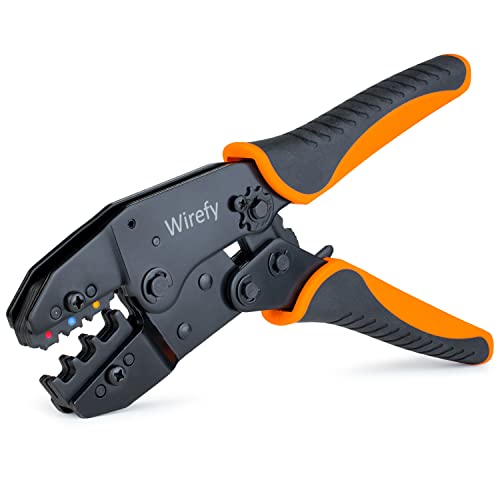
- Best for: Insulated nylon terminals on appliance and automotive wiring.
- Brand: Wirefy
- Model: Wirefy-CRMP-01
- Wire range: AWG 22-10
- Terminals: insulated nylon connectors
Insulated nylon terminals on appliance and automotive wiring.
Insulated terminals only; it will not close ferrules or open-barrel pins.
The Wirefy tool covers the most common workshop terminal: the insulated nylon connector. Its double-indent die presses the barrel in two places, which spreads the load and keeps the sleeve intact, while the ratchet drives each crimp through a full cycle before the handles release on their own. An adjustment wheel sets the crimping force, with (+) and (-) marks for fine tuning, so the same tool suits thin signal leads and heavier appliance wiring. At 540 grams with a 6-inch handle, it rides easily in a tool belt. For steady insulated-terminal work, this is the dependable middle of the set.
Klein Tools 1005 Cutting and Crimping Tool
- Best for: Quick manual crimps and tight spaces on mixed terminal jobs.
- Brand: Klein Tools
- Model: 1005
- Wire range: AWG 10-22, insulated and non-insulated terminals
- Style: Crimper/Cutter
Quick manual crimps and tight spaces on mixed terminal jobs.
No ratchet, so crimp force depends on your hand; it will not close ferrules.
The 1005 is the manual plier for quick work. It crimps insulated and non-insulated terminals from 10 to 22 AWG, and its tapered nose reaches into junction boxes and crowded panels where a ratchet body cannot turn. A hardened cutter sits in the nose, so the same tool trims the wire before the crimp. The plastic-dipped red handles and alloy steel body suit daily use, and the tool is made in the USA. At 9.75 inches and 12.8 ounces, it carries easily in a pouch. For fast repairs and mixed terminal jobs, this is the tool that stays in the bag.
Knipex 97 52 36 PreciForce Crimping Pliers
- Best for: Insulated terminals, plug connectors, and butt connectors where force must stay consistent.
- Brand: Knipex
- Model: 97 52 36
- Application: insulated terminals, plug connectors, butt connectors
- Capacity: 0.5 to 6 sq mm (AWG 20-10)
Insulated terminals, plug connectors, and butt connectors where force must stay consistent.
Built for insulated terminals only; it will not close ferrules or open-barrel pins.
The PreciForce is the precision pick of this set. Its factory-calibrated ratchet sets the crimping force before the tool leaves the factory, and the setting can be adjusted again later, so each insulated terminal, plug connector, and butt connector closes with the same force. Three crimping positions cover 0.5 to 6 sq mm, which runs from 20 to 10 AWG. Chrome vanadium electric steel, oil-hardened, gives the body its long life, and multi-component grips keep the handles steady through a long run. At 220 mm and 487 grams, it balances leverage with control. For work where every joint must match, this is the tool to trust.
Which One Fits Your Situation
You wire electronics and small control boards
Take the iCrimp SN-28B. Small pins need small dies, and this tool folds conductor and insulation wings together for DuPont and JST housings. Add the Sopoby kit only if your boards also feed terminal blocks. Skip the heavier terminal tools here; their dies will crush a fine pin before the ratchet finishes.
You fit out panels and terminal blocks
Take the Sopoby ferrule kit. Ferrules keep stranded ends solid under a screw, and the included assortment covers the sizes a first panel needs. Pair it with the Knipex PreciForce for the insulated terminals on the same panel, so each joint gets the die made for it. That pairing covers nearly every connection a control panel holds.
You repair appliances and vehicle wiring
Take the Wirefy tool for insulated nylon terminals, with the Klein 1005 alongside for quick manual jobs. The ratchet keeps repeat crimps even, and the manual plier reaches tight spots behind dashboards and inside appliance housings. Keep both in the bag and match the tool to the space, not just the terminal.
You want one tool for quick jobs around the shop
Take the Klein 1005. It crimps the common insulated and non-insulated terminals, cuts wire with the nose cutter, and fits a pouch without adding bulk. It will not replace a ferrule crimper or a micro crimper, but for fast fixes and mixed jobs it is the tool you will reach for first.
Common Mistakes
- Crimping the wrong nest for the terminal size: a nest one size up leaves a loose joint, and one size down cuts strands. Match the marking on the die to the terminal in front of you.
- Crimping over insulation instead of bare conductor: the die must bite the metal strands, not the sleeve. Strip to the length the terminal needs and seat the conductor fully before you squeeze.
- Re-crimping a finished joint to make it tighter: a second squeeze deforms the barrel and weakens the grip. If a crimp fails a tug check, cut it off and fit a fresh terminal.
- Using a ferrule die on an insulated terminal, or a terminal die on a ferrule: each profile packs the metal differently, and the wrong one leaves a joint that looks done but pulls free.
- Forgetting that heavy lugs and wire-rope sleeves need a different tool: these five pliers suit light and medium wiring, while battery cable lugs and rope sleeves need a hydraulic crimper.
Frequently Asked Questions
Can one crimper handle every terminal type?
No. Each terminal family needs its own die profile: open-barrel pins fold wings, insulated terminals press a barrel inside a sleeve, and ferrules pack strands into a square block. A die made for one family will damage another. Keep one tool per family you crimp often, and add tools as new terminal types enter your work.
Do ferrules need a special crimper?
Yes. A ferrule is a thin metal sleeve that must be pressed evenly from several sides so the strands inside form a solid block. A standard terminal die crushes it from two sides only, which leaves a loose end that frays under a screw. A four-sided ferrule die, like the one in the Sopoby kit, packs the sleeve into a square shape that seats firmly in a terminal block.
Why does my crimp feel loose after the handles open?
A loose crimp usually means the wrong nest, a wire that never reached the back of the barrel, or a ratchet that opened early. Check the nest marking against the terminal size, push the stripped conductor fully home before you squeeze, and let a ratchet finish its full cycle. If the joint still pulls free with a firm tug, cut it off and fit a fresh terminal.
How do I know the wire is fully seated before I squeeze?
Look into the barrel before you close the handles: the stripped strands should reach the far end, with no bare wire showing past the insulation and no gap at the entry. Give the wire a light tug while the terminal sits loose in the die. If it slides, push it deeper. A seated wire resists a gentle pull and leaves the insulation just outside the crimp zone.
Related guides
More from Amazon
Programs that pair well with the guide above. Offers and eligibility are set by Amazon and may change.
A free business account with business pricing and bulk-buying tools for work, shop or home office.
Create a business accountFree shipping on eligible items, Prime Video and more. Eligible new members can start with a free trial.
Start a Prime free trialAudiobooks and podcasts to listen to on the go. Eligible new members can start with a free trial.
Try Audible freeAd-free music streaming. Eligible new subscribers can start with a free trial.
Try Music Unlimited freeAs an Amazon Associate we earn from qualifying purchases.

Write Your Review
No reviews yet. Be the first to share your experience!