As an Amazon Associate I earn from qualifying purchases. This post may contain affiliate links at no extra cost to you.
Most people pick a bedroom clock the same way they pick a nightstand: whatever looks fine in the store and fits next to the bed. Then they spend years squinting at tiny digits at 6 a.m., fumbling with buttons they cannot find in the dark, or waking up angry because a display glows like a landing strip across the room. The right bedroom clock solves these frustrations without adding complexity, while the wrong one introduces a daily annoyance you never signed up for.
What separates a good bedroom clock from a mediocre one comes down to a handful of concrete decisions: how far away you can actually read the digits, whether the display dims or stays aggressively bright, how loud and reliable the alarm tone is, and how many steps it takes to set the thing up the first night. The options below span from under ten dollars to over one hundred and fifty, and each fills a different niche. This roundup compares published specs, current pricing, and aggregated owner feedback to help you narrow the field quickly.
As an Amazon Associate we earn from qualifying purchases at no extra cost to you.


Quick Picks
| Product | Best for | Price |
|---|---|---|
| Amazon Basics Small Digital Oval | Simplest reliable backup | $9.99 |
| Odokee Digital Alarm Clock | Reading across the room | $19.99 |
| Hatch Restore 3 | Science-backed sleep routine | $169.99 |
| Netzu Loud Digital Alarm Clock | Deep sleepers | $11.99 |
| Mesqool Projection Alarm Clock | Checking time without turning over | $20.99 |
| Netzu 3-in-1 Digital Clock | Compact living room or shelf placement | $11.99 |
| Sharp Digital Alarm Clock | Classic no-frills functionality | $9.99 |
| DreamSky Wooden Digital Alarm Clock | Warm aesthetic with large digits | $19.99 |
How We Picked
We filtered these eight by four criteria that matter most in a bedroom setting. First, display readability at typical bedside-to-bed distances, since a clock you cannot read while half-asleep is just decorative. Second, light management options such as dimmers or off-switches, because unwanted glow disrupts melatonin and annoys partners. Third, alarm reliability measured by available volume levels and dual-alarm settings that give you redundancy. Fourth, setup friction, including whether a clock demands a phone, an app, or a Wi-Fi connection just to display the time.
The 8 Best Bedroom Clocks in 2026
Amazon Basics Small Digital Oval
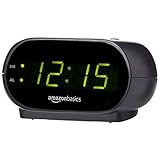
This is the clock you buy for a guest room, a dorm, or your second nightstand. It does three things without asking for anything in return: shows the time on an LED display, offers a nightlight for navigating to the bathroom, and keeps the alarm functional during power outages via battery backup. The oval shell is compact enough to fit on narrow shelves.
- Pro: Battery backup means you are never stranded after a power cut.
- Pro: Built-in nightlight adds utility without a separate device.
- Con: The 4.5-by-3.5-inch footprint limits how large the digits can be, making it harder to read from across a room.
Skip it if your nightstand sits more than a few feet from your pillow and you need to check the time without reaching for it.
Odokee Digital Alarm Clock
The Odokee earns its name by putting large, high-contrast digits front and center. Owners consistently highlight how easily they read the time from bed without sitting up, which is the single most practical feature in this category. It also includes a snooze function and adjustable brightness, keeping it versatile for shared bedrooms where one person dislikes ambient glow.
- Pro: Digit size and contrast make it readable from across the room without straining.
- Pro: Brightness control lets you dial the display down for dark rooms.
- Con: At this price, the plastic housing can feel lightweight and less durable than wooden or metal alternatives.
Skip it if you want smart features, audio content, or projection. This is a display-first device and nothing more.
Hatch Restore 3
The Restore 3 is less a clock and more a sleep and wake routine system wrapped in a minimalist shell. Circadian lighting shifts color temperature through the evening to support melatonin, and the science-backed audio library guides you from bedtime through a gentle sunrise simulation. The Putty finish looks at home on a modern nightstand without screaming “gadgets.”
- Pro: Circadian light and audio replace a separate sunrise lamp, white noise machine, and bedtime app.
- Pro: The build and finish justify the price tag for people who value bedroom aesthetics.
- Con: Requires a phone and app for initial setup and most customization, adding a layer between you and the clock.
Skip it if you want a set-and-forget alarm. This device demands a learning curve and a monthly app commitment to unlock its full value.
Netzu Digital Alarm Clock, Loud Alarm
Designed explicitly for heavy sleepers, kids, teens, and seniors, this Netzu model stacks dual alarms, five volume levels, and bold digits into an 11.99-dollar package. The dual-alarm feature is genuinely useful for households where one person needs a wake signal and another needs a nudge thirty minutes later. Five dimmer levels give you granular control over nighttime brightness.
- Pro: Dual alarms and multiple volume levels provide redundancy that single-alarm clocks cannot match.
- Pro: The plug-in design avoids battery anxiety while keeping setup simple.
- Con: The function-dense control layout can feel overwhelming at first, and the marketing language suggests a utilitarian design that will not impress on a curated nightstand.
Skip it if you only need one alarm and a minimal interface.
Mesqool Digital Projection Alarm Clock
The projection feature lets you toss the time onto a wall or ceiling without turning over or sitting up. For people who share a bed and do not want to disturb their partner with a display glow, this solves a real problem. Five dimmer levels on the main display and dual alarms round out a practical package.
- Pro: Projection mode lets you check the time from bed without any display light on your face.
- Pro: Five dimmer levels give fine-grained control over brightness in a shared room.
- Con: The projection angle requires some positioning trial to land cleanly on your chosen surface, and the extra lens mechanism is one more point of failure over time.
Skip it if you have limited wall or ceiling space near the bed, or if you dislike anything more complex than a flat-front clock.
Netzu 3-in-1 Digital Clock
This compact unit works as an alarm clock, a temperature display, and a date readout in a small footprint suited for a living room shelf, kitchen counter, or bedside table. The “3-in-1” framing is honest: it covers the basics without pretension. Its small size means it does not dominate a surface visually.
- Pro: Temperature and date displays add ambient utility beyond the alarm function.
- Pro: The compact form factor fits tight spaces where bulkier clocks cannot.
- Con: Being small means the digits are proportionally limited, so readability drops quickly once you move past arm’s-length distance.
Skip it if your primary use case is checking the time from across the room. Its strengths are in secondary placement.
Sharp Digital Alarm Clock
Sharp’s design leans into physical keyboard-style controls and a large snooze button, a layout that owners with arthritis or limited dexterity appreciate. The red LED display gives a classic bedside glow that some people find less disruptive than white or blue light. It is simple, plug-in, and does not need batteries for daily use.
- Pro: Tactile keyboard controls and an oversized snooze button reduce fumbling in the dark.
- Pro: Red LED glow is easier on the eyes during nighttime checks than bright white digits.
- Con: The overall aesthetic reads as dated, and if your display preference leans toward blue or white, the red tone cannot be changed.
Skip it if you want a modern-looking bedroom or need the display to match a specific color scheme.
DreamSky Wooden Digital Alarm Clock
For people who find plastic nightstand devices visually jarring, this wooden shell with large digits bridges the gap between décor and function. The wood-grain casing warms up a bedside setup that would otherwise look like an electronics counter. Large numbers keep it practical, and the design includes multiple brightness settings for dark rooms.
- Pro: Wooden housing looks intentional on a nightstand rather than disposable.
- Pro: Large digits maintain readability despite the compact overall size.
- Con: At 19.99 dollars, it sits in the same price tier as plastic options that include extra features like projection or dual alarms, making it a value question depending on your priorities.
Skip it if you want maximum feature density per dollar and can tolerate a plastic housing.
Buying Guide
Display Readability and Light Management
The most common bedroom-clock complaint in owner reviews is not that the alarm failed, but that the digits were impossible to read without sitting up, or that the display was too bright to sleep beside. Prioritize clocks with explicitly large digits and at least three dimmer levels. If your bed faces a wall, a projection model eliminates the need to turn toward a display entirely. Blue-white light suppresses melatonin more than warm amber or red tones, so if light sensitivity matters to you, lean toward clocks offering warm display options or a full-off setting for the screen while the alarm still functions.
Alarm Redundancy and Volume
A single alarm that misses once is enough to ruin a morning. Dual-alarm models give you a primary and a backup on separate schedules, which is useful for staggered wake-ups in shared households or for anyone who has overslept before. Check how many volume levels a clock offers, because a single “loud” setting may still be insufficient for a deep sleeper. Volume controls are more meaningful than alarm-tone variety; a harsh, adjustable tone beats a pleasant one you cannot hear.
Power Source and Setup Friction
Plug-in clocks keep time without you thinking about them, but a power outage resets everything unless battery backup is included. Battery-operated clocks are immune to outages but demand periodic replacement. Smart clocks add Bluetooth or Wi-Fi dependency, meaning setup involves a phone, an app, and sometimes an account. For 2026, the practical question is whether you value the sleep-routine features enough to accept that friction. If you want zero maintenance, choose a plug-in unit with battery backup and no app requirement.
Our Verdict
Our top pick is the Odokee Digital Alarm Clock. It nails the core bedroom-clock job, large readable digits with brightness control, at a mid-range price without forcing apps or batteries into the equation. The budget pick is the Amazon Basics Small Digital Oval, which covers the essentials including power-outage insurance for under ten dollars. If you are a deep sleeper who has overslept more than once this month, the Netzu Loud Alarm Clock wins instead: its dual alarms and multiple volume settings give you the redundancy that simpler clocks lack.
FAQ
Should a bedroom clock have a dimmer?
Yes, if your partner or your own sleep quality is sensitive to light. A dimmer lets you read the clock without flooding the room. If a clock only offers full brightness or off, you lose the ability to check the time at night without a compromise.
Is a projection clock worth it?
It is worth considering if you share a bed and want to avoid any display light near your face. Projection lets you keep the clock’s own screen dimmed or off while still reading the time on a wall or ceiling.
Do smart clocks like the Hatch Replace a traditional alarm?
They do, but with tradeoffs. You gain audio routines and light cycles at the cost of app dependency and a significantly higher price. If all you need is a reliable alarm with readable digits, a traditional clock is simpler and cheaper.
Are wooden clocks actually better?
The housing material does not change accuracy or alarm function. Wooden cases offer a warmer look and sometimes slightly better acoustic properties for the alarm tone. Buy one for aesthetics; buy plastic for features-per-dollar.