
Our Short List of 3

- Best for: Fences and small layout jobs.
- Aluminum alloy body with anodized finish
- Thickened triangular plastic hooks at both ends
- Laser-etched scale
- UV-coated bubble tube

- Best for: A spare set for the whole crew.
- Acrylic body
- Red color
- 75 by 12.5 mm (3 by 0.49 in)
- 5-pack
- Best for: A single reliable level in the toolbox.
- 3-inch length
- Aluminum construction
- Open hooks that slide onto the line
- Easy-to-read vials
All 5 Picks at a Glance
| Product | Specs | Action |
|---|---|---|
| BETHEL L-16A 3-Pack Bubble Line Level |
| Check price on Amazon |
| LAIESYA L109 5-Pack Hanging Line Level |
| Check price on Amazon |
| IRWIN 1794484 Aluminum Line Level |
| Check price on Amazon |
 Stanley 42-287 Aluminum Line Level 3-Pack |
| Check price on Amazon |
 SCCUP Mason Line String Kit with Magnetic Post Level |
| Check price on Amazon |
Key takeaways
- Compare the best line levels for string layout, from aluminum Stanley and IRWIN hanging levels to Johnson levels and packs for fences and foundations.
What's inside
As an Amazon Associate I earn from qualifying purchases. This post may contain affiliate links at no extra cost to you.
A line level is a bubble vial with a hook at each end, and it solves a problem no spirit level can touch: checking whether two far-apart points sit at the same height. You hang it near the middle of a string, read the bubble, and you know whether a fence run, a row of deck footings, or a drainage fall is true. The tool weighs almost nothing and lives in a pocket, yet a bad one reads crooked and wastes an afternoon of layout work.
We compared the loose hanging levels and mason line kits below against late-November 2026 tracker offers and fresh roundup listings, and we kept only listings with a live Amazon offer or a current roundup pick behind them. Confirm availability before ordering, since stock on these small tools turns over fast. The five picks run from single aluminum levels to a full kit with string, blocks, and a post level, so match the pick to the job, not to the brand name alone.
Sections
Quick Picks
As an Amazon Associate we earn from qualifying purchases
| Product | Best for | Key spec |
|---|---|---|
| BETHEL L-16A 3-Pack | Fences and small layout jobs | Aluminum body, laser-etched scale |
| LAIESYA L109 5-Pack | A spare set for the whole crew | Acrylic body, 75 by 12.5 mm |
| IRWIN 1794484 | A single reliable level in the toolbox | Aluminum body, 3-inch length |
| Stanley 42-287 3-Pack | Replacing worn levels | Aluminum body, 3-3/32-inch length |
| SCCUP Mason Line Kit | A full layout set for posts and brickwork | 6 hanging levels, 2 rolls of 540-foot line |
How to Choose
Body material and weight
Aluminum bodies stay flatter on the line than light plastic, and they survive drops better than thin acrylic. A bent level reads crooked even when the string is true. Weight cuts the other way: a heavy level drags the string down in the middle, so the bubble reads low on long spans. The best compromise is a light aluminum frame, which is why three of the five picks below use aluminum. Plastic and acrylic sets win on quantity and cost, and they suit a crew that needs a level on every line at once. Hang the level near the middle of the span, where sag is largest, so the reading reflects the worst of the droop.
Hooks and how they grip the line
Open hooks slide onto a taut string and let you move the level along the line, which is why most masons and fence builders prefer them. The trade is that an open hook can slip off when the string moves in wind. Closed or triangular hooks grip harder and stay put, but they take longer to seat and can pinch a soft cord. Either design works if the hooks fit the line you plan to use, so match the hook to the cord: thin braided mason line suits a snug hook, while a thicker twisted line needs a wider opening. Before trusting a reading, tug the string and watch the bubble settle in the same place.
Vial readability
The vial is the whole instrument. A clear tube with dark marks is easy to read in bright sun, while a pale vial washes out and forces you to shade it with a hand. Some listings call the vial shatterproof or give it a UV coating that slows aging in outdoor use, and both claims are worth having on a tool that lives in a toolbox. A single vial is all a line level needs, since it reads only one direction. If the bubble drifts while you watch, the string is moving in wind or the line is stretching, so wait for calm air or shorten the span before you trust the reading.
Pack size or a full kit
A single level suits one person pulling one line, and it is the cheapest way to replace a worn tool. A three-pack or five-pack suits a small crew running several lines at once, since nobody has to wait or swap one level between strings, and a spare lets you cross-check one level against another on the same string. A kit adds the string itself, a reel, line blocks, and sometimes a post level, which suits someone setting up a job from scratch. Buy the kit only if you need the string and the extras; if you already own mason line, loose levels give you more levels for the same money.
The 5 Best Options
BETHEL L-16A 3-Pack Bubble Line Level
- Best for: Fences and small layout jobs.
- Aluminum alloy body with anodized finish
- Thickened triangular plastic hooks at both ends
- Laser-etched scale
- UV-coated bubble tube
Fences and small layout jobs.
The listing gives no length, so check the size before ordering.
BETHEL sells the L-16A as a three-pack of aluminum alloy levels with an anodized finish, and the pack is the best value here for anyone who wants spares. Thickened triangular plastic hooks at both ends grip the string and resist cracking, while a laser-etched scale and a UV-coated bubble tube keep the vial readable after a summer outdoors. The listing gives a weight of 0.05 kilograms but no length, so measure the vial against your string before the first job. Three levels also let you compare readings across one line and spot a bad vial fast.
LAIESYA L109 5-Pack Hanging Line Level
- Best for: A spare set for the whole crew.
- Acrylic body
- Red color
- 75 by 12.5 mm (3 by 0.49 in)
- 5-pack
A spare set for the whole crew.
The listing gives no detail on hook design or vial marks.
LAIESYA packs five red acrylic levels in one set, and the count is the point: a crew can hang one on every line. Each level measures 75 by 12.5 millimeters, about 3 by 0.49 inches, and the bright red body is easy to spot on a string across a yard. The listing is short and says nothing about hook design or vial marks, so this set suits simple layout work rather than jobs where the reading must be exact. Acrylic is lighter than aluminum, which helps on long spans, but it will not survive a hard knock the way a metal body does.
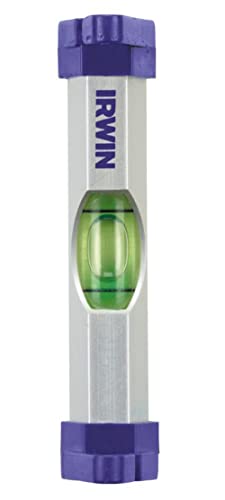
IRWIN 1794484 Aluminum Line Level
- Best for: A single reliable level in the toolbox.
- 3-inch length
- Aluminum construction
- Open hooks that slide onto the line
- Easy-to-read vials
A single reliable level in the toolbox.
One piece only; the listing gives two different sizes in different fields, so confirm the length.
The IRWIN 1794484 is the single aluminum line level, a 3-inch tool with open hooks that slide onto the line and vials the maker calls easy to read. It is the one to buy when you want a single reliable level in the toolbox rather than a pack of spares. The open hooks make it fast to hang and move along a fence run or a brick course. Note the model number carefully: the 1794484 is a hanging line level, a different tool from the IRWIN post levels that strap to a post. One piece only, so buy a second if a helper will pull a line with you.
Stanley 42-287 Aluminum Line Level 3-Pack
- Best for: Replacing worn levels.
- Part number 42-287
- 3-3/32-inch length
- Aluminum body
- 1 vial
Replacing worn levels.
Two different sizes are listed; the pick rests on roundup listings, so confirm availability before ordering.
Stanley sells the 42-287 as a three-pack of aluminum line levels under part number 42-287, and the maker describes it as a replacement catseye level. The title gives a length of 3-3/32 inches, while a bullet lists about 3.50 by 3.30 by 0.80 inches, which may be the packed size rather than the level itself, so measure the vial on arrival. Three pieces from a known brand make this the natural pick for replacing worn levels across a crew. The listing rests on fresh roundup picks rather than a live tracker offer, so confirm availability before ordering.
SCCUP Mason Line String Kit with Magnetic Post Level
- Best for: A full layout set for posts, patios, and brickwork.
- 6 hanging line levels
- Post and pipe level with rubber strap
- 2 beech wood line blocks
- 2 rolls of 540-foot #18 braided nylon line
A full layout set for posts, patios, and brickwork.
The listing gives mixed line-length figures in different fields, so confirm the amount of line on arrival.
The SCCUP kit is the full layout set in this guide, and it suits anyone setting up a project from scratch. Inside the box are six hanging line levels, a post and pipe level on a rubber strap, two beech wood line blocks, two rolls of 540-foot #18 braided nylon line, and a reloadable reel. The line carries 168-pound tensile strength and comes in a dual color for visibility across a yard. The post level straps to metal and non-metal posts alike, which makes it handy for setting posts to plumb as well as to level. Buy this kit for the whole setup, not for the levels alone.
Which One Fits Your Situation
Setting fence posts and deck footings
Pull a string between batter boards, hang a level near the middle, and read the bubble to set every post top to the same height. The IRWIN single or the BETHEL three-pack suits this work, since aluminum bodies stay flat and open hooks slide along the line. Add the SCCUP kit if the job also needs posts checked for plumb, since its strapped post level does that job without a second tool.
Laying brick courses
Brick courses need a level on the line for every row, and a pack of levels keeps the work moving. The LAIESYA five-pack gives every mason a level, while the SCCUP kit adds the line and blocks a bricklayer needs. Keep the string tight, since a slack line sags and the bubble reads low even when the course is true.
Setting up a layout job from scratch
If you own no mason line, no reel, and no blocks, the SCCUP kit is the honest buy: six levels, two rolls of line, blocks, a reel, and a post level in one box. Loose levels are cheaper only when the string and the extras are already in your toolbox, so count what you own before choosing.
Replacing worn levels for a crew
Worn vials read crooked, and a crew that shares one level wastes time waiting. The Stanley three-pack replaces tired levels with a known brand, and the BETHEL three-pack does the same at a lower outlay. Buy a pack, hang each level on one string, and set aside any piece whose bubble disagrees with the rest.
Common Mistakes
- Reading a loose, sagging string instead of pulling it taut first.
- Hanging the level off-center, where sag is smallest, instead of near the middle of the span.
- Trusting a size from a listing that gives two different figures.
- Expecting a line level to replace a longer spirit level on short runs or fine indoor work.
- Leaving the string in sun and wind, where it stretches and the reading drifts.
Frequently Asked Questions
How does a line level work?
A line level is a short bubble vial with a hook at each end. You hang it on a taut string stretched between two points, and the bubble sits between two marks when the string runs level. It compares two far-apart points, which is why it suits fence runs, deck footings, and drainage falls that a long spirit level cannot span.
Where should I hang the level on the string?
Hang it near the middle of the span, where sag is largest. A string always droops a little between its anchors, and the middle is where the droop shows most. Pull the string tight first, then read the bubble straight on, with your eye level with the vial, since viewing from above or below shifts the bubble against the marks.
Can a line level replace a spirit level?
No. A line level tells you whether two points are at the same height along a string, but it is not a precision instrument. For fitting cabinets, tiling a floor, or any fine indoor work, use a proper spirit level on a straight edge or a laser. A line level shines outdoors, where long distances meet uneven ground.
How do I check whether a new level reads true?
Stretch a string tight between two fixed points, hang the level near the middle, and note where the bubble sits. Lift it off, turn it end for end, and hang it back in the same spot. If the bubble sits in the same place relative to the marks, the vial reads honestly. If it shifts, split the difference or retire that piece.
Related guides
More from Amazon
Programs that pair well with the guide above. Offers and eligibility are set by Amazon and may change.
A free business account with business pricing and bulk-buying tools for work, shop or home office.
Create a business accountFree shipping on eligible items, Prime Video and more. Eligible new members can start with a free trial.
Start a Prime free trialAudiobooks and podcasts to listen to on the go. Eligible new members can start with a free trial.
Try Audible freeAd-free music streaming. Eligible new subscribers can start with a free trial.
Try Music Unlimited freeAs an Amazon Associate we earn from qualifying purchases.


Write Your Review
No reviews yet. Be the first to share your experience!