
Our Short List of 3

- Best for: Everyday trim, molding, and coped joints.
- Blade material: high-speed steel
- Blade length: 6-1/2 inches
- Tooth count: 17 TPI
- Frame depth: 5-1/2 inches

- Best for: Home workshops and first-time coping saw buyers.
- Blade length: 6-3/8 inches
- Tooth count: 15 TPI
- Blade material: hardened carbon steel
- Frame: steel frame
- Best for: Wide boards, mixed materials, and tool-free blade changes.
- Frame depth: 6.3 inches
- Blade length: 5.1 inches
- Included blades: 5 (general woodworking x2, wood board, plastic, light metal)
- Blade material: hardened and tempered steel
All 5 Picks at a Glance
| Product | Specs | Action |
|---|---|---|
| IRWIN Tools ProTouch Coping Saw (2014400) |
| Check price on Amazon |
| Stanley 15-106A Coping Saw |
| Check price on Amazon |
| KAKURI Coping Saw with 5 Replacement Blades |
| Check price on Amazon |
 TOOLCOOL Coping Saw with Hex Handle |
| Check price on Amazon |
 Big Horn 19365 Aluminum Frame Coping Saw |
| Check price on Amazon |
Key takeaways
- Compare five coping saws that cut tight curves and coped joints, with tensioned thin blades, rotating frames and grips that track smooth and true.
What's inside
As an Amazon Associate I earn from qualifying purchases. This post may contain affiliate links at no extra cost to you.
A coping saw earns its bench space when a curve gets tight, a corner needs scribing, or a molding joint must close without a gap. The thin blade, held taut in a deep frame, follows lines that a larger handsaw cannot reach, turning slow, careful work into clean, controlled cuts. The five saws below cover the full spread of the category, from a light everyday frame to a rigid alloy frame built for long sessions at the bench.
What sets these saws apart is not one feature but the balance of several: frame depth, blade choice, tension control, and grip comfort. A deep frame reaches farther into wide stock. A blade that rotates lets the cut follow the line instead of forcing the work to turn. A handle that tensions the blade with a simple twist keeps the cut true. Use the guide below to match those traits to the work you do most, and to the materials you cut week after week.
Sections
Quick Picks
As an Amazon Associate we earn from qualifying purchases
| Product | Best for | Key spec |
|---|---|---|
| IRWIN Tools ProTouch Coping Saw (2014400) | Everyday trim and molding | 17 TPI high-speed steel blade |
| Stanley 15-106A Coping Saw | First saw for home workshops | 6-3/8 inch blade that rotates 360 degrees |
| KAKURI Coping Saw with 5 Replacement Blades | Mixed materials and wide boards | 6.3 inch frame depth with 5 blades |
| TOOLCOOL Coping Saw with Hex Handle | Fine detail and scroll cuts | 15, 18 and 24 TPI blades included |
| Big Horn 19365 Aluminum Frame Coping Saw | Long sessions and firm control | CNC-machined aluminum alloy frame |
How to Choose
Frame Depth and Reach
Frame depth decides how far into a board the blade can travel before the frame meets the edge. A shallow frame suits small trim and thin stock, while a deep frame clears wide crown molding and broad panels. The saws here range from about 4-3/4 inches of cutting depth to more than 6 inches of frame depth, so measure the widest stock you cut often and pick a frame with room to spare. A frame that just barely reaches forces awkward angles and wandering cuts, while extra depth costs little and adds room for interior cutouts and curved work.
Blade Choice and Tooth Count
Tooth count shapes the cut. Fine teeth leave a smoother edge on veneer and thin trim, medium teeth balance speed and finish on general woodwork, and coarse teeth clear softwood fast. Sets that include several blades let one frame handle wood, plastic, and light metal without a separate purchase. Check that the blades use the standard pinned ends your frame accepts, and keep a spare set on hand, since a thin blade can snap at the worst moment. A dull blade wanders, so change it before the cut quality drops.
Tension and Blade Rotation
A coping saw only cuts true when the blade stays taut. Look for a tension system you can set with one hand: a twist handle, a cam lever, or a locking knob that holds its setting through a long cut. The blade should also rotate, ideally through a full circle, so the teeth can follow a curve without turning the workpiece. Frames that lock the blade at set angles help on repeated cuts, while free rotation suits scrollwork and tight turns. A loose blade flexes, chatters, and drifts off the line.
Handle Comfort and Frame Weight
The handle is where the saw meets the hand, and comfort matters more than it looks. A shaped wood handle warms to the grip and suits long sessions, while a molded grip with a soft touch layer resists slipping when hands get tired. Weight matters too: a light frame reduces fatigue overhead and on vertical cuts, while a heavier frame can feel steadier on the bench. Hold the saw the way you will use it, check that the handle turns freely for tensioning, and favor frames that balance without pulling the blade off line.
The 5 Best Options
IRWIN Tools ProTouch Coping Saw (2014400)
- Best for: Everyday trim, molding, and coped joints.
- Blade material: high-speed steel
- Blade length: 6-1/2 inches
- Tooth count: 17 TPI
- Frame depth: 5-1/2 inches
Everyday trim, molding, and coped joints.
Ships with a single blade, so keep spares on hand for metal or plastic work.
The ProTouch is the familiar workhorse of the group, built around a flat-bar steel frame that stays rigid under tension. Its high-speed steel blade cuts cleanly through trim and molding, and the triangular ProTouch grip fills the hand without hot spots during long runs of coping. DuraSteel pins hold the blade ends firmly, so the blade stays put when the cut turns tight. With a 5-1/2 inch frame depth and a 6-1/2 inch blade, it handles most interior trim profiles, and the limited lifetime warranty backs the frame for the long haul. It is the saw to reach for when the job is ordinary trim, done often.
Stanley 15-106A Coping Saw
- Best for: Home workshops and first-time coping saw buyers.
- Blade length: 6-3/8 inches
- Tooth count: 15 TPI
- Blade material: hardened carbon steel
- Frame: steel frame
Home workshops and first-time coping saw buyers.
The flat frame gives less reach into wide stock than deeper frames here.
The Stanley 15-106A is a straightforward steel-frame saw that suits a home workshop where a coping saw comes out for trim, small repairs, and craft work. The blade turns a full circle, so tight curves and inside corners stay manageable without repositioning the work. A cushion-grip handle softens long sessions, and the hardened carbon steel blade holds an edge through softwood and light trim. Four replacement blades ride along in the pack, which means a snapped blade is a quick swap instead of a trip to the store. It is a practical first coping saw, simple to set up and easy to keep.
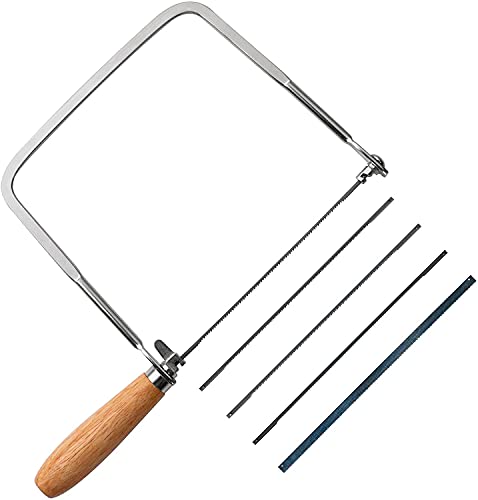
KAKURI Coping Saw with 5 Replacement Blades
- Best for: Wide boards, mixed materials, and tool-free blade changes.
- Frame depth: 6.3 inches
- Blade length: 5.1 inches
- Included blades: 5 (general woodworking x2, wood board, plastic, light metal)
- Blade material: hardened and tempered steel
Wide boards, mixed materials, and tool-free blade changes.
The 5.1 inch blade is shorter than the standard 6-1/2 inch blades on other saws here.
The KAKURI set stands out for depth and blade variety. Its 6.3 inch frame reaches farther into wide boards than any other saw here, and the five included blades cover general woodworking, board stock, plastic, and light metal, so one frame handles mixed jobs without extra purchases. Blade changes need no tools: rotate the handle, swap the blade, and carry on, even outdoors without a kit. The wooden handle fits the hand well, and the hardened, tempered blades hold their edge through long sessions. For wide trim and varied materials, this is the most flexible pick of the five.
TOOLCOOL Coping Saw with Hex Handle
- Best for: Fine detail, scrollwork, and curved cuts at varied angles.
- Frame: aluminum alloy and stainless steel
- Handle: hardwood hex handle
- Blade rotation: 360 degrees with bearing and locking lever
- Included blades: 15 TPI, 18 TPI, 24 TPI high-speed steel blades
Fine detail, scrollwork, and curved cuts at varied angles.
Two handle shapes exist for this model, so check the listing shows the hex handle.
The TOOLCOOL pairs an aluminum alloy frame with a hex-shaped hardwood handle that will not roll off the bench and gives a firm grip during fine work. Its blade turns a full circle and locks at any angle through a bearing and locking lever, which keeps the cut on line through scrollwork and tight curves. Three high-speed steel blades in 15, 18, and 24 TPI cover rough shaping through fine detail, and tension adjusts by turning the handle, with no tools needed. The rigid frame resists bending under load, so the blade tracks true even when the cut gets demanding.
Big Horn 19365 Aluminum Frame Coping Saw
- Best for: Long sessions, firm control, and demanding detail work.
- Frame: CNC-machined anodized aluminum alloy
- Handle: hex-shaped rosewood handle
- Blade rotation: 360 degrees, locks at any angle
- Tension: rosewood handle rotation with positive lock and open lever
Long sessions, firm control, and demanding detail work.
The premium frame costs more than the other saws here, so weigh it against how often you cope.
The Big Horn 19365 is the heavy-duty pick, built around a CNC-machined anodized aluminum alloy frame that stays rigid through long, demanding cuts. A rosewood handle tightens and loosens the blade by rotation, and a positive lock with an open lever holds the blade angle once set, so the cut stays where it belongs. The blade rotates a full circle and locks at any angle for tight profiles and inside curves. Three blades in 15, 18, and 24 TPI cover coarse, general, and fine work, and the hex-shaped rosewood handle resists rolling and balances well in the hand.
Which One Fits Your Situation
Trim and molding most days
Pick the IRWIN ProTouch. Its rigid flat-bar frame, DuraSteel pins, and comfortable grip suit repeated coped joints on baseboard and crown molding. The 17 TPI blade leaves a clean edge on trim, and the 5-1/2 inch frame depth clears common profiles. Keep spare blades nearby, since the pack holds one.
First coping saw for the home workshop
Pick the Stanley 15-106A. It is simple to set up, the blade rotates a full circle, and four spare blades come in the pack. The cushion grip stays comfortable through occasional jobs, and the steel frame handles trim, small repairs, and craft work without fuss. A snapped blade is a quick swap, not a ruined afternoon, which matters when the saw only comes out now and then.
Wide boards and mixed materials
Pick the KAKURI set. The 6.3 inch frame reaches farther into wide stock than the rest, and five blades cover wood, board, plastic, and light metal. Tool-free blade swaps by handle rotation keep the work moving, even away from the bench. The wooden handle stays comfortable through long cuts, and the deep frame clears wide molding that shallower saws cannot reach.
Fine scrollwork and long bench sessions
Pick the TOOLCOOL for locking blade angles and three tooth counts, or the Big Horn 19365 when a rigid alloy frame and a rosewood handle matter most. Both rotate a full circle and lock at any angle, which keeps tight curves on line through long cuts. The TOOLCOOL suits varied detail work, while the Big Horn rewards long sessions with a frame that never flexes under load.
Common Mistakes
- Forcing a dull blade through the cut instead of swapping it, which bends the blade and wanders off the line.
- Setting the blade slack, so it flexes, chatters, and leaves a ragged edge.
- Cutting with the teeth facing the wrong way, which fights the stroke and dulls the blade fast.
- Choosing a frame too shallow for the stock, then twisting the work to fit the saw instead of the saw to the work.
- Skipping blade rotation on curves, which binds the blade and snaps it mid-cut.
Frequently Asked Questions
What is a coping saw used for?
A coping saw cuts tight curves, inside corners, and scribed joints in trim and molding. Its thin blade, held taut in a deep frame, follows lines that larger handsaws cannot. It also handles curved cuts in thin wood, plastic, and light metal when fitted with the right blade.
How do I keep the blade from snapping?
Keep the blade taut, let the teeth do the work, and ease off on tight turns instead of forcing the frame. Rotate the blade to match the curve, and swap a dull blade before it bends. A blade that flexes under load is the one most likely to snap.
Can one coping saw cut wood, plastic, and metal?
Yes, with the right blade. Fine teeth suit thin wood and veneer, medium teeth handle general woodwork, and a hacksaw-style blade cuts light metal. Sets like the KAKURI, TOOLCOOL, and Big Horn include several blades, so one frame covers more materials.
How do I change a coping saw blade?
Release the tension, unhook the blade ends from the pins, and fit the new blade with its teeth pointing toward the handle. Re-tension until the blade rings slightly when plucked, then check that it sits square in the frame before the first cut.
Related guides
More from Amazon
Programs that pair well with the guide above. Offers and eligibility are set by Amazon and may change.
A free business account with business pricing and bulk-buying tools for work, shop or home office.
Create a business accountFree shipping on eligible items, Prime Video and more. Eligible new members can start with a free trial.
Start a Prime free trialAudiobooks and podcasts to listen to on the go. Eligible new members can start with a free trial.
Try Audible freeAd-free music streaming. Eligible new subscribers can start with a free trial.
Try Music Unlimited freeAs an Amazon Associate we earn from qualifying purchases.




Write Your Review
No reviews yet. Be the first to share your experience!