What's inside
- Quick answer: which corded circular saw should you buy?
- How we chose these saws
- Corded circular saw comparison table
- Best for all-day framing
- Best for heavy lumber and rough jobsites
- Best for DIY and light remodeling
- Worked example: how long a cord can your saw handle?
- Blade side and sight line: what it means in practice
- Shoe material and weight: magnesium vs aluminum
- Decision matrix: match the saw to your work
- Safety guidance for corded circular saws
- What to look for in a blade
- Frequently asked questions
- Final recommendation
As an Amazon Associate I earn from qualifying purchases. This post may contain affiliate links at no extra cost to you.
The DeWalt DWE575SB is the best corded circular saw for most remodeling work because it combines a 15-amp motor, an electric brake, a 57-degree bevel, and a weight under 9 lb. The Makita 5007MGA is the better choice for all-day framing with a left-side blade and a magnesium build, and the Skilsaw SPT77WML-01 is the pick when you want a worm drive for heavy lumber. The Skil 5280-01 covers occasional DIY cuts at the entry level.
Corded 7-1/4 inch circular saws look alike on a shelf, yet the right one changes how fast you frame a wall and how tired your shoulder is at 4 p.m. This guide compares the saws framers and remodelers actually weigh against each other: amp rating, blade side and sight line, shoe material and weight, bevel capacity, depth of cut, brake, and cord. It ends with a worked extension cord calculation and a decision matrix so you can match a saw to your work.
As an Amazon Associate we earn from qualifying purchases at no extra cost to you.




Sections
- Quick answer: which corded circular saw should you buy?
- How we chose these saws
- Corded circular saw comparison table
- Best for all-day framing
- Best for heavy lumber and rough jobsites
- Best for DIY and light remodeling
- Worked example: how long a cord can your saw handle?
- Blade side and sight line: what it means in practice
- Shoe material and weight: magnesium vs aluminum
- Decision matrix: match the saw to your work
- Safety guidance for corded circular saws
- What to look for in a blade
- Frequently asked questions
- Final recommendation
Our Top Picks
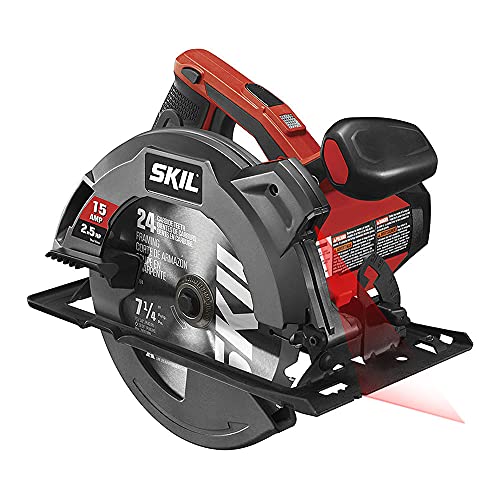 SKIL 15 Amp 7-1/4 Inch Circular Saw with7-1/4 Inch (Pack of 1)14.2 x 9.8 x 8.5 inches8.7 poundsCheck on Amazon


Quick answer: which corded circular saw should you buy?
- Best overall for remodeling: DeWalt DWE575SB, light, braked, and with a generous bevel range.
- Best for all-day framing: Makita 5007MGA, magnesium components and left-side blade for a clear line of sight for right-handed users.
- Best worm drive: Skilsaw SPT77WML-01, built for torque in wet or thick lumber.
- Best for rough jobsite abuse: Milwaukee 6390-21, a rugged 15-amp saw with a high-torque reputation.
- Best left-blade alternative: Bosch CS5, a 15-amp saw with a left blade and a high bevel range.
- Best value for DIY: Skil 5280-01, an entry-level 15-amp saw that fits occasional use.
- Best light-duty alternative: Metabo HPT C7SB3, a lighter 15-amp saw for straight cuts, with a smaller bevel range.
- Best for heavy ripping and beams: Makita 5477NB, a hypoid gear-drive saw with a heavy build.
How we chose these saws
This is a research-based guide. We compared manufacturer specification sheets and published specification summaries from major tool-review publications, then kept saws that are current catalog models. Where sources disagreed, we described the spec by class or noted that it varies by source. We did not include weights, shoe materials, or blade sides that we could not confirm; where a spec is not stated, the saw’s entry says so. The criteria are:
- Power class. A 15-amp motor is the working standard for framing. A 13-amp saw is acceptable for lighter remodeling and DIY cutting.
- Drive type. Sidewinders are lighter and faster. Worm drive and hypoid saws are heavier, longer, and deliver more torque for thick or wet lumber.
- Blade side and sight line. A left-side blade sits on the left of the motor, so right-handed users can see the cut line on the shorter side of the lumber. A right-side blade changes the angle you view the cut from.
- Weight and shoe material. Magnesium shoes cut weight and resist bending. Aluminum or stamped steel is cheaper but heavier or less rigid.
- Bevel and depth. A 50-plus degree bevel covers hip and valley framing. Depth at 90 degrees should reach 2-1/2 inches to cut through a doubled 2x without flipping the board.
- Cord and brake. An electric brake stops the blade quickly. Cord length and flexibility determine how often you need an extension.
Corded circular saw comparison table
| Saw | Drive | Amps | Weight (published) | Bevel | Max depth at 90 degrees | Electric brake |
|---|---|---|---|---|---|---|
| DeWalt DWE575SB | Sidewinder | 15 | 8.8 lb | 0-57 degrees | 2-1/2 in | Yes |
| Makita 5007MGA | Sidewinder | 15 | 10.6 lb | 0-56 degrees | 2-1/2 in | No |
| Skilsaw SPT77WML-01 | Worm drive | 15 | About 11.3 lb | 0-51 degrees | 2-1/2 in | No |
| Milwaukee 6390-21 | Sidewinder | 15 | 10.4 lb | Up to 50 degrees | 2-3/8 in | No |
| Bosch CS5 | Sidewinder (left blade) | 15 | 10.2 lb | 0-56 degrees | 2-1/2 in | No |
| Skil 5280-01 | Sidewinder | 15 | Varies by source (about 7 to 12 lb) | 0-51 degrees | 2-1/2 in | No |
| Metabo HPT C7SB3 | Sidewinder | 15 | 9.5 lb | 0-45 degrees | 2-1/2 in | No |
| Makita 5477NB | Hypoid gear drive | 15 | 14.3 lb | Up to 51.5 degrees | 2-3/8 in | No |
All eight saws use a 7-1/4 inch blade. Weights are published figures and can vary slightly with the cord and included accessories.
Best for all-day framing
Framers make hundreds of cuts per day, and every extra pound adds up. The best framing saws balance light weight, a clear line of sight, and a shoe that does not bend when you drop it. A magnesium shoe and a high bevel range are the standouts here.
Makita 5007MGA
Spec line: 15 A sidewinder · 7-1/4 in blade · 10.6 lb · 0-56 degree bevel · 2-1/2 in depth at 90 degrees · magnesium components · no electric brake
Best for: Framers and carpenters who cut all day and want a durable, well-balanced saw with a left-side blade sight line.
Skip if: You want an electric brake or you cut overhead frequently, where every pound matters.
- Pros: Magnesium shoe and housing resist impact, strong bevel range, a long-standing jobsite favorite.
- Cons: Heavier than the DeWalt DWE575SB, and no electric brake means the blade spins down more slowly.
DeWalt DWE575SB
Spec line: 15 A sidewinder · 7-1/4 in blade · 8.8 lb · 0-57 degree bevel · 2-1/2 in depth at 90 degrees · electric brake
Best for: Remodelers and carpenters who want light weight and a high bevel capacity without giving up power.
Skip if: You need a heavy-duty worm drive for wet or thick lumber.
- Pros: The lightest 15-amp saw in this guide among the framing-capable models, 57-degree bevel, electric brake for faster stopping.
- Cons: A lighter saw can feel less planted when pushing through very dense lumber, and the base DWE575 model without the SB suffix lacks the brake and some features.
Bosch CS5
Spec line: 15 A sidewinder · left-side blade · 7-1/4 in blade · 10.2 lb · 0-56 degree bevel · 2-1/2 in depth at 90 degrees · no electric brake
Best for: Right-handed users who want a left-blade sight line and a high bevel range in a mid-weight saw.
Skip if: You prefer a lighter saw or one with an electric brake.
- Pros: Left-blade view of the line, strong bevel, capable of full-depth framing cuts.
- Cons: Heavier than the DeWalt, no brake, and less common on jobsites so accessories and parts are harder to find in some areas.
Best for heavy lumber and rough jobsites
When you cut thick beams, wet pressure-treated lumber, or structural members, gearing matters more than weight. Worm drive and hypoid saws sit longer and heavier, with the motor behind the blade, which gives more torque and a good view of the line for right-handed users.
Skilsaw SPT77WML-01
Spec line: 15 A worm drive · left-side blade · 7-1/4 in blade · about 11.3 lb · 0-51 degree bevel · 2-1/2 in depth at 90 degrees · magnesium housing · no electric brake
Best for: Framers who cut thick, wet, or pressure-treated lumber and want the torque and sight line of a worm drive.
Skip if: You need a lighter saw for overhead or one-handed use, or you cut a lot of sheet goods where a sidewinder is quicker.
- Pros: High torque, long-standing jobsite reputation, strong straight-line tracking.
- Cons: Longer and heavier than a sidewinder, narrower bevel range than the best sidewinders, and the worm drive gear case needs periodic oil per the manual.
Milwaukee 6390-21
Spec line: 15 A sidewinder · 7-1/4 in blade · 10.4 lb · bevel up to 50 degrees · 2-3/8 in depth at 90 degrees · no electric brake
Best for: Rough jobsite work where durability and motor torque matter more than weight or a high bevel.
Skip if: You need to cut a full 2-1/2 inch depth at 90 degrees in one pass, or you want a lighter saw.
- Pros: Rugged build, high no-load speed for a framing saw, popular on production jobsites.
- Cons: Slightly shallower depth of cut than most competitors and no electric brake.
Makita 5477NB
Spec line: 15 A hypoid gear drive · 7-1/4 in blade · 14.3 lb · bevel up to 51.5 degrees · 2-3/8 in depth at 90 degrees · no electric brake
Best for: Production framers who rip long boards and value a hypoid gear drive over weight.
Skip if: You make a lot of overhead cuts or work for long stretches without a rest.
- Pros: Gearing built for sustained cutting, good torque for thick stock.
- Cons: The heaviest saw here at 14.3 lb, which adds fatigue across a full day.
Best for DIY and light remodeling
Occasional users do not need a production saw. They need a saw that is light enough to handle, has a high enough bevel to cut common angles, and has enough power for 2x lumber and plywood.
Skil 5280-01
Spec line: 15 A sidewinder · 7-1/4 in blade · weight varies by source (about 7 to 12 lb) · 0-51 degree bevel · 2-1/2 in depth at 90 degrees · no electric brake · laser guide on many configurations
Best for: Homeowners cutting plywood, decking, and 2x lumber a few times a year.
Skip if: You frame regularly or want a saw that survives daily drops.
- Pros: Entry-level cost tier, 15-amp motor, bevel range suitable for most DIY cuts.
- Cons: Not built for daily jobsite abuse, no brake, and published weight and RPM figures vary by source, so confirm on the model you buy.
Metabo HPT C7SB3
Spec line: 15 A sidewinder · 7-1/4 in blade · 9.5 lb · 0-45 degree bevel · 2-1/2 in depth at 90 degrees · no electric brake
Best for: Light remodeling where straight cuts are the main task and bevel needs stay at 45 degrees or below.
Skip if: You cut hips, valleys, or steep bevels.
- Pros: Lighter than most 15-amp saws, easy to handle.
- Cons: A 45-degree bevel limit rules out steeper cuts, and it is a lighter-duty saw.
Worked example: how long a cord can your saw handle?
A corded saw is only as strong as the power that reaches it. Long, thin extension cords cause voltage drop, which makes the motor run hot and slows the blade under load. Here is the calculation you can repeat for any cord run.
- Start with the current. A 15-amp saw can pull close to 15 A under load, for example when starting a cut in wet lumber.
- Use cord resistance. Typical copper resistance is about 2.5 ohms per 1,000 feet for 14 AWG and about 1.6 ohms per 1,000 feet for 12 AWG.
- Count the round trip. Current travels out and back, so a 50 ft cord is 100 ft of wire, and a 100 ft cord is 200 ft of wire.
- Calculate voltage drop. Voltage drop equals current times resistance.
| Cord | Wire length (round trip) | Resistance | Drop at 15 A | Percent of 120 V |
|---|---|---|---|---|
| 50 ft, 14 AWG | 100 ft | About 0.25 ohm | About 3.8 V | About 3.2 percent |
| 50 ft, 12 AWG | 100 ft | About 0.16 ohm | About 2.4 V | About 2.0 percent |
| 100 ft, 14 AWG | 200 ft | About 0.50 ohm | About 7.6 V | About 6.3 percent |
| 100 ft, 12 AWG | 200 ft | About 0.32 ohm | About 4.8 V | About 4.0 percent |
Reading the result: A common rule of thumb is to keep voltage drop under about 3 percent on a motor load. A 50 ft 12 AWG cord meets that. A 100 ft 14 AWG cord, at more than 6 percent, will make a framing saw labor in dense lumber. For runs of 50 ft or more, use 12 AWG. For a 100 ft run, use 12 AWG and avoid daisy-chaining cords. Also check that the circuit itself is not shared with other heavy loads: a 15-amp breaker can trip when a 15-amp saw and a shop vacuum run together.
Blade side and sight line: what it means in practice
On a left-blade saw, the blade sits on the left side of the motor. A right-handed user holding the saw sees the blade and cut line more directly, with the shoe resting on the wider piece of lumber. On a right-blade saw, the motor sits to the left of the blade, so the cut line is often partly hidden behind the guard.
This is not a rule that one is better. It is a matter of which hand you use and which side of the board you tend to keep. Left-handed users often prefer a right-blade saw for the same reason. Before you buy, hold the saw, imagine the board on the left and right of the blade, and decide which side you will normally save.
Shoe material and weight: magnesium vs aluminum
The shoe, or base plate, is the flat metal plate that rides on the lumber. Magnesium shoes are lighter than aluminum and stiffer than stamped steel. They cut weight and resist bending when dropped, which is why they appear on higher-tier saws like the Makita 5007MGA and the Skilsaw SPT77WML-01. Aluminum shoes are common on mid-range saws and are durable enough for most work, though they can bend if dropped on a hard surface. Stamped steel shoes are the cheapest and can bend out of square, which causes cutting errors.
Weight differences of one to two pounds matter over a day. If you hold the saw above shoulder height or make hundreds of cuts, choose the lighter saw. If you spend most of your time cutting at waist height on a bench or sawhorses, a heavier saw can feel steadier and cut straighter.
Decision matrix: match the saw to your work
| Your work | Priority | Good choices |
|---|---|---|
| Full-time framing | Durability, magnesium shoe, bevel | Makita 5007MGA, Skilsaw SPT77WML-01 |
| Remodeling and trim carpentry | Light weight, brake, bevel | DeWalt DWE575SB, Bosch CS5 |
| Pressure-treated and wet lumber | Torque, worm or hypoid gearing | Skilsaw SPT77WML-01, Makita 5477NB |
| Rough jobsite abuse | Rugged build | Milwaukee 6390-21, Makita 5007MGA |
| Weekend DIY projects | Cost, simple operation | Skil 5280-01, Metabo HPT C7SB3 |
| Overhead or one-handed cuts | Lowest weight | DeWalt DWE575SB |
Safety guidance for corded circular saws
- Unplug before changing blades. Disconnect the cord from the outlet, then lock the blade and use the wrench supplied with the saw.
- Set the depth correctly. Adjust the blade so it extends about 1/4 inch below the board. Too deep a setting raises kickback risk and exposes more blade below the workpiece.
- Support and clamp the workpiece. Do not cut a board held only by your hand or leg. Support both sides of the cut so the board does not pinch the blade.
- Keep the guard working. The lower blade guard should snap closed freely. Never tape or pin it open.
- Start the blade before it touches wood. Let the saw reach full speed, then feed it steadily without forcing.
- Stand to the side of the cutting line so you are not behind the saw if kickback happens, and hold the saw with both hands.
- Wear eye and hearing protection, and a dust mask when cutting treated lumber or manufactured boards.
- Use a grounded outlet and a heavy-gauge cord in good condition. Do not use a damaged cord or cut off the ground pin. On damp job sites, use a GFCI-protected circuit.
- Let the blade stop before setting the saw down. A saw with an electric brake stops sooner, but you should still wait for it to stop fully.
What to look for in a blade
The saw is only half of the cut. For framing, a 24-tooth blade removes material quickly and is the norm for rough lumber. For plywood and finish work, a blade with 40 or more teeth gives cleaner edges. A thin-kerf blade needs less power and suits a lighter saw. If you cut pressure-treated or wet lumber, a blade with carbide teeth and an anti-stick coating helps reduce pitch build-up. Match the blade diameter to the saw, which for all eight saws here is 7-1/4 inches, and match the arbor size to the manual.
Frequently asked questions
What is the best corded circular saw for framing?
The Makita 5007MGA and Skilsaw SPT77WML-01 are the common framing choices. The Makita is a light, durable sidewinder, and the Skilsaw is a worm drive for heavier lumber.
Is a worm drive better than a sidewinder?
A worm drive has more torque and a longer body, which suits thick or wet lumber. A sidewinder is lighter and faster, which suits remodeling, sheet goods, and overhead work.
How many amps does a circular saw need?
For framing and regular remodeling, choose a 15-amp saw. A 13-amp saw can handle lighter cuts and occasional work, but it will slow down more in thick lumber.
What is the difference between blade-left and blade-right saws?
The blade sits on the left or right side of the motor. For a right-handed user, a left-blade saw usually gives a clearer view of the cut line, while a right-blade saw can hide the line behind the guard.
Why does shoe material matter?
Magnesium shoes are lighter and stiffer than stamped steel, so they resist bending and cut weight. Aluminum is a durable middle ground. Stamped steel is the cheapest and can bend out of square.
How long can my extension cord be for a 15-amp saw?
Use a 12-gauge cord for runs over 50 feet. At 15 amps, a 50-foot 12 AWG cord loses about 2 percent of voltage, while a 100-foot 14 AWG cord loses more than 6 percent.
Do I need an electric brake on a circular saw?
It is not required, but it stops the blade within a few seconds after you release the trigger, which reduces the chance of contact and lets you move to the next cut sooner. The DeWalt DWE575SB includes one.
What bevel capacity do I need?
A 45-degree bevel covers most cuts. If you frame hips, valleys, or cut steep angles, choose a saw with a bevel of 50 degrees or more, such as the DeWalt DWE575SB or Makita 5007MGA.
Final recommendation
For a single corded circular saw that handles remodeling, light framing, and general carpentry, the DeWalt DWE575SB is the most balanced choice because of its low weight, brake, and bevel range. For full-time framing, step up to the Makita 5007MGA or, if you cut thick or wet lumber, the Skilsaw SPT77WML-01. Choose the Skil 5280-01 only for occasional DIY use. Whichever saw you pick, buy a 12-gauge extension cord if you need to work far from an outlet, set the blade depth to just clear the board, and keep both hands on the saw.