What's inside
As an Amazon Associate I earn from qualifying purchases. This post may contain affiliate links at no extra cost to you.
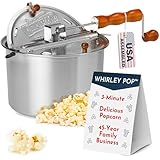
The best stovetop popcorn popper for most households is a 3-quart aluminum or stainless-steel crank popper with a built-in stirring mechanism, a vented lid, and a flat base sized for your burner.
That format gives you more control than a saucepan, while avoiding the bulk and electrical dependence of an air popper. The right choice depends mainly on batch size, how often you make popcorn, your cooktop, and whether easy cleaning matters more than maximum capacity.
As an Amazon Associate we earn from qualifying purchases at no extra cost to you.



Sections
Quick picks by cooking situation
| Situation | Best choice | Why it fits | Trade-off |
|---|---|---|---|
| One or two people | 2.5- to 3-quart crank popper | Usually handles 1/3 to 1/2 cup of kernels without taking much storage space | Not ideal for parties |
| Family movie nights | 4- to 6-quart stovetop popper | Accommodates roughly 1/2 to 3/4 cup of kernels in one batch | Needs a larger burner and more storage room |
| Lowest purchase cost | Heavy saucepan with a loose-fitting lid | Often costs less than a dedicated popper and has other kitchen uses | Requires manual shaking and offers less even stirring |
| Frequent use | Thick stainless-steel popper with a metal gear mechanism | Better resistance to worn coatings and repeated heating | Heavier and commonly more expensive |
| Glass or ceramic cooktop | Flat, smooth-bottom popper with no raised feet | Spreads contact across the cooking surface and is easier to move gently | Must still be lifted rather than dragged |
What separates the best stovetop popcorn popper from an ordinary pot?
Capacity that matches the kernel load
Manufacturers usually advertise the vessel’s total volume, not the safe kernel capacity. Kernels expand several times during popping, and an overfilled popper produces crowded, unevenly heated popcorn. As a practical guide, load a dedicated popper to about one-quarter of its stated volume with kernels and oil combined, unless its instructions specify a different maximum.
A 3-quart popper generally suits a small household. A 4-quart model is a useful middle ground for two to four people, while a 6-quart model is more appropriate when everyone wants a bowl at once. Do not choose the largest model automatically: a wide, partially filled pan can heat less evenly on a small burner.
Stirring mechanism
A crank-operated stirrer is the feature that most clearly distinguishes a dedicated stovetop popper. Turning the handle keeps kernels moving across the hot base, distributes oil, and reduces the number of kernels sitting in one scorching spot.
- Crank with a metal stirring arm: the best balance of control, simplicity, and repairability.
- Crank with a plastic gear: lighter and often cheaper, but the gear can wear if the handle is forced against unpopped kernels.
- No stirrer: acceptable for a small saucepan, provided you shake it carefully and regularly.
- Removable stirrer: easier to wash, but check that the attachment does not leave a gap where kernels can catch.
Turn the crank steadily rather than rapidly. If it suddenly becomes difficult to rotate, reduce the heat or stop forcing it; a jammed mechanism is more likely to damage a gear or bend a shaft than improve the batch.
Lid design and steam control
The lid needs to contain kernels while allowing steam to escape. A fully sealed lid traps moisture, making finished popcorn softer and increasing pressure as the batch expands. Look for vents or a lid that sits securely without forming an airtight seal.
A hinged lid is convenient because it stays attached and is less likely to be misplaced. A removable lid is easier to clean thoroughly, especially around the hinge area, but it may become hot and awkward to lift. A transparent lid can help you judge the batch, although steam and oil quickly reduce visibility during popping.
Handles and lid knobs should remain far enough from the pan that they can be gripped with a dry mitt. Metal lids are durable but conduct heat; heat-resistant plastic parts are comfortable but should not be exposed to a burner flame or placed directly in a hot oven.
Aluminum versus stainless steel
| Characteristic | Aluminum | Stainless steel |
|---|---|---|
| Typical heating behavior | Heats quickly and spreads heat well | Usually heats more slowly; quality depends heavily on base construction |
| Typical 3- to 4-quart empty weight | About 1.5-2.5 lb | About 2.5-4.5 lb |
| Durability | Can dent or scratch more easily | More resistant to dents, abrasion, and repeated use |
| Cleaning | Often requires gentler detergents; bare aluminum may discolor | Usually tolerates soaking and scrubbing better |
| Induction compatibility | Usually no, unless it has a magnetic steel plate | Only if the base is magnetic and specifically marked for induction |
| Best reason to buy | Low weight and fast response | Long-term durability and broad cooktop compatibility |
Stainless steel is not automatically the better-heating material. A thin stainless pan can develop hot spots, whereas an aluminum body often heats more evenly. For stainless steel, prioritize a thick encapsulated or bonded base. For aluminum, prioritize a sturdy rim, a flat bottom, and a crank assembly that does not flex.
Cooktop compatibility: check before buying
- Gas: almost any flat-bottom popper works, but keep flames beneath the base rather than around its sides.
- Electric coil: choose a base that covers the coil reasonably well and does not wobble.
- Glass or ceramic: use a smooth, clean bottom and lift the popper instead of sliding it.
- Induction: aluminum alone will not work. A magnet should cling firmly to the underside, or the manufacturer should explicitly list induction compatibility.
- Outdoor burner: confirm that the handles and lid materials can tolerate the burner’s heat and that the vessel cannot tip on the grate.
Measure the burner and storage space, not just the popper’s advertised capacity. A 6-quart pan may be approximately 10-12 inches wide and 6-8 inches tall with the lid attached, while a compact 3-quart model is often around 8-10 inches wide. Exact dimensions vary, so use the manufacturer’s measurements when cabinet clearance is tight.
Cleaning effort and ownership costs
Popcorn itself is inexpensive; the recurring ownership issue is cleanup. Oil and fine hull fragments collect around the stirrer shaft, under a removable agitator, and inside lid vents. A popper with fewer seams is usually easier to maintain than one with decorative rivets and enclosed hinges.
After cooking, let the pan cool until it is warm but safe to handle. Wipe out loose oil, then wash the pan with warm water and a small amount of dish soap. Use a soft brush around the shaft and vents. Avoid pouring cold water into a very hot pan, which can stress a bonded base or distort thinner metal.
Unless the instructions specifically allow it, do not put a crank popper in the dishwasher. Dishwasher detergent and prolonged heat can dull aluminum, attack nonstick coatings, or leave water trapped in the gear housing. Never submerge a lid containing a sealed gear assembly if the instructions warn against it.
A simple cost-per-use calculation
Suppose a dedicated popper costs $35 and you use it twice per week for three years. That is approximately 312 uses, or about 11 cents per use before ingredients. A $20 saucepan used for the same period costs about 6 cents per use, but the dedicated popper may save time and reduce failed batches. If you use it only once a month, the convenience premium is much harder to justify.
Common mistakes that shorten a popper’s life
- Filling beyond the recommended kernel amount, which overloads the crank and crowds the pan.
- Using high heat from the start, which burns oil and creates more residue without necessarily popping faster.
- Forcing the handle when kernels jam beneath the stirrer.
- Dragging a full popper across a glass cooktop.
- Storing it while damp, especially around a hinge, shaft, or gear housing.
- Using metal utensils on a coated interior.
For frequent popcorn makers, the most sensible specification is a 3- to 4-quart popper with a flat base, a vented lid, and a metal or replaceable stirring mechanism. Choose aluminum when low weight and quick heating matter most; choose stainless steel when durability, induction compatibility, and easier long-term maintenance matter more.
Bottom line
The best stovetop popcorn popper is not necessarily the largest or most heavily advertised. Match the capacity to your normal batch, verify the base against your cooktop, favor a reliable crank over decorative features, and inspect how the lid, vents, shaft, and gear area will be cleaned. For most kitchens, a compact 3- or 4-quart model is the most balanced choice; a 6-quart popper earns its space only when you regularly cook for a group.