What's inside
As an Amazon Associate I earn from qualifying purchases. This post may contain affiliate links at no extra cost to you.
The best non toxic mixing bowls for most kitchens are uncoated stainless steel for durability, borosilicate glass for visibility, glazed ceramic for serving, and platinum-cured silicone for lightweight, quiet mixing—provided each material is free from damaged coatings, cracks, and unclear additives.
As an Amazon Associate we earn from qualifying purchases at no extra cost to you.


Sections
Quick answer: which material should you buy?
- Choose stainless steel if you want the longest service life, easy nesting, low weight, and resistance to chips and breakage.
- Choose glass if you want to see contents, microwave compatibility, and a material with no interior coating to wear away.
- Choose ceramic if the bowls will go from preparation to the table and you value stability over light weight.
- Choose silicone if storage space is limited or you need a flexible bowl for folding and pouring, but verify that it is food-grade and made from high-quality silicone.
“Non-toxic” is not a regulated guarantee that makes every bowl equally safe. Material grade, glaze quality, manufacturing controls, heat exposure, and condition all matter. Look for clear manufacturer information about food contact, avoid damaged surfaces, and do not treat a vague “eco” or “chemical-free” label as a specification.
Material comparison: safety, coatings, and everyday behavior
| Material | Typical sizes and weight | Coating concern | Dishwasher and heat use | Chip and damage resistance |
|---|---|---|---|---|
| 18/8 or 18/10 stainless steel | 1.5–5 qt; about 0.4–1.8 lb per bowl | Usually uncoated; avoid decorative interior finishes | Usually dishwasher-safe; not for microwave use | Excellent against chips; may dent or scratch |
| Borosilicate or tempered glass | 1–4 qt; about 0.8–3.0 lb per bowl | Normally no coating; inspect for cracks and cloudy damage | Many are dishwasher-safe; only microwave or oven use when marked | Cannot chip like ceramic, but can crack or shatter from impact or thermal shock |
| Glazed ceramic or stoneware | 1–4 qt; about 1.5–5.0 lb per bowl | Food-safe glaze is essential; do not use worn or crazed glaze | Often dishwasher-safe; heat ratings vary considerably | Most vulnerable to edge chips and hairline cracks |
| Food-grade silicone | 1–4 qt; about 0.3–1.2 lb per bowl | Material quality and fillers matter; avoid unexplained coatings | Usually dishwasher-safe; follow the stated temperature limit | Does not chip, but can tear, stain, or retain odors |
Stainless steel: the practical default
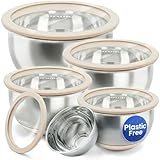
Stainless steel is the strongest all-purpose choice. Bowls made from 18/8 or 18/10 stainless steel contain chromium and nickel in commonly used food-contact alloys and normally have no lining to flake or wear. A polished interior is easy to inspect and does not absorb odors or colors.
The trade-offs are equally important: stainless steel cannot go in a microwave, may become noisy when whisking, and can show scratches or dents. It is also reactive to strong salt or acidic mixtures under some conditions, especially if left sitting for a long time, so transfer tomato, citrus, or heavily salted mixtures when practical. A silicone base or non-slip ring improves stability but adds a part that can loosen or trap moisture.
Glass: clean visibility with more weight
Glass is attractive when you want to monitor layers, dough hydration, or the amount of mixture without scraping the sides. A plain, food-contact glass interior has no polymer coating, and glass does not retain odors. Borosilicate glass is designed to handle temperature changes better than ordinary soda-lime glass, but neither type is immune to thermal shock.
Do not move a very cold glass bowl directly onto a hot surface or add boiling liquid to a chilled bowl unless the manufacturer permits it. Examine rims and bases regularly. A small chip or hairline crack can become a break during vigorous mixing. Glass is also substantially heavier than steel or silicone, which matters when a bowl is full of batter.
Ceramic: stable and attractive, but inspect the glaze
Ceramic bowls are useful for mixing thick doughs because their weight keeps them from sliding. They can also serve as attractive tableware. Their safety depends on the glaze and manufacturing quality rather than on the word “ceramic” alone. Choose products explicitly described as food-safe and made for food contact, with care instructions that match your intended use.
Discard ceramic bowls with rim chips, deep scratches, exposed rough patches, or extensive crazing—a network of fine glaze cracks. Avoid assuming that an oven-safe bowl is automatically safe on a stovetop, under a broiler, or after rapid temperature changes. Ceramic’s first failure point is often the rim, especially when bowls are stacked without protective spacing.
Silicone: flexible and space-efficient
Silicone bowls are quiet, lightweight, and easy to store. They can be squeezed to create a pouring spout, and collapsible designs are helpful in small kitchens. Look for food-contact documentation and a clearly stated temperature range. Platinum-cured silicone is often preferred for a neutral material specification, although curing method alone does not establish the quality of the finished product.
Silicone is not automatically better because it is flexible. Very soft bowls can buckle while whisking, and thin walls may split around a reinforced rim. Silicone can also absorb strong odors or become permanently stained. Wash it thoroughly and allow it to dry completely before folding it for storage. If a bowl develops a tacky surface, persistent chemical odor, or tear, replace it.
Decision matrix for different kitchens
| Your situation | Best fit | Why | What to compromise on |
|---|---|---|---|
| Low budget and frequent baking | Stainless steel set | Long life, low breakage risk, and broad size range | No microwave use; can slide without a base |
| Small kitchen or limited cabinets | Nested stainless steel or silicone set | Stacking reduces storage footprint | Silicone is less rigid; steel may be noisier |
| Microwave preparation | Glass set | Visible contents and microwave compatibility when labeled | More weight and breakage risk |
| Serving at the table | Glazed ceramic | Stable, attractive, and good for presentation | Heavier and more vulnerable to chips |
| Children helping with cooking | Silicone or lightweight stainless steel | Lower breakage risk and easier handling | Silicone can deform; steel cannot enter a microwave |
| Large batches and stand-mixer work | Deep stainless steel, 4–6 qt | High capacity with manageable weight | Check mixer clearance and bowl diameter |
Features that matter more than appearance
Nesting and usable capacity
A bowl’s listed capacity is usually measured to the brim, not to a comfortable working level. For whisking or tossing, plan to use roughly 60–70% of the stated capacity. A 4-quart bowl therefore offers about 2.4–2.8 quarts of practical working room. This reduces splashing and leaves space for folding ingredients.
Check whether handles, pour spouts, and non-slip bases prevent the bowls from nesting. A set that saves only 2 inches of cabinet height but leaves the largest bowl unstable may be less useful than a simpler, handle-free design.
Weight and stability
Heavy ceramic stays put but becomes tiring when full. Lightweight steel is easier to lift but benefits from a damp towel or silicone base. Silicone offers the lowest lifting effort but usually needs a firm counter surface. For everyday mixing, a stable 2- to 3-quart bowl is often more useful than an oversized bowl that is difficult to hold.
Dishwasher design
“Dishwasher-safe” describes the main bowl, not necessarily every accessory. Removable silicone bases, painted measurement marks, glued feet, and wooden handles may require hand washing. Place bowls so water can drain from their rims and bases, and inspect trapped moisture beneath rings before stacking.
Durability and ownership realities
Stainless steel usually lasts the longest; its common wear is cosmetic scratching, denting, or a loosened base. Glass stays odor-free but fails suddenly when cracked or struck. Ceramic’s glaze and rim wear first. Silicone’s most common problems are staining, odor retention, stretching, and tears near thin edges.
Use wooden, silicone, or nylon utensils when protecting a decorative surface matters. Metal whisks are generally appropriate for bare stainless steel, but repeated aggressive scraping can mark polished finishes. Never use a chipped glass or ceramic bowl for vigorous mixing, and do not try to repair a food-contact crack with household adhesive.
How to choose a set without overbuying
- Pick the material based on your main task: steel for general mixing, glass for visibility and microwave work, ceramic for serving, or silicone for storage.
- Choose three useful capacities: approximately 1.5–2 qt for small prep, 2.5–3 qt for everyday mixing, and 4–5 qt for batters and large batches.
- Confirm the actual interior: reject bowls with unexplained coatings, decorative paint inside, strong persistent odors, or unclear food-contact information.
- Check nesting with accessories attached: handles and bases should not make the stack wobble or waste cabinet space.
- Match cleaning instructions to your routine: dishwasher convenience is valuable only if feet, lids, and markings can tolerate it.
Bottom line
For one dependable set, choose uncoated 18/8 or 18/10 stainless steel with stable bases and three or four nested sizes. Add a plain glass bowl if microwave use and visibility matter, or a food-grade silicone bowl if compact storage is the priority. Ceramic is the right specialist choice for serving and stability, but it demands the closest inspection for chips, crazing, and heat limitations. The safest long-term decision is not a particular label: it is a clearly specified material, an intact surface, suitable care instructions, and a design you will actually clean and use correctly.