What's inside
As an Amazon Associate I earn from qualifying purchases. This post may contain affiliate links at no extra cost to you.
Sections
Best 100W USB-C Chargers for Laptops and Phones
The best 100W USB-C charger for most people is a compact four-port GaN model with a clear power-sharing chart; choose a two-port charger for simpler laptop-and-phone travel, or a larger desk model if you regularly charge several devices at once. The key is not the headline 100W figure alone: it is how much power remains available to the laptop when other ports are in use, and whether the charger includes a cable rated for that load.
Quick picks by situation
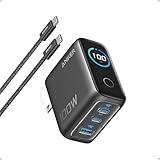
- For a travel bag: Anker Prime 100W GaN Wall Charger. Its three USB-C ports and compact design suit a laptop, phone, and accessory without taking up much room.
- For a simple laptop-and-phone setup: UGREEN Nexode 100W USB-C Charger. Its four-port layout gives flexibility, though simultaneous charging reduces the power available to each device.
- For a desk with several devices: Baseus 100W GaN chargers with multiple USB-C and USB-A outputs. Check the specific model’s power-sharing chart: Baseus sells several chargers with different layouts and allocations.
- For a charger-and-cable bundle: Choose a model explicitly sold with a 5A, 100W-capable USB-C cable. Bundles vary by retailer and product version, so verify the box contents before buying.
Comparison: ports, power sharing, and travel size
The figures below are useful for comparing common 100W-class designs, but exact dimensions and port allocations can vary between model revisions and regional versions. Treat the sharing figures as examples to verify against the manufacturer’s chart for the precise model you are considering.
As an Amazon Associate we earn from qualifying purchases at no extra cost to you.



| Charger | Port layout | Example output distribution | Approx. size and weight | Cable included? | Best fit |
|---|---|---|---|---|---|
| Anker Prime 100W GaN Wall Charger | 3 USB-C | One port: up to 100W; two ports: commonly up to 65W + 30W; all three: commonly up to 45W + 30W + 18W | About 2.4 × 2.4 × 1.2 in; roughly 7 oz | Often sold without one; check the package | Travel with a laptop and smaller devices |
| UGREEN Nexode 100W USB-C Charger | 3 USB-C, 1 USB-A | One USB-C port: up to 100W; with multiple devices, power is shared and the laptop may receive less than 100W | Roughly 2.7 × 2.7 × 1.3 in; about 9 oz | Package-dependent | One charger for a mixed-device kit |
| Baseus 100W GaN multiport charger | Varies by model; commonly 2–3 USB-C and 1–2 USB-A | Up to 100W from one USB-C port on suitable models; combined output depends on the model and active ports | Model-dependent; typically around 3 × 2 × 1 in and 8–11 oz | Package-dependent | Desk charging and varied cable types |
Dimensions, weight, included accessories, and multiport allocations are not uniform across product versions. Check the manufacturer’s current specification sheet before purchase, especially if your laptop needs more than 65W while another device is connected.
How to choose for your actual charging routine
For a laptop and phone on the move
A two- or three-port charger is usually the easier travel choice. Fewer ports mean less temptation to expect full laptop speed while several devices are connected. Look for a single USB-C output that reaches 100W, plus a published two-device allocation such as 65W for the laptop and 30W for the phone. That pairing is ample for many ultrabooks and phones, although some larger laptops charge faster at higher wattages.
Compactness is more than the charger’s dimensions. A foldable plug, a shape that does not block neighboring outlets, and a cable short enough to manage in a hotel room can make a larger difference than shaving a few grams off the adapter.
For a desk with several devices
Choose by the simultaneous-use chart, not by counting ports. A four-port charger may offer less laptop power than a two-port model when three devices are plugged in. If your laptop needs 65W and you also want to charge a tablet and phone, confirm that the chosen combination preserves at least 65W for the laptop. USB-A ports are handy for older accessories, but they generally do not provide the same modern USB-C Power Delivery options.
For a laptop that draws close to 100W
Check the laptop’s original adapter rating and whether it accepts 100W USB-C Power Delivery. Some gaming and workstation laptops require a proprietary adapter, draw more than 100W under heavy load, or charge slowly through USB-C. A 100W charger can still be useful for light work or travel, but it may not replace the original power supply in every situation.
The cable can limit the charger
A 100W-capable charger does not guarantee 100W charging through any USB-C cable. For power above 60W, use a cable rated for 5A and 100W or higher, typically with an e-marker chip. A cable included in the box is convenient only if its rating is stated. If the listing does not specify the cable’s wattage, budget for a known 100W-or-higher USB-C cable rather than assuming an ordinary charging cable will work.
For a simple power check, compare the charger’s output with the laptop’s requirement. If a laptop is rated for 65W and the charger assigns it 65W when a phone is connected, the arrangement meets the adapter’s rated input target. If the charger instead drops that port to 45W, the laptop may charge more slowly, particularly during demanding work. This is why the power-sharing table matters more than the total printed on the charger.
Ownership details that affect everyday use
- Heat is normal, but airflow matters. Small GaN chargers can become warm at high output. Avoid covering the adapter or leaving it pressed against bedding or a bag while in use.
- Expect renegotiation when plugging in devices. Adding or removing a device can briefly interrupt charging as the charger reallocates power. This is normal for many multiport designs.
- Protect the ports and cable ends. Dust and strain are common causes of charging trouble. Unplug by holding the connector, not pulling the cable, and keep the adapter dry.
- Travel compatibility still matters. Check the charger’s input-voltage range and plug design for your destination. A plug adapter may be needed; it does not convert voltage.
Bottom line
For a compact travel setup, the Anker Prime 100W is a strong fit if its port allocation matches your laptop-and-phone combination. For more connection options, consider a UGREEN Nexode or a specific Baseus 100W model, then compare its exact sharing chart and package contents. Before buying any of the best 100W USB-C chargers, confirm three things: your laptop accepts USB-C charging, the charger supplies enough power with your intended ports occupied, and the cable supports the wattage you need.