What's inside
As an Amazon Associate I earn from qualifying purchases. This post may contain affiliate links at no extra cost to you.
Sections
Best No-Gas Welders: Compare Power Sources, Output, and Duty Cycle
The best no-gas welder for most occasional repairs is a 120V inverter flux-core machine rated for at least 90A, but frequent fabrication or thicker steel calls for a 240V model with more output and a longer duty cycle. Flux-core is the practical choice for most people seeking a gas no welder; stick welding is another gas-free option, while true gas-shielded MIG requires a shielding-gas cylinder.
What “no-gas” welding actually means
Self-shielded flux-core wire contains ingredients that create shielding as the wire melts, so the process does not need an external gas bottle. It suits outdoor repairs better than gas-shielded MIG because a light breeze is less likely to disrupt its shielding. It still produces fumes, slag, and more spatter than clean, gas-shielded MIG.
As an Amazon Associate we earn from qualifying purchases at no extra cost to you.

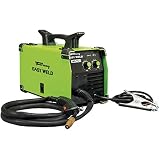
Stick welders also work without shielding gas, using flux-coated electrodes. They are often compact and capable on thicker steel, but starting and maintaining a smooth arc can take practice. Some multiprocess machines offer both flux-core and stick welding, which can be useful if the jobs vary.
Compare the options by job
| Welder type | Typical input | Useful output range | Practical material range | Gas needed? | Main trade-off |
|---|---|---|---|---|---|
| 120V inverter flux-core | 120V household circuit | About 30–140A | Thin sheet to roughly 1/8 in. steel in a suitable joint; thicker work may need multiple passes | No, with self-shielded wire | Portable and easy to power, but limited sustained output |
| 240V flux-core or multiprocess inverter | 208–240V circuit | About 30–200A | Often suitable for steel around 1/4 in. with proper preparation and passes | No for self-shielded flux-core | More headroom, but needs a 240V outlet and is usually less convenient to move |
| Stick inverter | 120V or 208–240V, depending on model | About 20–200A | Thin material with careful technique through heavier steel, depending on electrode and power | No | Versatile and field-friendly, but slag removal and arc control take practice |
| Gas-shielded MIG | 120V or 208–240V, depending on model | About 30–200A | Thin sheet through thicker work, depending on machine and passes | Yes | Cleaner welds and less spatter, but adds a cylinder and wind sensitivity |
These are broad planning ranges, not guarantees: machine ratings, wire or electrode choice, joint design, fit-up, and operator technique all matter. Check the manufacturer’s output chart for the exact machine rather than treating a maximum amperage as a thickness rating.
Choose by power, material, and work pattern
For home repairs on a standard outlet
Choose a 120V flux-core machine if you will repair gates, brackets, garden equipment, or other small steel parts and need to work away from a dedicated welding circuit. Look for adjustable voltage or a well-calibrated control range, compatible 0.030- or 0.035-inch self-shielded wire, and a published duty-cycle chart. A 120V circuit does not make every machine equally capable: extension-cord length and wire gauge, breaker capacity, and other loads on the circuit can affect performance.
For thicker steel or repeated fabrication
A 240V machine is the better fit when you regularly weld heavier sections, make long welds, or want more room to increase output without running the welder at its limit. Confirm that your workshop has the correct outlet and breaker before buying. If you do not, the cost and inconvenience of adding a circuit may outweigh the benefit of a higher-output machine.
For outdoor work or varied jobs
Self-shielded flux-core and stick are sensible choices where carrying a gas cylinder is inconvenient. Flux-core offers a wire-fed process that many new welders find easier to keep moving; stick can be useful for repairs on thicker or less-than-pristine steel, but it requires matching the electrode to the metal and joint. Neither process makes surface preparation optional: remove paint, oil, rust, and moisture from the weld area.
Understand duty cycle before comparing amperage
Duty cycle is the portion of a 10-minute period a welder can operate at a stated output before needing to cool. For example, a rating of 20% at 90A means up to 2 minutes of welding and 8 minutes of cooling in that period at that output. A rating of 40% at 150A means 4 minutes welding and 6 minutes cooling at 150A. These ratings are tied to the stated amperage and test conditions; at lower output, a machine may run longer.
For occasional short repairs, a modest duty cycle may be perfectly workable. For long beads or production work, prioritize a higher duty cycle at the amperage you will actually use—not just the machine’s maximum amperage. Repeated thermal shutdowns slow the job and can tempt operators to defeat cooling safeguards, which should never be done.
Plan for spatter, finish, and consumables
Flux-core tends to leave more spatter and a slag layer over the weld than gas-shielded MIG. Expect to chip or brush slag away and spend more time cleaning the surrounding surface before painting. A smooth-looking bead is not proof of a sound weld; use the correct settings, keep a consistent travel angle and speed, and check for incomplete fusion or visible defects. For work where appearance matters, practice on matching scrap and consider whether a gas-shielded setup better suits the finish requirement.
Wire, contact tips, and drive components are routine wear items on a wire welder. Slag and spatter can build up around the nozzle and tip; clean them regularly, and replace a worn or obstructed contact tip when wire feeding becomes erratic. Keep wire dry and stored as directed, since moisture and contamination can contribute to poor weld quality. On stick equipment, electrodes also need suitable storage, and slag must be removed between passes.
Quick decision guide
| Your situation | Best starting point | Why |
|---|---|---|
| Occasional repairs, limited budget, 120V only | Basic inverter flux-core welder | No cylinder or new circuit; adequate for many small steel jobs |
| Beginner who wants one machine for varied repair work | Multiprocess inverter with flux-core and stick | Offers two gas-free processes; check that each mode has useful output |
| Frequent work on heavier steel, workshop has 240V | Higher-output 240V flux-core or multiprocess welder | More output headroom and potentially better duty cycle |
| Clean visible welds on thin material | Gas-shielded MIG, if a cylinder and sheltered workspace are practical | Typically less spatter and no flux slag, but not a no-gas process |
Bottom line
For a portable no gas welder that runs from a household outlet, start with a 120V inverter flux-core machine and verify its duty cycle at the output you need. Step up to 240V for repeated or heavier work, and choose stick if its electrode-based process better fits your repairs. If a clean finish is the priority, compare the extra cylinder and setup demands of gas-shielded MIG against the grinding and cleanup that flux-core typically requires.