What's inside
As an Amazon Associate I earn from qualifying purchases. This post may contain affiliate links at no extra cost to you.
The best hand held planer for most woodworkers and site carpenters in 2026 is a 3-1/4-inch corded model in the 7–8 amp range with a two-blade head and a depth knob adjustable down to 0.1 mm increments — the Makita KP0810 and Bosch PL2632K fit that description well. Cordless hand held planers like the DeWalt DCP580B have closed the gap enough that they’re now the smarter pick for door hanging and punch-list work where dragging a cord through a finished house costs more time than the battery saves.
As an Amazon Associate we earn from qualifying purchases at no extra cost to you.

Sections
What Actually Separates One Hand Held Planer From Another
A hand held planer tool looks simple — a motor spinning a cutterhead between a fixed rear shoe and an adjustable front shoe — but five specs determine whether it suits your work:
- Cutting width: 3-1/4 in (82 mm) covers door edges, 2x stock, and most boards. Wider 4-3/8 in models exist but are rare and heavy.
- Depth of cut: Most reach 1/16 in to 5/64 in per pass, but the graduated depth knob matters more than the maximum. Look for positive 0.1 mm clicks — you set 0.3 mm to ease a sticky door edge, not guess.
- Power: Corded units run 6–8 amps (~850–1100 W). Cordless 18V/20V Max brushless models now deliver similar removal rates on softwoods and most hardwoods.
- Weight: 6–8.5 lbs is normal. Anything over 8 lbs gets tiring when chamfering a line of deck balusters one-handed.
- Dust collection: Some models eject chips left, right, or switchable — important if you plane left-handed or against a wall. A bag is standard; a vacuum port is better indoors.
Best Hand Held Planers by Situation
Best all-rounder: Makita KP0810 (7.5 A, corded)
The long-standing shop favorite. The two-blade head spins at 16,000 RPM, the depth knob clicks in fine increments, and the chip ejection is switchable left/right. At 7.3 lbs it balances well for edge work. Downsides: the blade drums are narrower than the shoe edge on some units, which can leave a faint ridge if you skew the tool — keep the base flat and the passes overlapping.
Best for door hanging and site work: DeWalt DCP580B (20V Max, brushless, bare tool)
A cordless hand held electric planer removes the biggest on-site annoyance: no cord snagging on hinges, no hunting for an outlet in a half-wired remodel. Brushless motor, 15,000 RPM, about 5/64 in max depth. With a 5Ah battery expect roughly 35–45 minutes of continuous planing in softwood — far more in real door work, where cuts are short. Bare tool only; you need an existing 20V Max battery to make it a good value.
Best for precision and finish: Bosch PL2632K (6.5 A, corded)
Lighter (around 6.3 lbs) with a spring-loaded front shoe that keeps the tool from tipping at the start of a pass — the main cause of snipe on a hand held planer. The single-pass depth is conservative, which is a feature for flush-trimming door stiles where gouging ruins the job.
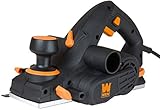
Best budget pick: WEN 6530 (6 A, corded)
Typically well under half the price of the pro brands. You give up chip-direction control, fine depth clicks, and long-term blade availability — but for trimming a swollen door twice a year, it’s hard to argue against it. The fence is basic; don’t rely on it for rebate work.
Best for rabbets and edge rebates: Makita 1912B or the KP0810 with the rebate fence
If your work includes fitting shiplap or tuning tenon cheeks, rebating depth matters — many planers top out around 3/8 in, and some budget models have effectively no rebating capacity because the fence blocks the shoe.
Spec Comparison
| Model | Power | Width | Max depth/pass | No-load RPM | Weight | Chip ejection | Typical price (2026) |
|---|---|---|---|---|---|---|---|
| Makita KP0810 | 7.5 A corded | 3-1/4 in | 5/32 in (4 mm) | 16,000 | 7.3 lbs | Left or right | $190–230 |
| DeWalt DCP580B | 20V Max cordless | 3-1/4 in | 5/64 in (2 mm) | 15,000 | 6.7 lbs (tool only) | Right (vac adapter) | $180–220 bare |
| Bosch PL2632K | 6.5 A corded | 3-1/4 in | 1/16 in (1.6 mm) | 16,500 | 6.3 lbs | Left or right | $150–190 |
| WEN 6530 | 6 A corded | 3-1/4 in | 1/8 in (3 mm) | 17,000 | 6.5 lbs | Right only | $45–65 |
| Makita XPK02 (18V LXT) | 18V cordless | 3-1/4 in | 1/8 in (3 mm) | 12,000 | 7.5 lbs w/ battery | Left or right | $200–250 bare |
Numbers are manufacturer-published figures; real removal rate in dense hardwood like oak will run lower on the cordless models.
Decision Matrix: Match the Planer to the Job
| Your situation | Priority spec | Pick |
|---|---|---|
| Hanging/easing interior doors on site, no power nearby | Cordless, fine depth clicks, under 7 lbs | DeWalt DCP580B (or XPK02 if on Makita batteries) |
| Workshop edge-jointing boards, daily use | Durable blades, switchable chip ejection, deep cut | Makita KP0810 |
| Finish-critical work (flush stiles, veneer edges) | Anti-snipe shoe, shallow max depth | Bosch PL2632K |
| Occasional DIY, a few doors a year | Price | WEN 6530 |
| Rebates, lap joints, tenon tuning | Rabating depth ≥3/8 in, real edge fence | KP0810 or 1912B with fence |
Getting Clean Results: Technique That Specs Won’t Tell You
- Snipe control: Press down on the front knob at the start of the cut, shift weight to the rear handle as the tail shoe comes onto the work. Skipping this is why beginners get a gouged first inch.
- Skew the tool slightly: Angling the planer 10–15° to the travel direction reduces tear-out on figured grain and makes each pass easier to push.
- Depth discipline: Two passes at 0.5 mm beat one at 1 mm on hardwood. On a sticky door, mark the binding spots with a pencil first — plane only where the marks are, not the whole edge.
- Blade reality: Carbide reversible blades last 50–150 linear feet in clean softwood but one hidden screw head or a grain of concrete on a reclaimed board will nick them instantly. Nicks leave a line on every pass. Keep a spare set ($10–30 per pair) and rotate to a fresh edge at the first ridge.
- Dust: The included bags fill in minutes and restrict airflow once half full, spitting chips back onto the surface you’re cutting. Indoors, a vacuum adapter pays for itself immediately.
Ownership Costs Over Five Years
A quick cost-per-use check: a $200 corded planer used on 40 doors over five years, plus six pairs of blades (~$120) and one drive belt (~$10), runs about $8.25 per job. The same cordless tool adds a battery (~$80–130) but typically saves 10–15 minutes of cord management per door — worth it only if you’re billing time or already own the batteries.
What wears first, in order: blades (consumable), drive belt (3–6 years of regular use), depth-knob detent spring (loses its click — the tool still works but settings drift), and carbon brushes on brushed motors. Brushless cordless models remove the last item entirely.
FAQ
Can an electric hand held planer replace a bench planer or jointer?
No. Hand held planers are for removing small amounts of material on edges and localized high spots — they follow the existing surface, so they can’t flatten a cupped board or true a 6-foot edge the way a jointer does.
Is a cordless hand held planer powerful enough for hardwood?
Current brushless 18V/20V models handle oak and maple fine at shallow depths (under 1 mm per pass). At maximum depth in dense wood they slow noticeably compared to an 8-amp corded unit.
What width do I need for door work?
3-1/4 in is the standard and covers the 1-3/4 in thickness of a typical exterior door plus most edge-banding and stile work. Wider is unnecessary — a hand held planer isn’t meant for face-flattening boards.
How do I avoid ridges between passes?
Overlap each pass by a third, keep the shoes dead flat, and check that your blades are set level — most models have alignment plates or a gauge for this. A ridge after blade changes almost always means uneven blade projection.