What's inside
As an Amazon Associate I earn from qualifying purchases. This post may contain affiliate links at no extra cost to you.
The core difference between a jointer and a planer comes down to one job each: a jointer flattens one face and squares one edge of a board, while a planer makes the opposite face parallel and brings the board to a uniform thickness. Neither machine can fully do the other’s work, which is why serious furniture shops run both in sequence.
As an Amazon Associate we earn from qualifying purchases at no extra cost to you.


Sections
What a Jointer Actually Does
A jointer has two flat cast-iron tables with a rotating cutterhead set between them. You push the board across the tables, and the knives shave material off the bottom face. Because the outfeed table registers against the freshly cut surface, the jointer removes cup, bow, and twist — it creates one genuinely flat reference face.
Raise the board on edge and run it against the fence, and the jointer produces an edge that’s exactly 90 degrees (or another set angle) to that flat face. After jointing, a rough board has two things it didn’t have before: one flat face and one square edge. What it doesn’t have is consistent thickness — the top face can still be wavy and uneven, just with a flat bottom underneath.
What is the difference between a jointer and planer in practice? The jointer fixes geometry; it ignores thickness. Feed a twisted 8/4 board through a planer first and the planer’s rollers simply press the twist flat, then the board springs back twisted after it exits. That’s the mistake that sells a lot of unnecessary planer passes.
What a Planer Actually Does
A thickness planer (a lunchbox-style DeWalt DW735X or a stationary 15-inch machine are the common types) works from the opposite direction. Feed rollers press the board against a flat bed while the cutterhead above shaves the top face. Because the bed is flat and the cutterhead is parallel to it, the planer makes the top face parallel to whatever face is riding on the bed — and it controls final thickness to a fraction of a millimeter.
The catch: the planer can only make the top parallel to the bottom. If the bottom face isn’t already flat, the planer faithfully copies the warp. So the difference between a planer and jointer isn’t a matter of one being “better” — they attack the problem from opposite faces, and the planer depends on a flat reference the jointer provides.
The Standard Milling Sequence (S4S by Hand)
When you need a board that’s flat, square, and dimensioned, the workflow looks like this:
- Step 1 — Joint one face. Pick the better face, run it over the jointer until it’s dead flat (check with winding sticks or a straightedge).
- Step 2 — Joint one edge. Fence at 90°, joint one edge square to that face.
- Step 3 — Plane to thickness. Flat face down on the planer bed, take light passes (0.5–1 mm for hardwoods on a lunchbox planer) until the opposite face is clean and you hit your target thickness.
- Step 4 — Rip the second edge. Table saw or bandsaw, since the jointer already gave you a square reference edge for the saw fence.
- Step 5 — Crosscut to length. Miter saw or table saw sled.
This order matters. Reversing steps 1 and 3 is the most common beginner error — you’ll get a board of perfectly uniform thickness that still rocks on the bench.
Jointer vs. Planer: Head-to-Head
| Factor | Jointer | Thickness Planer |
|---|---|---|
| Primary job | Flatten face, square edge | Uniform thickness, parallel faces |
| Fixes cup/bow/twist | Yes | No — copies warp to the far face |
| Controls final thickness | No | Yes, to ~0.1 mm |
| Typical width capacity | 6–8 in. (benchtop/cabinet); 12–16 in. industrial | 12–13 in. (lunchbox); 15–20+ in. stationary |
| Typical board length handled | Long boards (limit is table length, ~46–72 in.) | Moderate; snipe risk on long stock |
| Common entry price range | Roughly $400–$900 benchtop 6″; $1,500+ for 8″ cabinet | Roughly $300–$700 lunchbox; $2,000+ stationary |
| Footprint | Long and low; needs infeed/outfeed room | Compact; can live on a shelf or stand |
| Cutterhead options | Straight knives or helical/spiral carbide | Straight knives or helical; lunchbox mostly 2–3 knives |
If You Can Only Buy One, Buy the Planer
For most home shops, the planer is the better first purchase, and here’s the reasoning. You can flatten faces without a jointer using workarounds that are cheap and proven:
- Planer sled: Shim the cupped board on a flat MDF sled, hot-melt glue or wedges holding it steady, and plane the top flat. Flip, remove the sled, plane the shimming face. You get a flat, parallel board with no jointer.
- Router flattening sled: A 1.5-inch surfacing bit in a plunge router riding on rails flattens slabs too wide for any hobbyist jointer.
- Buy S2S lumber: Paying the yard to straight-line rip and skip-plane covers much of the jointer’s job for a modest upcharge per board foot.
- Hand planes: A No. 5 or No. 6 flattens faces fine for small parts.
The reverse isn’t true — there’s no good jig that lets a jointer thickness a board. Some people rig jointer “thicknessing” attachments, but results are unreliable and the setup eats time. The planer’s function simply can’t be replicated by its counterpart.
Decision Matrix: Match Your Shop
| Your situation | Recommendation |
|---|---|
| Weekend hobbyist, buys S2S lumber, limited space | Planer only; use a sled for the occasional twisted board |
| Regular furniture builds, buys rough lumber to save money | Planer first, 6–8″ jointer when budget allows |
| Works mostly with stock under 6″ wide | 6″ jointer + 13″ planer covers everything |
| Wide panels, slabs, live edge | Planer plus router sled; skip the jointer unless you can fit a 12″+ model |
| Sheet goods and plywood projects only | Neither — plywood arrives flat and dimensioned |
| Tight budget under ~$500 total | Lunchbox planer; joint edges on the table saw with a straight-line jig |
| Production or professional shop | Both, plus a wide-belt sander downstream |
Ownership Realities: What Wears and What Goes Wrong
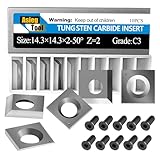
Knives are the consumable on both machines. A set of lunchbox planer knives runs roughly $30–$80 and lasts 50–150 board feet of hardwood before dulling shows as tear-out and glazed surfaces. Spiral/helical heads cost $250–$500 to retrofit but the carbide inserts rotate for four fresh edges and last far longer — worth it if you plane figured maple or run the machine weekly.
Planer snipe — a deeper cut at the board’s first and last few inches — is the most complained-about defect. Fix it by lifting slightly on the board ends as they enter and exit, milling stock a few inches long and cutting off the snipe, or running boards through end-to-end.
Jointer table alignment drifts with moves and seasons. If the outfeed table sits a hair below the knives, boards taper; check coplanarity yearly with a straightedge and feeler gauges.
Dust collection is non-negotiable. A planer generates enormous chip volume — a 4-inch hose on a real collector, not a shop vac, for anything bigger than quick passes. Jointers are gentler but still need it.
Common mistakes: jointing boards shorter than 12 inches (unsafe — the cutterhead is exposed), planing end grain, and taking 2 mm+ passes in hardwood, which dulls knives fast and stalls smaller motors.
The Bottom Line
What’s the difference between a jointer and planer, reduced to one line? The jointer establishes truth — flat and square; the planer establishes dimension — thickness and parallelism. If your lumber starts rough, you’ll eventually want both, with the jointer feeding the planer. If you’re buying one machine, buy the planer and flatten with a sled until the budget catches up.