What's inside
As an Amazon Associate I earn from qualifying purchases. This post may contain affiliate links at no extra cost to you.
The best tripod for a laser level is the one that matches your laser’s mounting thread and working height: the Bosch BT160 is the best all-round 5/8-11 tripod for rotary and heavier lasers, the DeWalt DW0881T is the best lightweight 1/4-20 tripod for line and dot lasers, and the Johnson 40-6330 Heavy Duty Elevating Tripod is the pick when you need fine height adjustment up to 10 feet. Get the thread right first, because everything else about stability and height follows from it.
As an Amazon Associate we earn from qualifying purchases at no extra cost to you.


Sections
Step One: Match the Thread
| Thread | Typical lasers | Tripod weight class | Notes |
|---|---|---|---|
| 1/4″-20 | Cross-line, green line, 3- and 5-point dot lasers | 2-5 lb | Same thread as camera tripods |
| 5/8″-11 | Rotary lasers, heavier line lasers, optical levels | 7-15 lb | Construction and survey standard |
An adapter lets a 1/4-20 laser sit on a 5/8-11 tripod, which is a sensible way to use one sturdy tripod for both tools. The reverse is not practical: a rotary laser on a light camera-style tripod is top-heavy and vulnerable to wind and bumps.
The Best Laser Level Tripods
Bosch BT160 Aluminum Contractor’s Tripod: best all-round 5/8-11
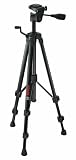
The BT160 extends from about 38 to 63 inches, weighs around 9 pounds and uses quick-clamp leg locks that set up fast. Its flat head accepts 5/8-11 instruments directly. The weight makes it stable outdoors, and the leg spread suits uneven ground. It does not have an elevating column, so height changes mean adjusting legs.
DeWalt DW0881T Laser Tripod with Tilting Head: best for line lasers
At roughly 3 pounds, the DW0881T extends to 72 inches and collapses to about 38 inches. Its 1/4-20 tilting head and built-in bubble level make it easy to aim a line laser for stairs and sloped work. It is a good fit for interior trim, tile and cabinet layout. The light build can shift on rough ground, so it is not the right base for a rotary.
Johnson 40-6330 Heavy Duty Elevating Tripod: best for height and fine adjustment
This heavy-duty tripod raises a 5/8-11 instrument from about 4 to 10 feet using a crank-driven center column, with safety chains between the legs to prevent collapse. The crank lets you put a rotary beam exactly at a target height without touching the legs, which makes it ideal for setting a beam above vehicles and stacked materials, or for ceiling work. It is heavier and costs more than a standard contractor tripod.
Johnson 40-6335 Contractor Aluminum Tripod: budget 5/8-11
For a straightforward rotary base, the 40-6335 adjusts from about 36 to 60 inches, has sharp metal feet for soil and removable rubber covers for indoor floors. It lacks an elevating column, but for footings, slabs and fence lines it covers the essentials at a lower price.
Comparison Table
| Tripod | Thread | Height range | Approx. weight | Elevating column | Price range |
|---|---|---|---|---|---|
| Bosch BT160 | 5/8″-11 | 38-63 in | 9 lb | No | $70-$110 |
| DeWalt DW0881T | 1/4″-20 | Up to 72 in | 3 lb | No (tilting head) | $50-$80 |
| Johnson 40-6330 | 5/8″-11 | 4-10 ft | Heavy-duty | Yes, crank | $250-$350 |
| Johnson 40-6335 | 5/8″-11 | 36-60 in | Moderate | No | $60-$100 |
Pick by the Work You Do
- Rotary laser on slabs and footings: Bosch BT160 or Johnson 40-6335.
- Rotary laser for ceilings, drop grid or clearing obstacles: Johnson 40-6330.
- Line laser for interior trim, tile and cabinets: DeWalt DW0881T.
- One tripod for both a rotary and a line laser: a 5/8-11 tripod plus a 1/4-20 adapter.
Why Height Matters: A Quick Calculation
A rotary beam must clear everything between the laser and the receiver. Suppose a pickup truck (about 6.5 feet tall) sits between your instrument and a footing 150 feet away. A standard 63-inch tripod puts the beam around 5.5 feet high, which the truck blocks. An elevating tripod raised to 8 feet clears it, and you simply add the extra height to your grade-rod reading. Likewise, for a 9-foot drop ceiling, a 10-foot elevating tripod lets you set the beam at grid height directly instead of transferring marks.
Stability Checklist on Site
- Spread the legs wide and press the feet firmly into soil. On concrete, use rubber feet or a tripod floor stabilizer to stop slipping.
- Keep the head roughly level by eye before mounting. Self-leveling lasers have a limited range, often about ±5°, and will stop working beyond it.
- Lock every leg clamp and check them again after the first few minutes; aluminum legs can settle.
- Hang a weight or sandbag from the center in wind.
- Never carry the tripod with the laser mounted. A knock to the head is the most common cause of calibration loss.
Ownership Notes
- Leg clamps wear first; keep them clean of concrete dust and grit.
- Aluminum is lighter; fiberglass or wood legs resist heat expansion in direct sun for precise work over long days.
- Check the threaded mounting screw for burrs, which can damage a laser’s base thread.
Common Questions
Can I use a camera tripod for a line laser?
For a small cross-line laser indoors, a sturdy camera tripod with a 1/4-20 screw works. The limitations are height, head stiffness and stability on dusty floors. A purpose-built laser tripod adds a taller reach and a head that locks firmly without drifting.
Do I need an elevating tripod for a rotary laser?
Not for most ground-level work. Footings, slabs and fence lines are handled well by a fixed-head contractor tripod and a grade rod. An elevating model pays off when you regularly set ceiling heights, shoot over obstacles or need to match a beam to a benchmark without moving the legs.
Is a heavier tripod always better?
Outdoors, extra mass resists wind and accidental bumps. Indoors, a lighter tripod is easier to move between rooms, and stability depends more on leg spread and floor grip than weight.