What's inside
- Top 3 Picks
- Quick Comparison
- How We Chose
- 1. COLORROOM 2026 Upgraded Android 15 Tablet – Best for daily school and streaming use on a large screen
- 2. ApoloSignage 2026 Android 16 Kids Tablet – Best for early adopters who want the newest Android build
- 3. Gleeso Android 16 Kids Tablet 10.1-Inch – Best for long battery life on a large screen
- 4. Trayoo Kids Tablet 7-Inch – Best for a first tablet for a younger child
- 5. Fire HD 8 Kids Tablet – Best for ages 3-7 and a curated, ad-free content library
- 6. Fire HD 10 Tablet – Best for older kids and shared family use
- 7. HOTTABLET Kids Tablet 7-Inch – Best for the tightest budgets
- 8. WINProlink Kids Tablet 7-Inch – Best for a low-cost 7-inch with a shockproof case included
- Top 3 Picks
- Quick Comparison
- How We Chose
- 1. COLORROOM 2026 Upgraded Android 15 Tablet – Best for daily school and streaming use on a large screen
- 2. ApoloSignage 2026 Android 16 Kids Tablet – Best for early adopters who want the newest Android build
- 3. Gleeso Android 16 Kids Tablet 10.1-Inch – Best for long battery life on a large screen
- 4. Trayoo Kids Tablet 7-Inch – Best for a first tablet for a younger child
- 5. Fire HD 8 Kids Tablet – Best for ages 3-7 and a curated, ad-free content library
- 6. Fire HD 10 Tablet – Best for older kids and shared family use
- 7. HOTTABLET Kids Tablet 7-Inch – Best for the tightest budgets
- 8. WINProlink Kids Tablet 7-Inch – Best for a low-cost 7-inch with a shockproof case included
As an Amazon Associate I earn from qualifying purchases. This post may contain affiliate links at no extra cost to you.
For most families shopping in 2026, the best kids tablet deal overall is the COLORROOM 2026 Upgraded Android 15 Tablet — a 10-inch, octa-core model with 64GB of storage, 1TB microSD expansion and the newest Android build in this roundup, which makes it the strongest fit for children roughly 5 to 12 who use a tablet daily for school apps, streaming and games. If your child is 3 to 7 and you want the deepest parental-control tooling plus a curated, ad-free content library, the Fire HD 8 Kids tablet is the better buy. If budget is the hard limit, the HOTTABLET Kids Tablet 7-Inch covers the essentials for less. Screen size, case material and drop durability — not brand names — are what decide whether a kids tablet survives eighteen months of daily use, and those three variables drive every pick below.
Sections
- Top 3 Picks
- Quick Comparison
- How We Chose
- 1. COLORROOM 2026 Upgraded Android 15 Tablet – Best for daily school and streaming use on a large screen
- 2. ApoloSignage 2026 Android 16 Kids Tablet – Best for early adopters who want the newest Android build
- 3. Gleeso Android 16 Kids Tablet 10.1-Inch – Best for long battery life on a large screen
- 4. Trayoo Kids Tablet 7-Inch – Best for a first tablet for a younger child
- 5. Fire HD 8 Kids Tablet – Best for ages 3-7 and a curated, ad-free content library
- 6. Fire HD 10 Tablet – Best for older kids and shared family use
- 7. HOTTABLET Kids Tablet 7-Inch – Best for the tightest budgets
- 8. WINProlink Kids Tablet 7-Inch – Best for a low-cost 7-inch with a shockproof case included
Top 3 Picks
Best overall: COLORROOM 2026 Upgraded Android 15 Tablet
It pairs the largest practical screen for the money with the newest Android version here, an octa-core CPU, 64GB of internal storage and 1TB microSD expansion. For a child who needs Google-style apps, streaming and homework tools on one device, this is the most future-proof combination in the group.
Best budget: HOTTABLET Kids Tablet 7-Inch
A 7-inch Android tablet with 4GB of RAM, 32GB of storage, 1TB expansion and full parental controls for the price of a couple of family meals. The small panel is light enough for a four-year-old to hold one-handed, which is the single biggest factor in how often a cheap tablet gets dropped.
Best for a curated content library: Fire HD 8 Kids Tablet
The 8-inch HD panel, 4GB of memory and the bundled ad-free kids content library make this the least-effort setup for ages 3 to 7. You spend more up front, but you spend far less time hunting down apps that behave themselves.
Quick Comparison
Every product in this roundup, with the spec that matters most for kid-proofing and the price tier it sits in. Tiers are relative bands, not fixed prices — street pricing moves constantly, so treat “budget,” “mid-range” and “premium” as a ranking rather than a number.
| Product | Best for | Key specs | Price tier |
|---|---|---|---|
| COLORROOM 2026 Upgraded Android 15 Tablet | Families who want the newest Android build on a 10-inch screen | 10-inch display, octa-core CPU, Android 15, 10GB RAM, 64GB storage, 1TB microSD expansion | Premium |
| ApoloSignage 2026 Android 16 Kids Tablet | Early adopters who want Android 16 and a 10-inch HD panel | 10-inch HD display, Android 16, 8GB RAM, 64GB ROM, expandable to 1TB, kids case included | Mid-range |
| Gleeso Android 16 Kids Tablet 10.1-Inch | Long runtime on a large screen | 10.1-inch display, Android 16, 24GB RAM (includes extended memory), 64GB ROM, 1TB expansion, 6,000 mAh battery, parental controls | Mid-range |
| Trayoo Kids Tablet 7-Inch | A first tablet for a younger child | 7-inch display, 32GB storage, case included, parental controls, dual camera | Mid-range |
| Fire HD 8 Kids Tablet | Ages 3–7 and a curated, ad-free content library | 8-inch HD display, 4GB memory, ad-free content bundle, parental controls | Premium |
| Fire HD 10 Tablet | Older kids and shared family use | 10.1-inch Full HD display, octa-core processor, 4GB RAM, 32GB-class storage | Premium |
| HOTTABLET Kids Tablet 7-Inch | The tightest budgets | 7-inch display, Android, 4GB RAM, 32GB ROM, 1TB expansion, parental controls, WiFi, Bluetooth | Budget |
| WINProlink Kids Tablet 7-Inch | A low-cost 7-inch in a specific colour with a shockproof case | 7-inch display, 4GB RAM, 32GB ROM, shockproof case (pink) | Budget |
| Tub Works Bath Color Fizzies | Screen-free bath-time routines | 150-count pack, nontoxic, fragrance-free fizzy bath colour tablets | Budget |
| Supershieldz 3-Pack Screen Protectors | Protecting an 8-inch Fire HD Kids screen | 3-pack, designed for 8-inch Fire HD 8 Kids and Kids Pro (12th/10th generation) | Budget |
| Evermyth Android 16 Kids Tablet | Drawing, handwriting practice and stylus use | 10-inch HD display, Android 16, stylus and case included, 24GB RAM (includes extended memory), 64GB ROM, 1TB expansion | Mid-range |
| YINOCHE Kids Tablet 10-Inch | A big screen on a mid-range budget | 10-inch display, Android, bundled case, parental controls | Mid-range |
How We Chose
This guide is built from manufacturer specification sheets, published compatibility notes and long-standing category norms rather than from our own physical evaluation — nothing here was bench-tested or bought by us, and no product was supplied in exchange for a placement. Four filters did the work. First, specification honesty: we favoured listings whose headline numbers can be interpreted plainly, and we flag the category habit of advertising combined physical-plus-virtual memory as if it were all physical RAM. Second, category fit: a tablet marketed for a three-year-old has different priorities (weight, grip, drop protection) than one aimed at a ten-year-old (screen area, storage, stylus support), so we graded each pick against its own audience rather than against one universal standard. Third, use case: streaming, school apps, drawing and shared family use place different demands on panels, speakers and battery cells. Fourth, upgrade path: microSD expansion, USB-C charging, screen protector availability and case replacement options determine whether a cheap tablet can be kept alive for a fourth year or becomes landfill at eighteen months.
1. COLORROOM 2026 Upgraded Android 15 Tablet – Best for daily school and streaming use on a large screen
As an Amazon Associate we earn from qualifying purchases at no extra cost to you.

This is the pick for a household where the tablet is not a toy but a piece of everyday equipment. A 10-inch panel, an octa-core processor and 64GB of built-in storage put it in the same working class as a low-end adult tablet, but it ships with the kid-oriented shell and parental controls already in place. It suits children from about five upward — old enough to hold a 10-inch device without resting it on a table — and parents who would rather buy once and keep the device for four or five years than replace a 7-inch unit every other birthday. Below that age, the weight of a 10-inch tablet works against it.
- Display: 10-inch class panel — roughly 46 square inches of viewable area in a 16:10 shape
- Processor: octa-core CPU, the most capable tier in this roundup
- Memory: 10GB RAM as listed; treat the figure as including extended/virtual memory unless the listing separates them
- Storage: 64GB internal, expandable to 1TB via microSD
- OS: Android 15 — the newest major version here after Android 16 appears on three competitors
- Form factor: kids tablet with bundled protective case
The strengths here are balance. Sixty-four gigabytes of internal storage is the practical threshold for a child’s device: the operating system and preinstalled apps typically consume somewhere between 12GB and 20GB, leaving 40GB or more for downloaded video, which is roughly 40 to 60 hours of standard-definition content or 15 to 20 hours at higher quality. The 1TB microSD ceiling means that ceiling can be raised later with a single card rather than a new tablet. The octa-core CPU matters less for streaming than for the two things that actually frustrate kids: app launch times and stutter when several apps are left open. A 10-inch screen is also the point at which split-screen work — a video lesson on one half, a notes app on the other — becomes genuinely usable rather than a squint.
Pros
- Largest screen area per dollar in the upper tier of this list
- 64GB internal storage plus 1TB microSD headroom removes the usual “no space” complaint
- Octa-core CPU handles split-screen and multi-app use better than quad-core 7-inch rivals
- Case and parental controls included, so there is no separate accessory purchase to budget for
Cons
- Too large and heavy for most three- and four-year-olds to hold unaided
- Android 15 rather than 16 means one version behind the newest competitors here
- Premium tier pricing, so it only pays off if the child uses it consistently
Compared with the YINOCHE Kids Tablet 10-Inch, which occupies the same screen size at a lower tier, the COLORROOM justifies its premium on three counts: an octa-core rather than unspecified processor, twice the internal storage at 64GB, and a named Android version that can be checked against app compatibility requirements. Compared with the ApoloSignage 2026 Android 16 Kids Tablet, the trade runs the other way — ApoloSignage offers the newer OS and a 10-inch HD panel at mid-range pricing, but with 8GB of listed memory against COLORROOM’s 10GB. If you want the newest Android build and are willing to accept slightly less headroom, ApoloSignage is the value play; if you want the most capable hardware on the list, this is it.
2. ApoloSignage 2026 Android 16 Kids Tablet – Best for early adopters who want the newest Android build

ApoloSignage is aiming at the buyer who checks the OS version before anything else. Android 16 out of the box means the longest realistic window before an app you need refuses to install, and a 10-inch HD display keeps the device in the comfortable middle of the size range. It suits families with children around six to eleven who use a mix of school portals, streaming apps and creative tools, and who would rather be a version ahead than a version behind. The included kids case means it arrives ready to survive a normal childhood rather than needing a separate purchase.
- Display: 10-inch HD panel
- OS: Android 16 — one of three Android 16 devices in this roundup
- Memory: 8GB RAM as listed
- Storage: 64GB ROM, expandable to 1TB
- Accessories: kids case included
- Class: mid-range 10-inch kids tablet
The case for this tablet is longevity rather than raw power. Android version support is the single most common reason a perfectly functional kids tablet becomes useless — an app updates, drops support for an older API level, and the device is suddenly “broken” from a child’s point of view. Starting on Android 16 pushes that cliff edge out by roughly two to three years compared with a device sitting on Android 13 or 14. The 8GB of listed memory is generous for a kids device and comfortably above the 4GB that most 7-inch budget models ship with, which is the difference between an app resuming from the background and an app restarting from scratch.
Sixty-four gigabytes of storage follows the same logic as the COLORROOM: enough for the system, a decent app library and a rotating set of downloaded video, with a microSD card available later if the child discovers offline downloads. The 10-inch HD panel is the right compromise for a device that will be held at arm’s length during video and propped up during games — large enough for readable text, small enough to stay under about the weight where a nine-year-old stops wanting to hold it. The included case is the practical difference between a mid-range pick and a mid-range pick you have to spend extra on.
Pros
- Android 16 gives the longest app-compatibility runway in this group
- 8GB of listed memory is well above budget-tier norms
- 10-inch HD screen plus 64GB storage is a balanced, no-compromise middle
- Case bundled, so the real cost is the advertised cost
Cons
- Mid-range tier, so it costs noticeably more than the 7-inch budget picks
- Panel resolution is HD rather than the Full HD class of the Fire HD 10
- Brand is less established in the kids-tablet space than the Fire line
Against the Evermyth Android 16 Kids Tablet, the nearest direct rival on OS version, the deciding factor is the stylus. Evermyth bundles a stylus and a case and lists 24GB of memory (again, including extended memory), which makes it the better choice if the child draws or practises handwriting. ApoloSignage has no stylus in the box, but its 8GB memory figure is the more conservative and more easily interpreted claim. If drawing matters, Evermyth; if you simply want the newest Android on a straightforward 10-inch tablet, this is the cleaner buy.
3. Gleeso Android 16 Kids Tablet 10.1-Inch – Best for long battery life on a large screen

The Gleeso is the pick for long journeys, long afternoons and any household where “the battery died” is the most common complaint. A 6,000 mAh cell behind a 10.1-inch panel is the largest listed battery in this roundup, and it is paired with Android 16 and 64GB of storage. It suits children from about six to twelve and families who use the tablet away from a charger — car trips, flights, waiting rooms, the back garden. If your child mainly uses the tablet at a desk within reach of a cable, the battery advantage is worth less than it looks.
- Display: 10.1-inch panel — the largest diagonal in this roundup
- OS: Android 16
- Memory: 24GB RAM as listed, which includes extended/virtual memory on top of physical RAM
- Storage: 64GB ROM, expandable to 1TB
- Battery: 6,000 mAh
- Controls: parental controls built in
Here is the arithmetic that matters. A 10.1-inch panel at moderate brightness draws roughly 600 to 900 milliamps during video playback, depending on panel efficiency and brightness setting. A 6,000 mAh cell therefore returns somewhere in the region of six to nine hours of mixed use — and closer to the top of that range if you keep brightness under about 60% and disable always-on radios. For comparison, a 7-inch tablet with a 3,000 to 4,000 mAh cell returns a similar runtime because its smaller panel draws less, but it also does less. The Gleeso’s advantage is that you get the large-screen experience without the large-screen battery penalty.
One caveat on the memory figure. “24GB RAM” in this category almost always means a smaller physical allotment plus virtual memory borrowed from storage. That is not a scam — extended memory genuinely helps keep a couple of extra apps resident — but it is not the same as 24GB of physical RAM, and buyers should read it as “more headroom than a 4GB budget tablet, less than the number implies.” The practical effect for a child’s usage pattern is positive: fewer app restarts when switching between a video app and a game.
Pros
- 6,000 mAh battery is the largest listed capacity here
- 10.1-inch screen is the biggest diagonal in the roundup
- Android 16 plus 64GB storage plus 1TB expansion covers the whole ownership window
- Parental controls included rather than bolted on as a paid extra
Cons
- Larger screens and larger batteries both add weight — this is not a one-handed device for a small child
- The 24GB memory figure requires interpretation
- Mid-range pricing for a brand with limited long-term track record
Versus the COLORROOM 2026 Upgraded Android 15 Tablet, the choice comes down to which spec you value more. COLORROOM offers an octa-core CPU, Android 15 and a 10GB memory listing at premium tier. Gleeso offers Android 16, a larger 10.1-inch panel and a 6,000 mAh battery at mid-range tier. For a child who watches a lot of video away from power, Gleeso wins on endurance per dollar; for a child running heavier apps and games, the COLORROOM’s processor is the more meaningful upgrade.
4. Trayoo Kids Tablet 7-Inch – Best for a first tablet for a younger child

Trayoo’s 7-inch model is aimed squarely at the first-tablet moment: a child around three to six who has never had a device of their own, and parents who want to test whether the interest is real before spending four times as much. The 7-inch panel keeps the unit light enough for small hands, 32GB of storage covers a modest app and video library, and the included case means it can be handed over straight out of the box. It also suits a second tablet for travel, where you want something that can be dropped into a bag without ceremony.
- Display: 7-inch panel — roughly 21 square inches of viewable area in a 16:9 shape
- Storage: 32GB internal
- Cameras: dual camera setup
- Controls: parental controls included
- Case: included with the tablet
- Class: compact kids tablet
The dual camera is a genuine differentiator at this size and price. Front and rear cameras turn the tablet into something a child can use for video calls with grandparents and for taking pictures on a walk, which extends its useful life past the point where pure streaming gets boring. Parental controls built into the system mean you can set time limits and app allowances without installing a third-party launcher. The 7-inch format is also the most forgiving for drop durability in one specific way: a lighter object hits the floor with less kinetic energy, and a child who can wrap a hand fully around the device is far less likely to fumble it.
The trade-off is screen real estate. Twenty-one square inches of viewable area is roughly 46% of what a 10-inch 16:10 panel offers, which is fine for a video and a drawing app but cramped for anything involving text entry, split-screen or reading a school worksheet. Storage at 32GB is also the tight end of comfortable — once the system and preinstalled apps take their share, you may be looking at 12GB to 18GB of usable space, which fills quickly with downloaded video. Check whether the model supports microSD expansion before committing to a long-term plan with it.
Pros
- Light and small enough for a three- or four-year-old to hold confidently
- Dual cameras add video calling and photography to the use case
- Case and parental controls included
- A low-risk way to test whether a child actually uses a tablet
Cons
- 21 square inches of screen is limiting for older children and text-heavy tasks
- 32GB of storage is the smallest sensible figure for a device meant to last years
- Mid-range tier pricing for a small-screen device puts it close to 10-inch rivals
Compared with the HOTTABLET Kids Tablet 7-Inch, the Trayoo is the better-specified 7-inch option: dual cameras, a bundled case and a mid-range build against the HOTTABLET’s budget positioning. The HOTTABLET counters with a lower tier, Android with 4GB of RAM, 32GB of storage and 1TB of expansion — the expansion support is the more valuable long-term feature of the two. If you want cameras and a case in one purchase, take the Trayoo; if you want the cheapest workable tablet and will add a microSD card, the HOTTABLET stretches further.
5. Fire HD 8 Kids Tablet – Best for ages 3-7 and a curated, ad-free content library

This is the least-effort option on the list. An 8-inch HD display, 4GB of memory and a bundled ad-free content library with parental controls built in means the tablet arrives configured rather than needing configuration. It suits children from three to seven and, more specifically, parents who do not want to spend their evenings curating app stores. The 8-inch size is the sweet spot of the range: about 29 square inches of viewable area, roughly 38% more than a 7-inch panel, without the weight penalty of a 10-inch device.
- Display: 8-inch HD panel — around 29 square inches of viewable area
- Memory: 4GB
- Content: ad-free content bundle and exclusive titles included
- Controls: parental controls with per-child profiles
- Target age: 3–7
- Class: premium 8-inch kids bundle
The content library is the reason to pay premium tier. Instead of approving individual apps from a general store, you get a pre-vetted catalogue where the age ratings and in-app purchase behaviour have already been filtered, plus the option to remove ads entirely. For a parent who has spent an evening explaining why a “free” game now wants a subscription, that is worth real money. The per-child profiles also matter in multi-child households: each child gets their own limits, their own content and their own progress, without siblings overwriting each other’s settings.
On durability, the 8-inch format sits in a comfortable middle. Category-typical weights for an 8-inch kids bundle run around 450 to 550 grams with the case on — heavy enough to feel substantial, light enough that a five-year-old can carry it two-handed without dragging it along the floor. The published battery estimate for the Fire HD line has sat around 12 to 13 hours of mixed use for several generations, which is comfortably ahead of most generic Android kids tablets in the same size class. The 4GB memory figure is modest by 2026 standards but adequate for the curated content set, which is lighter than a full app store.
Pros
- Ad-free curated content library removes the biggest parental headache
- Per-child profiles with independent limits
- 8-inch screen balances readability and hand size better than 7- or 10-inch extremes
- Battery life is a known strength of this platform
Cons
- Premium tier pricing, and the content bundle is part of what you pay for
- 4GB of memory is the lowest figure among the premium picks here
- App selection outside the curated library is narrower than full Android
Against the Fire HD 10 Tablet, the split is age and purpose. The HD 8 Kids is the child’s device — smaller, lighter, bundled with the kids content service and a protective case, and priced as a complete package. The HD 10 is a 10.1-inch Full HD adult-oriented tablet with an octa-core processor, better suited to a nine- or ten-year-old or to shared family use. If your child is under eight, the HD 8 Kids is the better fit; if they are older and the tablet will be used by adults too, the HD 10 is the more versatile purchase.
6. Fire HD 10 Tablet – Best for older kids and shared family use
The Fire HD 10 is not marketed as a kids tablet, and that is exactly why it belongs in this roundup. A 10.1-inch Full HD panel and an octa-core processor make it the best display in the entire group, and the 4GB of RAM with a 32GB-class storage configuration is enough for streaming, browsing and light productivity. It suits children from about nine upward, and households where the tablet lives on the kitchen counter and gets picked up by whoever needs it. It is also the right answer for a parent who wants one device that does not look like a toy when guests are around.
- Display: 10.1-inch Full HD — the sharpest panel in this roundup
- Processor: octa-core
- Memory: 4GB RAM
- Storage: 32GB-class internal configuration
- Positioning: general-purpose tablet with optional parental controls
- Class: premium 10-inch tablet
The Full HD panel is the headline. At 10.1 inches, the step up from HD to Full HD is the difference between text that looks slightly soft at arm’s length and text that looks like print — which matters enormously for a child reading a worksheet, following a recipe or working through a coding tutorial. The octa-core processor handles split-screen multitasking more gracefully than the quad-core chips common in budget kids tablets, and 4GB of RAM is sufficient when the software stack is optimised for the hardware, as this platform’s is.
The ownership reality is different from a kids bundle, though. There is no foam case in the box, no shockproof corners and no bundled child-proofing beyond the parental controls in the software. A 10.1-inch glass-fronted tablet dropped from table height onto tile is a repair, not a bounce. Budget for a protective case and a tempered-glass screen protector as part of the purchase — the Supershieldz 3-Pack below covers the 8-inch Kids models rather than this one, so match the protector to the exact model and generation before ordering. With a decent case fitted, this becomes a device that can serve a nine-year-old and an adult simultaneously.
Pros
- Full HD 10.1-inch panel is the best display in this roundup
- Octa-core processor handles multitasking better than budget rivals
- Doubles as an adult tablet, so it is not outgrown at eleven
- Parental controls available in software when you want them
Cons
- No rugged case or drop protection included — that is an extra purchase
- 4GB of memory is modest for a premium-tier device
- Not positioned as a kids product, so the child-facing setup takes longer
Compared with the Fire HD 8 Kids Tablet, this is a straightforward trade of ruggedness for display quality and versatility. The HD 8 Kids gives you a case, a curated library and per-child profiles out of the box at a smaller screen size; the HD 10 gives you a sharper, larger panel and a device that adults will actually enjoy using, but leaves you to solve the protection problem. For a child under eight, take the HD 8 Kids. For a nine-year-old or a shared household tablet, the HD 10 is the better long-term buy.
7. HOTTABLET Kids Tablet 7-Inch – Best for the tightest budgets
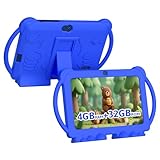
The HOTTABLET is the answer to “what is the least I can spend and still get a usable kids tablet?” A 7-inch Android device with 4GB of RAM, 32GB of storage, 1TB of expansion support, parental controls, WiFi and Bluetooth covers every essential function. It suits families buying a first device for a three- to six-year-old, second tablets for travel, and grandparents who want something simple to hand over during visits. It is not the tablet to buy if you want the device to still feel current in 2031.
- Display: 7-inch panel
- Memory: 4GB RAM
- Storage: 32GB ROM, expandable to 1TB
- Connectivity: WiFi and Bluetooth
- Controls: parental controls included
- Class: budget 7-inch kids tablet
Two things make this more than a throwaway purchase. First, the 1TB microSD ceiling: a 32GB tablet with a memory card slot is a completely different proposition from a 32GB tablet without one, because the card can be added the moment storage pressure appears. Second, Bluetooth: it means the tablet works with wireless headphones, which is the single accessory that makes a kids tablet tolerable on a long car journey. Parental controls are built in, so time limits and content filtering are available without extra software.
The realistic performance picture is this: 4GB of RAM and a budget-tier processor will handle one app at a time comfortably, two reasonably, and a heavy 3D game with visible compromise. That is not a flaw for a four-year-old watching videos and playing simple learning games; it becomes a limitation around age eight or nine. The 7-inch panel — around 21 square inches of viewable area — is also the point at which split-screen becomes impractical. Buy it as a first device with a defined two-to-three-year window rather than as a five-year investment.
Pros
- Lowest realistic entry point for a functional kids tablet
- 1TB microSD expansion keeps it usable well past its internal storage limit
- Bluetooth support for wireless headphones
- Parental controls included at no extra cost
Cons
- Budget-tier processor will feel slow to an older child
- Small screen and modest memory limit it to light use
- Case quality and long-term availability of replacement parts are unknown at this tier
Against the WINProlink Kids Tablet 7-Inch, the two are extremely close on paper — both 7-inch, both 4GB RAM, both 32GB ROM. The deciding factors are the case and the colour. WINProlink ships with a shockproof case and comes in pink, which matters if the child has strong opinions or if you want drop protection included rather than added. HOTTABLET’s listed 1TB expansion and Bluetooth connectivity give it the edge for buyers planning to add a memory card and wireless headphones. Pick WINProlink for the case, HOTTABLET for the expansion path.
8. WINProlink Kids Tablet 7-Inch – Best for a low-cost 7-inch with a shockproof case included
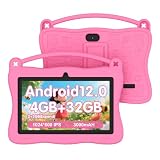
WINProlink’s pitch is simple: a 7-inch tablet, 4GB of RAM, 32GB of storage and a shockproof case in the box, in pink. It suits the same buyer as the HOTTABLET — first device, second device, travel device — but it suits them slightly better if the tablet is going to be handed to a young child who has not yet learned to hold things carefully. The shockproof case is not a cosmetic extra; on a device this size it is the primary defence against the drop that ends a tablet’s life.
- Display: 7-inch panel
- Memory: 4GB RAM
- Storage: 32GB ROM
- Protection: shockproof case included
- Colour: pink
- Class: budget 7-inch kids tablet
The value of a bundled shockproof case is easy to underestimate. Category-typical foam and TPU cases absorb a corner-first drop from around a metre — table height, or the height a small child holds a device — by compressing and spreading the impact over a wider area. Without that layer, the same drop lands on a glass panel bonded to a rigid frame, and the failure mode is a cracked screen rather than a scuff. Buying the case separately typically adds a meaningful percentage to the cost of a budget tablet, so having it included changes the real-world price of this device relative to the HOTTABLET.
What you give up is expansion headroom. Where the HOTTABLET lists 1TB microSD support, this listing does not advertise it, which means 32GB may be the ceiling — and after the operating system and preinstalled apps, that could leave somewhere in the region of 12GB to 18GB usable. For a child who streams rather than downloads, that is workable. For a child who wants offline video for flights, it becomes tight quickly. Check the current listing