
Key takeaways
- Compare dust collection fittings that join hoses, machines and collectors. We cover elbows, wyes and reducers and top picks for tidy workshop air.
What's inside
As an Amazon Associate I earn from qualifying purchases. This post may contain affiliate links at no extra cost to you.
A woodshop fills with fine dust fast, and the weak point is rarely the collector itself. Hoses slip off ports, a 4-inch main meets a 2-1/2-inch tool outlet with nothing to join them, and a sharp bend chokes airflow until chips pile up at the saw. Choosing fittings means matching diameters, picking elbows and wyes that keep air moving, and building sealed runs while machines change. The five fittings below cover those jobs, from a full network kit to a single cone reducer bridging two hose sizes.
This guide suits home woodworkers setting up a first dust run, owners of a small shop adding a second machine, and anyone whose router table throws chips across the bench. Every pick below comes from its Amazon listing name and specs, so diameters, included parts, and model numbers match what the maker publishes. All five picks carry the same brand because that maker lists the widest matching range of fittings, while the kits cover different diameters and jobs.
Sections
Quick Picks
As an Amazon Associate we earn from qualifying purchases
| Product | Best for | Key spec from title |
|---|---|---|
| POWERTEC 70306 Fittings Network | A full 4-inch shop network | 4-inch fittings network with Y-fittings and elbow |
| POWERTEC 70474 Elbow and Dust Bag | A planer dust port that needs a turn | 4-inch 90-degree elbow with 30-micron filter bag |
| POWERTEC 70315 Fittings Kit | Three small machines on one line | 2-1/2-inch fittings kit for a 3-machine setup |
| POWERTEC 70488 Router Table System | Dust above and below a router table | Router table system with Y fitting and reducers |
| POWERTEC 70338-P2 Cone Reducer | Joining 4-inch hose to 2-1/2-inch hose | 4-inch to 2-1/2-inch cone reducer with clamps |
How to Choose
Match the Diameter First
Measure every dust port before ordering anything, because a fitting that looks right can still leak if its diameter is off by a quarter inch. Most home shops run either 4-inch mains or 2-1/2-inch branches, and many tools mix the two, with a table saw on the larger line and a sander on the smaller one. Check whether the listing gives an inside or outside diameter, since a 4-inch hose slips over a different fitting than a 4-inch port. Write down each machine port size, then pick fittings that step between those sizes without tape, shims, or forced fits that work loose under vibration.
Elbows, Wyes, and Reducers Do Different Jobs
An elbow changes direction, a wye splits one run into two branches, and a reducer steps one diameter down to another, so each piece solves a different layout problem. A 90-degree elbow suits a tight turn behind a planer, while a 45-degree elbow keeps air moving with less drag on a longer run. A wye feeds two machines from one main without a hard tee that stalls airflow. A cone reducer joins a 4-inch hose to a 2-1/2-inch tool port, which is the most common mismatch in a small shop. Buy the piece that matches the job in front of you rather than a generic adapter that fits nothing well.
Kits Versus Single Fittings
A kit makes sense when several machines need connecting at once, because one box can hold elbows, wyes, clamps, and pipe for a whole run. The 4-inch network kit below covers a multi-machine layout, while the 2-1/2-inch kit suits three smaller tools sharing one collector. A single fitting makes more sense when only one joint is missing, such as a reducer between two hose sizes or an elbow behind a planer. Count the joints your layout needs before choosing, and keep a spare clamp or two on hand, since a missing clamp can hold up an otherwise finished run.
Seals, Clamps, and Airflow
A dust system only works when every joint seals, because one loose cuff can bleed away the suction that two machines share. Key hose clamps tighten by hand and hold a hose round on a fitting, while a flex cuff bridges a small gap between a port and a hose end. Clear plastic fittings help here, since you can see a blockage forming at a bend before it chokes the line. Keep runs as short and straight as the shop allows, and place blast gates where you can reach them, so closing one branch sends full suction to the machine in use.
The 5 Best Options
POWERTEC 70306 4-Inch Dust Collection Fittings Network

This network kit is the pick for a shop that wants a complete 4-inch backbone in one box. It bundles pipes, Y-fittings, an elbow, and mounting brackets, so a woodworker can run a main line along the wall and branch off to several machines without hunting down each piece separately. The clear pipes let you spot a clog before it grows, and the included brackets hold the run steady overhead. It fits a garage shop with a central collector and a few stationary tools, and it suits anyone who would rather plan one layout than assemble a system piece by piece.
Specs
- Model number 70306, 4-inch size, plastic material
- Includes 5 blast gates, 1 splice, and 4 3-foot dust collection pipes
- Includes 4 Y-fittings and 1 90-degree elbow
- Includes 10 U bracket clamp hangers, 20 screws, and 20 wall plugs
- First available January 5, 2024
Best for: Building a full 4-inch dust network for several machines at once.
Watch out for: The kit is built around 4-inch runs, so smaller tool ports still need a reducer to join it.
ASIN: B0CRDG7Q37
POWERTEC 70474 4-Inch 90-Degree Elbow and Dust Collector Bag

This elbow and bag set solves the awkward turn behind a thickness planer, where chips leave the port and need to drop into a bag without a long hose run. The 90-degree elbow turns the flow cleanly, the clear body shows a blockage at the bend before it backs up, and the 30-micron bag catches fine dust that would otherwise drift across the shop. It fits common planers from DEWALT and WEN, and the key hose clamp tightens by hand without tools. Confirm availability before ordering, since the listing showed no featured offers at the time of the latest crawl.
Specs
- Model number 70474, 4-inch ID by 4-inch OD 90-degree elbow
- Includes 1 30-micron dust collection bag and 1 4-inch key hose clamp
- Material: ABS plastic and polyester
- Item weight 1 pound, dimensions 13.58 by 7.99 by 4.65 inches
- Fits DEWALT DW735 and DW734, WEN PL1326 and PL1303
- First available June 13, 2025
Best for: Turning a planer dust port 90 degrees into a filter bag.
Watch out for: The bag suits planer chips and fine dust, not a full collector line, and stock should be confirmed before ordering.
ASIN: B0FCY3Q664
POWERTEC 70315 2-1/2-Inch Dust Collection Fittings Kit

This kit covers the smaller side of the shop, where a sander, a band saw, and a router table each carry a 2-1/2-inch port. It packs elbows, Y-fittings, and a generous set of key hose clamps into one box, so three machines can share a single collector line without a separate order for each joint. The 45-degree elbows keep bends gentle, which helps airflow on longer branch runs, and the stainless clamps resist rust in a damp garage. It is the neatest way to bring several small-port tools onto one dust line.
Specs
- Model number 70315, 2-1/2-inch size, plastic material
- 27 pieces in the kit
- Includes 2 45-degree elbow connectors and 2 Y-fittings
- Includes 3 clog-resistant blast gates and 20 2-1/2-inch key hose clamps
- Item dimensions 11 by 12 by 7 inches, UPC 843441111009
Best for: Connecting three small-port machines to one dust collector line.
Watch out for: Every fitting is 2-1/2-inch, so a 4-inch main still needs a reducer to meet this kit.
ASIN: B0B3X34JV7
POWERTEC 70488 Router Table Dust Collection System

This system tackles the router table, which throws chips both above the table and below it, and a single fence port never catches both. The kit pairs a rubber air intake with a foam strip seal at the top, a Y-fitting and reducers below, and hoses that carry debris to a shop vac or collector. It works with fixed-base routers from BOSCH, Makita, and Porter Cable, and it keeps the cut line visible instead of buried under chips. Lift router tables are the one exception, since the listing states this system does not fit them.
Specs
- Model number 70488, dust collection fittings for router tables
- Includes Y fitting, hoses, and reducers for shop vac or collector use
- Material: ABS plastic
- Outside diameter 4 inches, item length 5 feet
- Works with BOSCH PR20EVS, Makita, and Porter Cable routers
- Not compatible with lift router tables, UPC 843441155331
Best for: Capturing router dust from above and below the table at once.
Watch out for: Lift router tables need a different setup, since this kit does not fit them.
ASIN: B0FGCLC2YH
POWERTEC 70338-P2 4-Inch to 2-1/2-Inch Cone Reducer
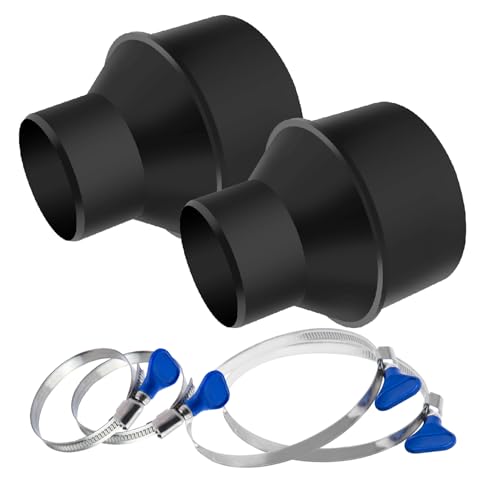
This cone reducer is the simplest fix for the most common mismatch in a home shop: a 4-inch hose meeting a 2-1/2-inch tool port. The tapered cone steps the airflow down without a hard shoulder that catches chips, and the two included reducers cover a pair of machines or a spare for the next layout change. Key hose clamps in both sizes come in the box, so each end tightens by hand and stays sealed under vibration. It also fits shop vac hoses and dryer vent runs, which makes it handy beyond the dust system itself.
Specs
- Model number 70338-P2, 4-inch to 2-1/2-inch cone reducer
- Includes 2 cone reducers, 2 4-inch key hose clamps, and 2 2-1/2-inch key hose clamps
- Material: ABS plastic and stainless steel
- 4-inch nominal end measures 3-61/64 inches OD and 3-41/64 inches ID
- 2-1/2-inch nominal end measures 2-15/32 inches OD and 2-9/32 inches ID
- First available March 1, 2022
Best for: Joining a 4-inch hose to a 2-1/2-inch port without leaks.
Watch out for: The reducer fits inside-diameter hose ends only, so an outside-diameter port needs a flex cuff as well.
ASIN: B09TNQ6YBG
Which One Fits Your Situation
A First Dust Run in a Small Shop
A first run should stay simple: one collector, one main line, and fittings that match the machines already in the shop. The 70306 network kit covers a 4-inch layout in a single box, with pipes, wyes, and brackets included, so a new shop owner can mount a run along the wall and branch to each tool. Add the 70338-P2 cone reducer wherever a smaller port meets the main, and the whole system stays sealed from the first cut.
Adding a Second or Third Machine
When a shop grows past one machine, the question is how to share one collector without losing suction at every branch. The 70315 kit answers it for smaller tools, since its elbows, wyes, and clamps connect three 2-1/2-inch ports to a single line. Pair it with the cone reducer if the main is 4-inch, and place a gate on each branch so the machine in use gets the full pull.
A Router Table That Throws Chips Everywhere
A router table needs dust control at two places at once, above the bit and below the table, and a fence port alone catches only half the mess. The 70488 system seals an intake over the cut and runs a Y-fitting below, so chips from both sides travel to the vac together. It fits fixed-base routers from the common brands, and it keeps the cut line clear enough to see the work.
Bridging Two Hose Sizes on a Tight Layout
Some shops only need one joint fixed, not a whole new network, and a single reducer does that job for less fuss than a kit. The 70338-P2 cone reducer steps a 4-inch hose down to a 2-1/2-inch port with clamps in both sizes included. It suits a sander or a small saw joining an existing main, and the second reducer in the pack covers the next machine added later.
Common Mistakes
- Mixing inside and outside diameters, so a hose that should slip over a fitting will not seat at all.
- Using a sharp 90-degree turn where a 45-degree elbow or a gentler bend would keep air moving.
- Skipping clamps on a joint, which lets vibration work a hose loose and bleed suction from the line.
- Buying a full kit when only one reducer is missing, or buying single fittings when a whole run needs building.
- Forgetting that a router table needs dust control above and below the table, not just at the fence.
Frequently Asked Questions
What size dust collection fittings does a home shop need?
Most home shops need both 4-inch and 2-1/2-inch fittings, since larger machines use the bigger size and sanders and small saws use the smaller one. Measure each tool port before ordering, and note whether the listing gives an inside or outside diameter. A cone reducer bridges the two sizes where they meet, so a mixed shop can run one main line.
Do I need a kit or single fittings?
A kit suits a shop connecting several machines at once, because one box holds the elbows, wyes, and clamps for a whole run. Single fittings suit a shop that only needs one joint fixed, such as a reducer between two hose sizes or an elbow behind a planer. Count the joints in your layout first, then choose the option that covers them without leaving spares you will never use.
Why does my dust hose keep slipping off the port?
A hose slips when its diameter does not match the fitting, when no clamp holds it, or when vibration works it loose. Key hose clamps tighten by hand and keep the hose round on the fitting, while a flex cuff bridges a small gap between port and hose end. Check each joint after the first few cuts, since a joint that felt tight at setup can loosen once machines run.
Can one dust collector serve several machines?
One collector can serve several machines when the runs are sealed and each branch has a gate to close it off. A wye splits a main into branches, and closing the gates on idle machines sends full suction to the one in use. Keep runs short and straight where possible, since long runs and sharp bends cut airflow before it reaches the tool.
Related guides
More from Amazon
Programs that pair well with the guide above. Offers and eligibility are set by Amazon and may change.
A free business account with business pricing and bulk-buying tools for work, shop or home office.
Create a business accountFree shipping on eligible items, Prime Video and more. Eligible new members can start with a free trial.
Start a Prime free trialAudiobooks and podcasts to listen to on the go. Eligible new members can start with a free trial.
Try Audible freeAd-free music streaming. Eligible new subscribers can start with a free trial.
Try Music Unlimited freeAs an Amazon Associate we earn from qualifying purchases.

Write Your Review
No reviews yet. Be the first to share your experience!