What's inside
- Top 3 Picks
- Quick Comparison
- How We Chose
- 1. SageNest L Shaped Desk, 50 Inch Reversible – Best for Corner Workstations
- 2. Sweetcrispy 40-Inch Small Computer Desk – Best for a First Bedroom Desk
- 3. Pamray 32 Inch Computer Desk with 4 Drawers – Best for Storage in a Narrow Footprint
- 4. DLisiting Black Computer Desk with Hutch & Drawers, 47 Inch – Best for Document-Heavy Work
- 5. DUMOS 31″ Small Computer Desk – Best for the Smallest Usable Footprint
- 6. Lufeiya Computer Desk with File Drawers Cabinet, 47 Inch Reversible – Best for Home Businesses That File Paper
- 7. Korfile 47 Inch Gaming Computer Desk – Best for Gamers Who Need Storage
- 8. Lufeiya Small Desk with Power Outlets and LED Lights, 32 Inch – Best for Teen Study Corners
- 9. PRAISUN 55 inch Gaming Desk – Best for Dual-Monitor Gaming
- 10. PRAISUN 55.1 Inch Computer Office Desk with Power Outlets and USB-C Port – Best for Device-Heavy Work-From-Home
- 11. ODK 53″ L Shaped Gaming Desk with Shelves – Best Overall for a Dedicated Home Office Corner
- 12. VASAGLE Computer Desk, Steel Frame, 47.2 Inch – Best Budget Desk for Sturdy Simplicity
- How to Choose
- Related Guides
- Top 3 Picks
- Quick Comparison
- How We Chose
- 1. SageNest L Shaped Desk, 50 Inch Reversible – Best for Corner Workstations
- 2. Sweetcrispy 40-Inch Small Computer Desk – Best for a First Bedroom Desk
- 3. Pamray 32 Inch Computer Desk with 4 Drawers – Best for Storage in a Narrow Footprint
- 4. DLisiting Black Computer Desk with Hutch & Drawers, 47 Inch – Best for Document-Heavy Work
- 5. DUMOS 31″ Small Computer Desk – Best for the Smallest Usable Footprint
- 6. Lufeiya Computer Desk with File Drawers Cabinet, 47 Inch Reversible – Best for Home Businesses That File Paper
- 7. Korfile 47 Inch Gaming Computer Desk – Best for Gamers Who Need Storage
- 8. Lufeiya Small Desk with Power Outlets and LED Lights, 32 Inch – Best for Teen Study Corners
- 9. PRAISUN 55 inch Gaming Desk – Best for Dual-Monitor Gaming
- 10. PRAISUN 55.1 Inch Computer Office Desk with Power Outlets and USB-C Port – Best for Device-Heavy Work-From-Home
- 11. ODK 53″ L Shaped Gaming Desk with Shelves – Best Overall for a Dedicated Home Office Corner
- 12. VASAGLE Computer Desk, Steel Frame, 47.2 Inch – Best Budget Desk for Sturdy Simplicity
- How to Choose
- Related Guides
As an Amazon Associate I earn from qualifying purchases. This post may contain affiliate links at no extra cost to you.
The best Black Friday desk deals for a small home or office usually come down to one question: do you need a desk that disappears into a corner, or one that earns its floor space with drawers and shelving? For most tight rooms, the SageNest L Shaped Desk, 50 Inch Reversible Computer Desk with CPU Stand is the best overall pick — it converts a dead corner into usable work surface, and the reversible build fits either a left- or right-handed layout without a custom order. If budget is the binding constraint, the DUMOS 31″ Small Computer Desk is the least expensive way to get a stable, genuinely usable writing surface into a bedroom or studio. If you are furnishing a dedicated office and want the most desk for the money, the ODK 53″ L Shaped Gaming Desk with Shelves, LED & Outlets is the premium choice. Every desk in this roundup is a fixed-height model, so the guide below also explains exactly when a fixed desk beats an adjustable one in a small space, and when it does not.
Sections
- Top 3 Picks
- Quick Comparison
- How We Chose
- 1. SageNest L Shaped Desk, 50 Inch Reversible – Best for Corner Workstations
- 2. Sweetcrispy 40-Inch Small Computer Desk – Best for a First Bedroom Desk
- 3. Pamray 32 Inch Computer Desk with 4 Drawers – Best for Storage in a Narrow Footprint
- 4. DLisiting Black Computer Desk with Hutch & Drawers, 47 Inch – Best for Document-Heavy Work
- 5. DUMOS 31″ Small Computer Desk – Best for the Smallest Usable Footprint
- 6. Lufeiya Computer Desk with File Drawers Cabinet, 47 Inch Reversible – Best for Home Businesses That File Paper
- 7. Korfile 47 Inch Gaming Computer Desk – Best for Gamers Who Need Storage
- 8. Lufeiya Small Desk with Power Outlets and LED Lights, 32 Inch – Best for Teen Study Corners
- 9. PRAISUN 55 inch Gaming Desk – Best for Dual-Monitor Gaming
- 10. PRAISUN 55.1 Inch Computer Office Desk with Power Outlets and USB-C Port – Best for Device-Heavy Work-From-Home
- 11. ODK 53″ L Shaped Gaming Desk with Shelves – Best Overall for a Dedicated Home Office Corner
- 12. VASAGLE Computer Desk, Steel Frame, 47.2 Inch – Best Budget Desk for Sturdy Simplicity
- How to Choose
- Related Guides
Top 3 Picks
Best overall: SageNest L Shaped Desk, 50 Inch Reversible Computer Desk with CPU Stand. The 50-inch L-shape is the sweet spot for a small room: wide enough for a monitor, keyboard, and a notebook, but shaped to hug a corner instead of running along a wall. The reversible return means you can flip it to suit the room, and the included CPU stand lifts the tower off the floor so it does not collect dust or get kicked. It is a budget-tier desk that solves a layout problem rather than just selling a rectangle.
Best budget: DUMOS 31″ Small Computer Desk. At roughly 31 inches wide, this is the smallest desk here that still takes a full-size monitor and keyboard without feeling like a shelf. It suits renters, dorm rooms, and anyone whose only free wall is barely wider than a door. The deep black finish hides scuffs better than light woodgrains, and the simple frame keeps the price at the bottom of the market.
Best premium: ODK 53″ L Shaped Gaming Desk with Shelves, LED & Outlets. The 53-inch L gives you two working legs of surface, the shelves get peripherals and books off the desktop, and the built-in outlets and LED lighting mean you are not crawling behind the desk with an extension cord. It is the pick when the desk has to be the whole office, not just a place for a laptop.
Quick Comparison
| Product | Best for | Key specs | Price tier |
|---|---|---|---|
| SageNest L Shaped Desk, 50 Inch Reversible | Corner workstations in small bedrooms and studios | 50 in L-shape, reversible left/right return, CPU stand included, fixed height | Budget |
| Sweetcrispy 40-Inch Small Computer Desk | A first desk in a bedroom or shared home office | 40 in wide rectangular top, black finish, fixed height | Budget |
| Pamray 32 Inch Computer Desk with 4 Drawers | Writers and students who need closed storage in a narrow footprint | 32 in wide, four drawers, simple modern frame, fixed height | Mid-range |
| DLisiting Black Computer Desk with Hutch & Drawers, 47 Inch | Document-heavy work and printer stations | 47 in wide, upper hutch, drawers, black finish, fixed height | Premium |
| DUMOS 31″ Small Computer Desk | The smallest genuinely usable footprint | 31 in wide, deep black finish, open frame, fixed height | Budget |
| Lufeiya Computer Desk with File Drawers Cabinet, 47 Inch Reversible | Home businesses that file paper | 47 in wide, reversible orientation, integrated filing cabinet | Premium |
| Korfile 47 Inch Gaming Computer Desk | Gamers who want storage plus cable management | 47 in wide, power outlets, LED lighting, five drawers | Mid-range |
| Lufeiya Small Desk with Power Outlets and LED Lights, 32 Inch | Teens, study corners, and shared bedrooms | 32 in wide, built-in outlets, LED lighting, compact top | Mid-range |
| PRAISUN 55 inch Gaming Desk | Dual-monitor gaming setups | 55 in wide, LED lighting, power outlets, raised monitor stand | Mid-range |
| PRAISUN 55.1 Inch Computer Office Desk with USB-C Port | Work-from-home setups with many devices | 55.1 in wide, outlets plus USB-C, reversible, four fabric drawers | Premium |
| ODK 53″ L Shaped Gaming Desk with Shelves | A dedicated office corner that needs storage | 53 in L-shape, integrated shelves, LED, power outlets | Premium |
| VASAGLE Computer Desk, Steel Frame, 47.2 Inch | No-frills sturdiness on a tight budget | 47.2 in wide, steel frame, open design, fixed height | Budget |
How We Chose
This roundup is built from published product specifications and category knowledge, not from physical evaluation. Every desk listed is a currently available model whose manufacturer publishes its dimensions, materials, and orientation options, and each one was assessed against four criteria. First, footprint honesty: a desk marketed as “small” only qualifies here if its stated width is genuinely workable in a bedroom, and the width figure is the number we lean on most, because it is the one measurement that decides whether a desk fits at all. Second, category fit: the list deliberately spans fixed-height writing desks, L-shaped corner desks, gaming desks with lighting and power, and office desks with filing storage, so a reader can match a desk to a room rather than to a marketing label.
Third, use-case match: we asked what each desk is actually good at — a 31-inch top is excellent for a laptop and terrible for a printer, a 55-inch gaming desk is the reverse — and assigned it a “best for” line accordingly. Fourth, upgrade path: we looked at whether the desk can absorb a monitor arm, a second screen, or a clip-on lamp without the top flexing, and whether the frame or the storage is the part that will limit the owner in two years. Price tiers are described as budget, mid-range, and premium rather than as fixed figures, because promotional pricing during a sale event changes daily and a tier is a more durable way to compare. Where a specification is not consistently published across listings, we describe it by class rather than quoting a number.
1. SageNest L Shaped Desk, 50 Inch Reversible – Best for Corner Workstations
As an Amazon Associate we earn from qualifying purchases at no extra cost to you.

This is the desk to buy when your room has a dead corner and no usable wall. The 50-inch L-shape puts one working leg along each wall of the corner, which means the surface you actually sit at can be narrower than a 50-inch straight desk while still holding a monitor, a keyboard, a mouse, and a notebook. It suits renters, students in shared housing, and anyone working in a bedroom where the desk has to coexist with a bed and a wardrobe.
Key specs at a glance
- Footprint class: L-shaped corner desk, 50 inches on the named dimension
- Orientation: reversible return, so the long leg can run left or right of the corner
- Included accessory: a CPU stand that lifts the tower off the floor
- Height: fixed, non-adjustable
- Construction class: metal frame with an engineered-wood top, the standard build for this price tier
- Price tier: budget
The CPU stand is the detail that separates this from a generic corner desk. Towers sitting on carpet pull in dust, get bumped by feet, and make cable swaps a chore. Lifting the tower into a cradle attached to the desk frame solves all three at once, and it also frees roughly a square foot of floor — which matters more in a small room than the same space would in a large one. The reversible design is the second real advantage. Corner desks are handed, and getting the handedness wrong means either returning the desk or living with the short leg on the wrong side of your chair. A reversible build lets you decide after the box is open.
Where it gives ground is rigidity. Any L-shaped desk at this tier relies on the corner joint for most of its stiffness, and the corner is also where the desk is most likely to rock if the floor is uneven. Plan on adjusting the feet carefully and re-tightening the corner fasteners after the first week of use — that settling period is normal for flat-pack furniture and it is the single most common reason a new desk feels wobbly.
Pros
- Turns unusable corner space into a real workstation
- Reversible orientation removes the handedness gamble
- CPU stand keeps the tower off the floor and out of the way
- Lowest price tier for an L-shaped footprint of this size
Cons
- Fixed height, so it will not suit anyone who wants to alternate sitting and standing
- Corner joint needs re-tightening after initial settling
- No integrated power, drawers, or cable channel
- An L-shape is a poor fit for a room with no usable corner
Against the ODK 53″ L Shaped Gaming Desk, the trade is straightforward: the ODK adds shelves, LED lighting, and outlets and gives you three more inches per leg, but it sits two tiers higher in price. Against the DUMOS 31″, the SageNest gives you far more surface area for a modest premium — but only if you have a corner to give it. If your room is a single straight wall, the DUMOS or the VASAGLE is the better buy.
2. Sweetcrispy 40-Inch Small Computer Desk – Best for a First Bedroom Desk

The 40-inch Sweetcrispy is the desk you buy for a teenager’s room, a spare-bedroom office, or a first apartment where the desk is going to be moved again within a year. Forty inches is the practical minimum for a setup that includes a monitor on a stand, a keyboard, and a mug, and it is also narrow enough to slide between a bed and a wall in a typical secondary bedroom.
Key specs at a glance
- Footprint class: compact rectangular desk, 40 inches wide
- Finish: black
- Height: fixed
- Construction class: metal legs with a flat engineered-wood top
- Storage: none built in
- Price tier: budget
Its strength is that it does one thing without compromise: it provides a flat, stable rectangle at the lowest price tier in this roundup while still being wide enough for real work. The open frame underneath means there is no drawer box to hit your knees on and no cabinet to block a wall outlet, which is an underrated advantage in a bedroom where the only socket is behind the desk. Cable management is a matter of a clip-on tray or a few adhesive clips, both of which cost very little.
The honest limitation is that 40 inches is a single-monitor width. A 27-inch display plus a laptop on a stand will fit; two 27-inch displays side by side will not, and a printer will have to live somewhere else. That is not a defect at this price tier — it is the arithmetic of a compact desk, and it is worth knowing before you buy rather than after.
Assembly on a desk of this class is typically a four-leg, flat-pack job: legs, a cross brace or two, and a top, with the hardware bagged and labeled. Expect a simple desk of this type to come together in well under an hour with the included Allen key, and expect the reverse job to take about the same, which is what makes it a good choice for renters.
Pros
- Lowest price tier while still offering a genuinely usable width
- Open under-desk area keeps wall outlets accessible
- Light enough for one person to move between rooms
- Simple construction means fast assembly and fast disassembly
Cons
- Single-monitor width only
- No drawers, shelves, or power built in
- Black finish shows dust more than a mid-tone woodgrain
- Not wide enough for a printer or a second screen
Compared with the Pamray 32 Inch with four drawers, the Sweetcrispy is wider but has nowhere to put anything. If you need closed storage more than you need surface width, the Pamray wins; if you need to spread out papers or a keyboard and a notebook, the Sweetcrispy’s extra eight inches matter more than drawers.
3. Pamray 32 Inch Computer Desk with 4 Drawers – Best for Storage in a Narrow Footprint

The Pamray solves the specific problem of needing drawers in a room that cannot fit a drawer unit. At 32 inches wide, it occupies roughly the same floor space as a small writing table, but it stacks four drawers into that footprint, which is the difference between a tidy study corner and a permanent pile of pens, chargers, and paperwork on the desktop.
Key specs at a glance
- Footprint class: compact desk, 32 inches wide
- Storage: four drawers integrated into the desk
- Style: simple modern, aimed at bedroom, study, and writing use
- Height: fixed
- Construction class: metal frame with engineered-wood panels and drawer fronts
- Price tier: mid-range
Drawers change how a small desk is used. On an open 32-inch desk, the top surface competes with everything you own. With four drawers, the surface is reserved for the monitor, keyboard, and the work in progress, and the clutter goes below. That is worth more in a bedroom study than an extra four inches of width would be, which is the central trade in this price tier.
The trade runs the other way on knee room. A drawer stack occupies the space under the desktop where your legs would otherwise go, so the usable seating position narrows. Anyone tall, or anyone who likes to sit at an angle with a foot tucked under the chair, should measure the clear gap between the drawer bank and the far leg before committing. As a rule, a desk with a drawer column works best with a chair that has no fixed armrests, because armrests are what collide with the drawer front when you push in.
Pros
- Four drawers at a 32-inch footprint, which is rare in this size class
- Desktop stays clear for actual work
- Mid-range tier rather than premium for a storage-equipped desk
- Neutral modern styling suits a bedroom or a study
Cons
- Drawer bank eats into under-desk legroom
- Drawers are small-format, not built for hanging files
- Narrower top than a 40-inch desk at a similar or lower tier
- Fixed height
Against the Lufeiya 32 Inch with outlets and LED, the Pamray trades lighting and power for enclosed storage. If your clutter is physical — paper, pens, cables — the Pamray is the better answer. If your clutter is electrical and you are tired of hunting for a free outlet, the Lufeiya’s built-in power is the more useful feature.
4. DLisiting Black Computer Desk with Hutch & Drawers, 47 Inch – Best for Document-Heavy Work

The DLisiting is the desk for someone whose work generates paper. The 47-inch top is wide enough for a monitor plus a keyboard plus a document you are actively working from, and the hutch above turns vertical space into shelving for binders, reference books, and the small office supplies that otherwise colonize the desktop.
Key specs at a glance
- Footprint class: full-size home office desk, 47 inches wide
- Storage: upper hutch shelving plus lower drawers
- Finish: black
- Height: fixed
- Construction class: metal frame with engineered-wood panels
- Price tier: premium
A hutch is the highest-value storage a desk can have, because it uses the air above the desktop rather than the floor beneath it. On a 47-inch desk, a hutch effectively doubles the storage capacity without costing an inch of floor space — the thing small rooms are shortest on. It also gives you a place for a desk lamp or a small plant at eye level rather than at elbow level, which keeps the working surface clear.
The cost of a hutch is visual weight and light. A tall upper section makes a room feel smaller and can block a window if the desk sits under one, and it can shadow the desktop if the room’s only light comes from a ceiling fixture directly above. In a genuinely small bedroom, that is a real consideration: a hutch desk placed against a wall with no window can turn a bright corner into a dim one. If the desk will sit in front of a window, choose a hutch-free model instead.
Assembly on a desk with both a hutch and drawers is the most involved job in this roundup by class. Expect more panels, more fasteners, and more chances to install a piece backward. The standard defense is to lay every panel out and label them before starting, and to attach the hutch to the desk body last, after the base is square and the feet are level.
Pros
- Hutch shelving adds storage without adding floor footprint
- 47-inch top handles a monitor, keyboard, and paperwork simultaneously
- Drawers keep small items out of sight
- Reads as a proper office desk rather than a temporary setup
Cons
- Premium tier for what is still a fixed-height desk
- Hutch makes a small room feel tighter and can block window light
- Most complex assembly in this list
- Heavier and harder to move than an open desk
Against the Lufeiya 47 Inch with file drawers, the DLisiting offers open shelving and the Lufeiya offers a proper filing cabinet. If your paper is loose and needs to be seen, take the hutch. If your paper belongs in hanging files and needs to be out of sight, take the Lufeiya.
5. DUMOS 31″ Small Computer Desk – Best for the Smallest Usable Footprint

When the available wall is barely wider than a doorway, this is the desk. At 31 inches, the DUMOS is the narrowest model in this roundup that still accommodates a monitor on a stand, a keyboard, and a mouse with room to move the mouse. It suits dorm rooms, box bedrooms, and the growing number of people who work from a corner of a living room and need to pack the desk away visually when the day ends.
Key specs at a glance
- Footprint class: ultra-compact desk, 31 inches wide
- Finish: deep black
- Height: fixed
- Construction class: metal frame with a flat engineered-wood top
- Use profile: writing, study, and light gaming
- Price tier: budget
The DUMOS is honest about what it is. There are no drawers, no outlets, and no lighting, and in exchange the price sits at the bottom of the market and the desk fits where nothing else does. For a laptop-and-notebook user, 31 inches is entirely sufficient. For a desktop tower plus a 27-inch monitor plus speakers, it is not, and no amount of clever cable management changes that.
The one upgrade worth planning for is a monitor arm. On a narrow desk, the monitor’s own base eats the most valuable real estate you have; clamping the display to the back edge or to a grommet frees the full 31 inches of top for keyboard, notebook, and mouse. Check that the desk’s top and frame can take a clamp — a thin top with no rear support can compress under a heavy arm — and check that the rear edge is accessible, which rules out desks pushed hard against a wall with a deep skirting board.
Assembly is about as simple as flat-pack furniture gets: legs, braces, top, hardware. A desk of this class typically takes well under an hour for one person, and it can be disassembled just as quickly for a move. That portability is a genuine feature for renters and students, not a consolation prize.
Pros
- Narrowest footprint here, so it fits walls nothing else will
- Lowest price tier alongside the Sweetcrispy
- Very quick to assemble and disassemble
- Open frame leaves outlets and floor space clear
Cons
- No storage, power, or lighting built in
- Too narrow for a desktop tower plus a large monitor
- Minimal cross-bracing means it is not the most rigid option
- Fixed height
Against the Sweetcrispy 40-Inch, the DUMOS buys you nine inches of wall back and saves a little money, at the cost of surface area. Against the VASAGLE 47.2 Inch steel-frame desk, the DUMOS is smaller but noticeably less substantial; if you have 47 inches of wall and want the most rigid desk per pound spent, the VASAGLE is the better buy.
6. Lufeiya Computer Desk with File Drawers Cabinet, 47 Inch Reversible – Best for Home Businesses That File Paper

This is the desk for a sole trader, a bookkeeper, or anyone who still keeps physical records. The 47-inch top is a full working surface, and the integrated filing cabinet underneath is the feature that separates it from every drawer desk in this roundup — a file drawer holds hanging folders upright, which a shallow utility drawer cannot.
Key specs at a glance
- Footprint class: full-size home office desk, 47 inches wide
- Storage: integrated filing cabinet with drawers
- Orientation: reversible, so the cabinet can sit on either side
- Height: fixed
- Construction class: metal frame with engineered-wood panels
- Price tier: premium
Reversibility matters more on this desk than on most. The filing cabinet is a solid mass under one end, and which end it sits on determines whether you roll your chair in from the left or the right, and whether the cabinet blocks a wall outlet. Because the desk can be assembled either way, you can decide after measuring the room rather than before — and in a small office where the desk has to slot between a door and a window, that flexibility is worth paying for.
Two practical notes on a desk with a filing cabinet. First, weight distribution: a full file drawer is heavy, and if all the paper ends up in the top drawer of the cabinet at one end, the desk becomes front-heavy and more prone to rocking. Load the bottom drawer first and keep the heaviest folders low. Second, floor clearance: cabinet drawers need room to pull out, so do not push the desk tight against a wall on the cabinet side, and check that the drawer front clears any skirting board.
Pros
- True filing storage, not just shallow drawers
- Reversible build lets you choose which side the cabinet sits on
- 47-inch top is wide enough for a monitor and open paperwork
- Looks like office furniture rather than a temporary desk
Cons
- Premium tier
- Cabinet reduces legroom on one side
- Heavier than an open desk and awkward for one person to move
- Fixed height
Against the DLisiting with hutch and drawers, the choice is about the shape of your paper problem. The DLisiting gives you visible shelving for binders and books; the Lufeiya gives you a closed file drawer for hanging folders. If you file weekly, take the Lufeiya. If you reference binders daily, take the DLisiting.
7. Korfile 47 Inch Gaming Computer Desk – Best for Gamers Who Need Storage

The Korfile is aimed at the player who wants a gaming desk that is also a desk. At 47 inches wide with five drawers, it holds a keyboard, a mouse, a headset, and a console or two while keeping controllers, cables, and spare peripherals out of sight. It suits a dedicated gaming room or a bedroom where the setup has to stay tidy between sessions.
Key specs at a glance
- Footprint class: full-size gaming desk, 47 inches wide
- Power: built-in outlets
- Lighting: LED accent lighting
- Storage: five drawers
- Finish: black
- Price tier: mid-range
Built-in outlets are the most genuinely useful gaming-desk feature, because a gaming setup is a power-hungry cluster: console, monitor, charging dock, headset stand, and speakers. Having outlets on the desk rather than on the wall behind it means you can plug in without dismantling the setup, and it removes the rat’s nest of extension leads that otherwise lives under the desk. LED lighting is the feature people buy and then stop noticing, but it does have a practical use: bias lighting behind a monitor reduces the contrast between a bright screen and a dark wall, which many people find easier on the eyes during long sessions.
The five drawers are the differentiator against the PRAISUN gaming desks, which are wider but carry less storage. On a 47-inch gaming desk, the drawer stack will occupy one side of the under-desk area, so plan your chair position and your footrest around it.
Pros
- Five drawers plus built-in power in a single mid-range desk
- Outlets remove the under-desk extension lead problem
- 47-inch top accommodates a large monitor and a console
- Black finish matches typical gaming peripherals
Cons
- Drawer bank takes up legroom
- LED lighting is cosmetic for most users
- Narrower than the 55-inch PRAISUN gaming desks
- Fixed height
Against the PRAISUN 55 Inch Gaming Desk, the Korfile trades eight inches of width for five drawers. If you run a dual-monitor setup, the extra width of the PRAISUN matters more. If you run a single large display and own a lot of small peripherals, the Korfile’s drawers are the better answer.
8. Lufeiya Small Desk with Power Outlets and LED Lights, 32 Inch – Best for Teen Study Corners
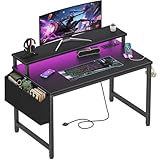
This is a study desk built around the reality that a student’s life is electrical. At 32 inches, it takes a laptop, a notebook, and a lamp, and the built-in outlets mean the laptop charger, phone, and desk light all plug in at the desk rather than across the room. It suits a teenager’s bedroom, a study nook, or a shared space where the desk doubles as a homework station and a charging point.
Key specs at a glance
- Footprint class: compact desk, 32 inches wide
- Power: built-in outlets
- Lighting: LED lighting
- Use profile: teen study, writing, light home office
- Height: fixed
- Price tier: mid-range
For this use case, built-in power is not a gimmick. A study corner in a bedroom is usually far from the nearest wall socket, and the alternative is a trailing extension lead across the floor — a trip hazard and a source of arguments. A desk with outlets solves it permanently. The LED lighting is a secondary benefit: used as a soft backlight it makes a screen-heavy desk less stark at night, and it gives the desk a defined look in a room that otherwise has none.
The 32-inch width is the constraint. A laptop plus a monitor is possible if the monitor is on an arm rather than a stand; a desktop tower plus a monitor is not. Buyers should also check the outlet placement on the specific unit, because a power strip mounted at the front edge of the desk is convenient but can foul a keyboard, while one at the back is tidier but harder to reach.
Pros
- Built-in outlets remove the need for an extension lead
- Compact enough for a bedroom study corner
- LED lighting gives a defined, modern look
- Mid-range pricing rather than premium
Cons
- 32-inch top limits the setup to a laptop or a single monitor
- No drawers or shelving
- LED lighting adds little for pure study use
- Fixed height
Against the Pamray 32 Inch with four drawers, this is a straight swap of storage for power and lighting. A student with loose paper and pens is better served by the Pamray; a student with three devices to charge is better served by the Lufeiya.
9. PRAISUN 55 inch Gaming Desk – Best for Dual-Monitor Gaming
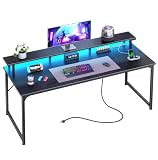
Fifty-five inches is where a gaming desk stops being a compromise. This PRAISUN fits two monitors side by side with room for a keyboard, a mouse with a full sweep, and a headset, and the raised monitor stand lifts the display line so you are not craning your neck down at the desk. It suits a dedicated gaming room or a home office that doubles as a battle station in the evening.
Key specs at a glance
- Footprint class: full-width gaming desk, 55 inches wide
- Lighting: LED accent lighting
- Power: built-in outlets
- Included: raised monitor stand
- Finish: black
- Price tier: mid-range
The raised monitor stand is the feature that justifies the width. On a flat desk, a monitor on its own base sits low, and the natural fix is a stack of books, which is unstable and looks it. A built-in riser puts the bottom of the screen at a sensible height, which lets you sit upright rather than hunched, and it creates a shelf underneath for a keyboard when you are not typing. Combined with 55 inches of width, it makes a two-screen layout genuinely comfortable.
The cost of 55 inches is floor space. This desk needs a wall of roughly four and a half feet plus clearance, which rules out most box bedrooms. It is also the point at which a desk stops being moveable by one person without disassembly. If your room cannot give it that wall, a 47-inch desk with a monitor arm will serve you better than a 55-inch desk squeezed in.
Pros
- 55-inch width comfortably takes two monitors
- Raised monitor stand improves screen height without extra purchases
- Built-in outlets for a power-hungry setup
- LED lighting adds atmosphere and mild bias lighting
Cons
- Needs a long wall; poor fit for small bedrooms
- No drawers or closed storage
- Heavier and more awkward to move than a 47-inch desk
- Fixed height
Against the Korfile 47 Inch, the PRAISUN wins on width and screen layout and loses on storage. Against the PRAISUN 55.1 Inch office desk with USB-C, this gaming model is the more specialized of the two: the office version adds fabric drawers and USB-C but is aimed at work rather than play. If your setup is two monitors and no paperwork, the gaming model is the simpler buy.
10. PRAISUN 55.1 Inch Computer Office Desk with Power Outlets and USB-C Port – Best for Device-Heavy Work-From-Home

This is the work-from-home desk for someone whose job runs through a laptop. The 55.1-inch top is wide enough for a laptop, an external monitor, and a document, and the power panel includes a USB-C port, which means a modern laptop can charge from the desk itself rather than through its own power brick. The four fabric drawers handle the small stuff — notebooks, cables, a headset — without the visual weight of a wooden drawer bank.
Key specs at a glance
- Footprint class: full-width office desk, 55.1 inches wide
- Power: built-in outlets plus a USB-C port
- Storage: four fabric drawers
- Orientation: reversible
- Use profile: home office, study, gaming
- Price tier: premium
USB-C is the detail worth paying attention to. Most desks in this category offer USB-A ports, which will charge a phone but will not charge a modern laptop at a useful rate. A USB-C port on the desk means one cable from the desk to the machine, and it also future-proofs the purchase — USB-C is the direction laptop charging has moved, and a desk with only USB-A will feel dated sooner. As with any built-in port, check the power rating rather than assuming it will run a large laptop at full speed.
Fabric drawers are a deliberate design choice rather than a cost cut. They are light, they do not rattle, and they soften the look of a large desk in a living space. They are also not load-bearing for heavy items and not suitable for files. If your storage needs are heavy, the Lufeiya 47 Inch filing desk is the better match.
Pros
- USB-C port suits modern laptop charging
- 55.1-inch top handles a laptop, monitor, and paperwork together
- Reversible orientation for awkward room layouts
- Fabric drawers keep the desk visually light in a living space
Cons
- Premium tier
- Fabric drawers are not suitable for files or heavy items
- Requires a long wall, like any 55-inch desk
- Fixed height
Against the PRAISUN 55 Inch gaming desk, the choice is about what sits on the desk. The gaming model gives you a monitor riser and a bolder look; this office model gives you USB-C and closed storage. Against the ODK 53-inch L-shape, this desk offers more width along one wall while the ODK offers corner efficiency — pick the ODK if you have a corner and this if you have a wall.
11. ODK 53″ L Shaped Gaming Desk with Shelves – Best Overall for a Dedicated Home Office Corner

If you have a corner and a budget that reaches the premium tier, this is the most desk you can get into a small room. The 53-inch L-shape gives you two working legs of surface, the integrated shelves take peripherals, books, and a headset off the desktop, and the built-in outlets and LED lighting mean the desk is effectively self-contained. It suits someone furnishing a permanent home office who wants the desk to be the whole setup.
Key specs at a glance
- Footprint class: L-shaped corner desk, 53 inches on the named dimension
- Storage: integrated shelves
- Power: built-in outlets
- Lighting: LED
- Finish: black
- Price tier: premium
The combination of an L-shape and shelving is what makes this work in a small room. A corner desk already converts dead space into surface; adding shelves above or beside the return converts dead air into storage. The result is that the desktop stays clear for the keyboard, mouse, and monitor, which is the condition that makes a small office feel calm rather than cramped. Built-in outlets complete the picture: nothing needs to run across the floor.
Two things to plan for. First, an L-shaped desk with a return and shelves is the heaviest, most complex assembly in this roundup by class; budget an afternoon, lay the panels out, and build the base square before attaching anything above it. Second, an L-shape dictates your chair position — you sit in the crook of the L, which means your chair’s rear clearance and your cable routing both need thinking about before the desk is placed, not after.
Pros
- Corner footprint plus shelving makes the most of a small room
- Built-in outlets and LED lighting reduce cable clutter
- 53-inch L gives two usable working surfaces
- Looks like permanent furniture rather than a temporary desk
Cons
- Premium tier
- Most involved assembly of any desk in this list
- Requires a genuine corner to work
- Fixed height
Against the SageNest 50 Inch L-shaped desk, the ODK costs substantially more and gives you shelves, lighting, and outlets in return. If you are setting up for the long term, those extras are worth it; if the desk is for a rental you may leave in a year, the SageNest does the core job for far less.
12. VASAGLE Computer Desk, Steel Frame, 47.2 Inch – Best Budget Desk for Sturdy Simplicity

This is the desk for someone who wants a solid frame and no features. At 47.2 inches wide with a steel frame, it offers the rigidity that cheap desks usually lack, in an open design with nothing to break, rattle, or go out of fashion. It suits a home office that already has its own storage, or a buyer who would rather add a drawer unit and a monitor arm than pay for them integrated.
Key specs at a glance
- Footprint class: full-size desk, 47.2 inches wide
- Frame: steel
- Design: open, no drawers or shelving
- Use profile: home office and gaming
- Height: fixed
- Price tier: budget
The value proposition here is straightforward: the money goes into the frame rather than into features. A steel frame at this width is noticeably more stable than the thin-tube legs common at the budget tier, and stability is the specification that matters most day to day — a desk that wobbles when you type is worse than a desk with one fewer drawer. Because there is nothing underneath, the full width is available for legroom and for a chair with armrests.
The absence of built-in power is the main practical gap. Budget for a clamp-mounted power strip or a desk-edge cable tray; both are inexpensive and together they close most of the distance between this desk and a feature-equipped model. A monitor arm is the other upgrade worth planning, and a steel-framed desk is usually the safest host for one because the frame, not just the top, carries the load.
Pros
- Steel frame gives better rigidity than typical budget desks
- 47.2-inch width suits a monitor plus a laptop
- Open design maximizes legroom and chair clearance
- Budget tier with no feature premium to pay for
Cons
- No drawers, shelves, power, or lighting
- Plain appearance compared with hutch or gaming desks
- Requires add-on purchases to match feature-equipped desks
- Fixed height
Against the Sweetcrispy 40-Inch, the VASAGLE gives you seven more inches of width and a sturdier frame for a similar tier. Against the DLisiting hutch desk, it gives up all the storage. If you want the desk to be furniture, buy the DLisiting; if you want a stable surface and will solve storage separately, buy the VASAGLE.
How to Choose
The single most important decision is not brand or finish — it is whether you want a fixed-height desk or an adjustable one, because that choice determines your budget, your assembly time, and how much floor space the desk consumes. Every desk in this roundup is fixed height. That is not a limitation of the list; it is a deliberate match to the search intent, because fixed desks dominate the value end of the market and they are what most small-space buyers actually end up with. But the choice deserves a proper explanation.
Standing versus fixed: the honest comparison. A fixed desk sits at one height, typically somewhere in the 28-to-30-inch range for standard adult furniture, and it costs whatever the top and frame cost. An adjustable standing desk adds a lifting mechanism — usually two or three electric legs, a control box, and a handset — and that mechanism typically adds a substantial premium, plus more weight, plus a control unit to fail. In exchange, you can change posture during the day, which many people find more comfortable over long working hours. The practical test is not “which is healthier” but “will I actually change height?” A standing desk that stays at sitting height is a fixed desk that cost more and has more to break.
For small rooms, there is a second consideration that rarely gets mentioned: standing desks need vertical clearance. If you plan to stand, you need to be able to raise the desk without hitting a shelf, a sloped ceiling, or a window frame, and you need to be able to step back from it, which requires more floor depth than a fixed desk in the same spot. In a genuinely small room, a fixed desk is often the only option that fits both horizontally and vertically.
Dimensions: the numbers that matter. Width determines what fits on the desk; depth determines what fits in the room. A 31-to-32-inch desk is a single-screen, laptop-first footprint. A 40-inch desk is a comfortable single-monitor desk with room for paperwork. A 47-inch desk is the standard home-office width and takes a monitor plus a laptop or a monitor plus a document. A 53-to-55-inch desk takes two monitors comfortably. On depth, a standard desk sits around 19 to 24 inches deep; anything shallower than about 20 inches puts the monitor too close unless you use a monitor arm, and anything deeper than about 24 inches eats floor you may not have.
For an L-shaped desk, the named dimension is usually the longer leg, and the return is typically shorter. The number to check before buying is not the headline figure but the width of the return, because that is what determines whether the desk can sit in your corner without its short leg jutting past a door frame. Measure the corner itself, then measure the wall on each side of it, then subtract at least an inch of clearance for skirting boards and uneven walls.
| Your situation | Width to look for | Shape | Storage priority | Suggested pick |
|---|---|---|---|---|
| Wall is under 36 in | 31–32 in | Straight | None; use a monitor arm | DUMOS 31″ or Sweetcrispy 40″ |
| Student with devices to charge | 32 in | Straight | Power outlets over drawers | Lufeiya 32″ with outlets |
| Paper clutter, no floor space | 32 in | Straight | Closed drawers | Pamray 32″ with 4 drawers |
| Dead corner in a bedroom | 50–53 in L | L-shaped | Shelves help; outlets help more | SageNest 50″ or ODK 53″ |
| Home business with physical files | 47 in | Straight, reversible | File drawer, not utility drawers | Lufeiya 47″ filing desk |
| Document-heavy reference work | 47 in | Straight with hutch | Open shelving above the top | DLisiting 47″ hutch desk |
| Single large monitor, many peripherals | 47 in | Straight | Drawers plus built-in power | Korfile 47″ gaming desk |
| Two monitors, gaming | 55 in | Straight | Width first, riser second | PRAISUN 55″ gaming desk |
| Laptop-centric remote work | 55 in | Straight, reversible | USB-C charging plus soft storage | PRAISUN 55.1″ office desk |
| Rigid surface, storage solved elsewhere | 47 in | Straight | None; add a drawer unit later | VASAGLE 47.2″ steel frame |
Weight capacity: what to look for and why the number is often vague. Desks in this category typically state a total load capacity somewhere in the range of roughly 100 to 200 pounds, with heavier steel-framed and L-shaped models at the upper end and the lightest compact desks at the lower end. Two things matter more than the headline figure. First, capacity is usually stated as a static, evenly distributed load — a 150-pound rating does not mean a 150-pound object balanced on one corner is safe, because the top and the leg joints see very different forces. Second, the failure point is almost never the frame; it is the joint between the top and the frame, or the fasteners. If you plan to clamp a monitor arm, put a heavy printer on the desk, or lean on the front edge while standing up, look for a desk where the top is thick, the frame runs close to the edges, and the fasteners are through-bolted rather than screwed into the panel. If a listing does not state a capacity, treat it as a light-duty desk and keep the load modest.
Assembly ease: the real timeline. Assembly difficulty scales with part count, not with price. A simple four-leg desk with a top and one or two braces is a job of roughly 20 to 45 minutes for one person with the included key. A desk with drawers adds drawer boxes, runners, and alignment, pushing a realistic estimate to 45 to 90 minutes. A desk with a hutch adds a second structure on top of the first, and an L-shaped desk adds a corner joint that has to be squared — those combinations commonly run to a couple of hours, and they are far easier with two people. Three habits cut the time and the frustration: lay out and identify every panel before tightening anything, leave all fasteners finger-tight until the frame is square, then tighten in a diagonal pattern; and re-check the fasteners a week after assembly, because flat-pack furniture settles.
Materials and finish. Nearly every desk at the budget and mid-range tiers uses an engineered-wood top — particleboard or MDF with a laminated or melamine finish — on a steel or aluminum frame. This is a sensible combination: the panel is flat and stable, and the metal frame provides the stiffness. What wears first is the edge banding, the thin strip that covers the cut edge of the panel. It lifts when it gets wet, so wipe spills rather than letting them sit, and avoid dragging a chair or a box across the edge. Melamine finishes are easy to clean but will show scratches on dark colors, which is why black desks need a little more care than mid-tone woodgrains. Powder-coated steel frames resist scratching well; the point where they fail is at the bolt holes, where repeated loosening and tightening wears the coating away and lets rust start. If you plan to move a desk repeatedly, a light touch on the fasteners is worth more than any protective product.
Small-space specifics. Three measurements decide whether a desk works in a small room. The wall width available, minus clearance for skirting and uneven plaster. The depth of the desk plus the depth of a pulled-out chair, which together typically need about 5 to 6 feet of floor from the wall to allow a chair to slide back. And the height of anything above the desk — a window sill, a shelf, a sloped ceiling — if you are considering an adjustable desk or a hutch. If you are short on depth rather than width, choose a shallower desk and a monitor arm rather than