Key takeaways
- Compare the best framing hammers for carpenters, from 25 oz hickory to 16 oz titanium, with face, handle and weight guidance for your trade.
What's inside
As an Amazon Associate I earn from qualifying purchases. This post may contain affiliate links at no extra cost to you.
The ESTWING Sure Strike California Framing Hammer in 25 ounces is the best overall pick for most carpenters: a forged steel head, a milled face that grips the nail, a rip claw and a hickory handle make it the traditional, no-surprises framing tool. A framing hammer is a long-handled, heavier claw hammer with a straight rip claw and usually a waffled (milled) face, built to drive 16d nails fast and pull or split lumber. If you want a lighter swing, the Estwing Ultra 19 ounce and the Vaughan titanium are the lighter-weight picks.
Sections
Quick List
- ESTWING Sure Strike 25 oz – best for traditional, heavy-duty production framing
- Spec Ops Fiberglass 20 oz – best for demolition-minded carpentry with a shock-absorbing grip
- JORGENSEN 22 oz One-Piece – best for general framing on a tighter budget
- ESTWING Ultra Series 19 oz – best for lighter swings and all-day comfort with a leather grip
- VANQUISH 22 oz Smooth Face – best for finish-minded framing where waffle marks are unwelcome
- VAUGHAN Titanium 16 oz – best as a light-duty runner-up for overhead and roofing work
Which One Is Right for You?
| If you… | Choose |
|---|---|
| Drive thousands of nails and want a long handle and heavy head | ESTWING Sure Strike 25 oz |
| Prefer a lighter hammer to reduce fatigue | ESTWING Ultra Series 19 oz |
| Want a one-piece steel hammer with a nail holder at a lower cost | JORGENSEN 22 oz |
| Frame decks or exposed lumber and do not want waffle marks | VANQUISH 22 oz |
| Do demolition and framing in the same day | Spec Ops Fiberglass 20 oz |
| Work overhead or on roofs and want the lightest option | VAUGHAN Titanium 16 oz |
Most professional framers choose between a 20 to 25 ounce head with a milled face. Heavier hammers drive nails faster per swing; lighter ones save your elbow over a long day. Handle material matters nearly as much as head weight.
All 6 Picks in Detail
1. ESTWING Sure Strike 25 oz – Best for Traditional Production Framing
As an Amazon Associate we earn from qualifying purchases at no extra cost to you.
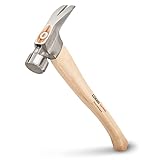
This is Estwing’s California-style framing hammer, and its specification set reads like a framer’s checklist: 25 ounce forged steel head, rip claw, milled face, a magnet to start nails and a genuine hickory handle held with a triple wedge. Estwing gives an overall length of about 18 inches, though some retailers show 17.5 inches. Hickory absorbs shock and replaces easily, which is why many carpenters stay with wood handles.
It suits production framers, deck builders and anyone who wants to put the nail home in two or three blows. The weight is substantial, so it can tire a new user, and wood handles can break if you pry with them. Keep the wedge tight and the handle free of cracks.
A good habit with any wood-handled hammer is to inspect the wedge and the eye of the head before each job. A handle that rattles in the head is a safety hazard, and re-wedging or replacing the handle takes minutes. Keep the hickory dry, wipe away sweat and avoid leaving the hammer in a hot truck bed where the wood can dry and shrink.
- Head weight: 25 oz forged steel
- Face: milled with a magnetic nail starter
- Claw: straight rip claw
- Handle: genuine hickory, curved, triple wedge construction
- Overall length: about 18 in per Estwing; some retailers list 17.5 in
Pros:
- Heavy head drives nails fast
- Replaceable wood handle
- Magnetic nail starter
Cons:
- Heavy for all-day overhead work
- Wood handle needs care when prying
Compared with the Ultra 19 ounce, it hits harder but asks more of your arm.
2. Spec Ops Fiberglass 20 oz – Best for Framing and Light Demolition

The Spec Ops hammer is a 20 ounce fiberglass-handled tool with a rip claw and a shock-absorbing grip. The listing names framing, carpentry and demolition as uses and gives a 13 inch handle, which is shorter than a classic 16 to 18 inch framing hammer. A shorter handle is easier to control in tight spots and for bar-and-nail tasks, but it gives up leverage and swing speed.
It suits carpenters who also tear things apart, remodelers and people who want a rubberized grip over wood. Fiberglass resists snapping under prying, and a short handle is handy in close quarters. Confirm the head material, face type and whether the head is steel on the product page.
Because the listing mentions demolition, this is the hammer many carpenters keep for the rough part of a remodel, like pulling sheathing or knocking out blocking. Its fiberglass handle shrugs off prying that would stress hickory, which makes it a sensible beater tool, leaving a nicer hammer for the final nailing.
- Weight: 20 oz per the listing
- Handle: fiberglass, about 13 in per the listing
- Claw: rip claw
- Grip: shock-absorbing
- Face pattern and magnetic nail holder: confirm on listing
Pros:
- Durable fiberglass handle
- Good in tight spaces
Cons:
- Short handle sacrifices swing speed
- Less traditional feel
It is closest to the Jorgensen in weight class, but the fiberglass handle and shorter reach set it apart.
3. JORGENSEN 22 oz One-Piece – Best for General Framing

The Jorgensen is a 22 ounce one-piece forged framing claw hammer with a nail holder, a milled face, a side puller and a shock-absorbing anti-slip grip. One-piece forging removes the head-to-handle joint, so the head can’t loosen or fly off. The listing also describes a heavy-duty build, which makes it a sensible choice for general carpentry.
It suits contractors, homeowners and apprentices who want a steel hammer without a premium name. The tradeoff with one-piece steel is vibration; the grip and its design matter. Confirm the handle length and finish on the product page, since the title does not list them.
Many first-time buyers overlook the side puller built into some one-piece hammers. It gives you a notch for yanking small nails without using the full claw, which saves wear on the face of the hammer and your wrists. The nail holder is equally handy on a ladder, where setting a nail one-handed is safer than juggling it.
- Weight: 22 oz
- Construction: one-piece forged steel
- Face: milled
- Extras: nail holder, side puller, shock-absorbing grip
- Handle length and finish: confirm on listing
Pros:
- Head cannot come loose
- Nail holder and side puller
- Midweight head
Cons:
- Steel transmits more vibration than wood
- Specs less detailed in the title
Next to the Vanquish, it uses a milled face rather than a smooth one, which grips nails better.
4. ESTWING Ultra Series 19 oz – Best for Lighter Swings and Comfort

Estwing’s Ultra Series is forged from a single piece of American steel, wrapped with a leather washer grip. This E19SM model has a 19 ounce head, a milled face, a magnetic nail starter and a rip claw, according to the listing and Estwing’s page. The overall length is about 15.5 inches, noticeably shorter than a classic framing hammer.
It suits finish carpenters, remodelers and anyone whose arm tires with heavier tools. The short length and light head are comfortable but give up some power on big nails. The leather grip is familiar and warm in cold weather, though it can wear in wet conditions.
The leather grip is the signature of the Ultra Series, and it is a polarizing detail. Fans like the warm, cushioned feel and the way it absorbs some shock; others prefer rubber for wet or muddy conditions. If you work outdoors in winter, leather also feels warmer in the hand than bare steel or hard plastic.
- Head weight: 19 oz
- Face: milled with magnetic nail starter
- Claw: rip claw
- Grip: leather washer grip, riveted
- Overall length: about 15.5 in per Estwing
- Made in the USA per the listing
Pros:
- Lighter and easy to control
- One-piece steel is durable
Cons:
- Less driving power than 22-25 oz tools
- Leather grip needs care in the wet
It is the lighter alternative to the Sure Strike, trading power for comfort.
5. VANQUISH 22 oz Smooth Face – Best for Exposed Lumber and Decks

The Vanquish is a 22 ounce one-piece forged framing hammer with a straight claw and a smooth face. The listing describes a shock-reducing grip and a magnetic nail holder. The smooth face matters: unlike a milled or waffle face, it leaves clean impact marks on soft lumber, making it a smarter pick for deck boards, fascia and trim carpentry.
The tradeoff is grip on the nail head. Smooth faces can skate off a nail if you strike off-center, so they suit careful drivers. If you frame production walls all day, a milled face is safer. Confirm the handle length on the product page.
Because the face is smooth, take extra care to strike the nail head squarely. Practice on scrap lumber first if you are used to a milled face, and consider wearing safety glasses, since a glancing blow can send a nail flying. For visible decking, a smooth face can save you from sanding out waffle marks later.
- Weight: 22 oz
- Construction: one-piece forged
- Face: smooth
- Claw: straight claw
- Extras: magnetic nail holder, shock-reduction grip
- Handle length: confirm on listing
Pros:
- Smooth face leaves cleaner marks
- Shock-reducing grip
Cons:
- Nails can slip off a smooth face
- Not ideal for production walls
It sits in the same weight class as the Jorgensen but with the opposite face choice.
6. VAUGHAN Titanium 16 oz – Best as a Light-Duty Runner-Up

The Vaughan is a titanium hammer with a precision-cast one-piece head, a milled face, a 17 inch hickory handle and a magnetic nail holder, per the listing. Titanium is much lighter than steel for the same size, so the 16 ounce head is aimed at roofers, remodelers and overhead work where arm fatigue is the problem. At 16 ounces it is below the usual weight for heavy framing, so it makes sense as a runner-up for lighter tasks rather than a primary rough framing hammer.
Retailer pages for the Vaughan Dalluge line mention a nail-puller feature and a handle overstrike guard, but confirm this exact model’s features on the product page. Titanium hammers usually cost more than steel, and the light head requires technique: a controlled swing, not brute force.
Roofers often favor lightweight hammers because the work is repetitive and overhead, and a 16 ounce head can be swung for many hours with less strain. If you use it on framing, expect to take more swings per nail than with a 22 or 25 ounce head, which is a fair tradeoff when comfort is your priority.
- Weight: 16 oz head
- Material: titanium head
- Face: milled
- Handle: 17 in hickory
- Extras: magnetic nail holder
- Overstrike guard and puller: confirm on listing
Pros:
- Very light head reduces fatigue
- Long handle for reach
Cons:
- Less power per swing for big nails
- Typically a premium-class tool
Compared with the Estwing Ultra, it is lighter still but has a longer handle and a hickory feel.
Specs Compared
| Hammer | Head weight | Face | Handle / construction | Claw | Extras |
|---|---|---|---|---|---|
| ESTWING Sure Strike | 25 oz | Milled | Hickory, about 18 in overall | Rip claw | Magnetic nail starter |
| Spec Ops Fiberglass | 20 oz | Confirm on listing | Fiberglass, 13 in | Rip claw | Shock-absorbing grip |
| JORGENSEN | 22 oz | Milled | One-piece forged steel | Claw (confirm type) | Nail holder, side puller |
| ESTWING Ultra | 19 oz | Milled | One-piece steel, leather grip, about 15.5 in | Rip claw | Magnetic nail starter |
| VANQUISH | 22 oz | Smooth | One-piece forged steel | Straight claw | Magnetic nail holder |
| VAUGHAN Titanium | 16 oz | Milled | 17 in hickory, titanium head | Claw (confirm type) | Magnetic nail holder |
How We Chose These
We built this guide from published information about the six listed hammers. That meant reading the listing titles, manufacturer pages for Estwing and Vaughan where available and retailer specification fields, and comparing head weight, face style, handle material and construction. We avoided making claims about swing speed or driving performance that we could not verify. Where a listing omitted a detail, such as the Jorgensen’s handle length, we say to confirm it on the product page. The Vaughan is placed as a runner-up because its 16 ounce head is lighter than typical framing weights.
What to Look For
Head Weight and Swing
Head weight sets how much energy each swing delivers. Framers often use 20 to 28 ounce heads, because a heavier head drives a 16d nail in fewer blows. Lighter heads in the 16 to 19 ounce range are easier on the arm and better for trim, roofing and overhead work. A rule of thumb: if you drive more than a few hundred nails a day, move up to 22 ounces or more; if you mostly do punch-list tasks, 16 to 20 ounces keeps you fresh. Weight alone is not everything, since a longer handle also increases head speed.
Milled Versus Smooth Face
A milled (waffle) face bites into the nail head and reduces slips, which is why framing hammers usually have one. The pattern leaves a waffle mark on the wood, which can be unwanted on exposed surfaces. A smooth face leaves a clean dent and is preferred for finish work, but nails skate more easily. Pick milled for structural framing and smooth for visible work.
Handle Material and Length
Hickory is classic: it dampens vibration and can be replaced. Steel, one-piece hammers are durable and nearly indestructible but transmit more shock, so grips matter. Fiberglass handles resist breaking and absorb some vibration. Longer handles, around 16 to 18 inches, generate speed and reach, while handles under 14 inches favor control. If you work in wall cavities or between joists, a shorter handle may fit better.
Claw, Magnets and Comfort Features
Rip claws are straighter and better for prying and splitting lumber, while curved claws pull nails more easily. Magnetic nail starters let you start a nail one-handed on a ladder. A good grip reduces fatigue; leather and rubberized grips both work, but check the product page for the exact material. Worked example: a 22 ounce hammer with a 16 inch handle suits general carpentry, while a 25 ounce hammer with an 18 inch handle favors big framing jobs.
Matching the Hammer to the Job
Think about where you spend most of your day. Wall and floor framing with 16d sinkers rewards a 22 to 25 ounce head and a handle of 16 inches or more, because you are swinging at waist height with room to build speed. Sheathing, fascia and decking are lighter tasks where a 20 to 22 ounce hammer is plenty, and a smooth face may be worth it. Remodeling inside existing walls favors a shorter handle and a rip claw you can use for prying. Roofing and overhead work reward the lightest head you can drive with. Many carpenters own two or three hammers and switch by task, which is cheaper than it sounds compared with the cost of a sore shoulder. If you can only buy one, a 22 ounce milled-face model is the most versatile compromise between power and comfort.
Safety, Technique and Care
Wear safety glasses whenever you drive nails or demolish material, because chipped steel, flying nails and splinters are real hazards. Never strike two hammers together or hit a hardened steel surface such as a chisel with a framing hammer; use a purpose-made tool for that job. Hold the handle near the end for maximum swing speed, and let the weight of the head do the work rather than muscling each blow. Keep the face clean of tar, sap and rust, since a slick face increases the chance of a glancing hit. Wipe steel with a light oil to prevent rust, and store the hammer dry. Check for chips on the face and cracks near the claw; a damaged head should be retired rather than repaired.
Questions
What weight framing hammer should I buy?
Most carpenters choose between 20 and 25 ounces. Go heavier if you drive lots of 16d nails and lighter if you work overhead or have arm fatigue.
Is a titanium hammer worth it?
Titanium offers a lighter head for the same size, which reduces fatigue, but it costs more and has less mass per swing. It is a good fit for roofing, overhead and long days with finish work.
Should I get a milled or smooth face?
Milled faces grip the nail and are better for structural framing, while smooth faces leave cleaner marks on exposed lumber. Choose based on whether marks will be visible.
Do wooden handles break easily?
They can if you pry with them or if the head loosens. Hickory handles are replaceable, and keeping the wedges tight and the wood dry extends life.
Can I use a framing hammer for demolition?
Yes, within limits. Rip claws are good for prying lumber and pulling nails, but avoid striking hardened steel or using the hammer as a pry bar beyond its design.
How do I stop my elbow from hurting after a day of framing?
Use a lighter head or a vibration-reducing grip, relax your grip and swing from the shoulder rather than the wrist. Rotating between two hammers on long days and taking breaks also help reduce strain.
Update History
- October 14, 2026 – Initial publication; product set drawn from current catalog listings.
- Check the product page for current specifications and availability before buying.
Sources
- Manufacturer product and specification pages for Estwing and Vaughan
- Retailer listing titles and specification fields for all six products