What's inside
- Quick picks by camping situation
- What matters more than the advertised quart number?
- Head-to-head: premium rotomolded versus budget hard coolers
- Ice retention: insulation is only half the result
- Drain design, leak resistance, and portability
- Choosing the right size
- Ownership realities and maintenance
- Bottom line
- Quick picks by camping situation
- What matters more than the advertised quart number?
- Head-to-head: premium rotomolded versus budget hard coolers
- Ice retention: insulation is only half the result
- Drain design, leak resistance, and portability
- Choosing the right size
- Ownership realities and maintenance
- Bottom line
As an Amazon Associate I earn from qualifying purchases. This post may contain affiliate links at no extra cost to you.
The best insulated coolers for camping depend on your trip: choose a rotomolded 45–55-quart cooler for several days at a car campsite, a lighter 50–70-quart hard cooler for budget group camping, and a compact soft cooler when portability matters more than maximum ice retention.
As an Amazon Associate we earn from qualifying purchases at no extra cost to you.


Sections
- Quick picks by camping situation
- What matters more than the advertised quart number?
- Head-to-head: premium rotomolded versus budget hard coolers
- Ice retention: insulation is only half the result
- Drain design, leak resistance, and portability
- Choosing the right size
- Ownership realities and maintenance
- Bottom line
Quick picks by camping situation
- Best all-round car-camping size: A 45–55-quart rotomolded cooler, such as the YETI Tundra 45, Pelican Elite 45 Quart, or RTIC 52 QT Ultra-Tough.
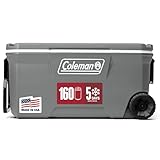
- Best value for family weekends: A large hard cooler such as the Coleman Xtreme 5 70-Quart, provided you have room for its larger footprint and do not need premium latches or maximum durability.
- Best balance of price and construction: The Igloo BMX 52 Quart, with thick insulation, a reasonably manageable size, and a lower typical market price than premium rotomolded models.
- Best for short hikes from the car: A quality soft-sided cooler with backpack straps or padded shoulder straps. It will be easier to carry but generally will not retain ice as long as a thick-walled hard cooler.
- Best base-camp setup: Two coolers rather than one oversized box: one for frequently accessed drinks and one dedicated to food.
What matters more than the advertised quart number?
Cooler capacity is usually measured as internal volume, but usable capacity is lower once you account for thick walls, a basket, ice, and the irregular shape of food containers. A 45-quart cooler does not hold 45 quarts of food and drinks while also leaving space for ice.
For a practical estimate, reserve about 35–40 percent of internal volume for ice on a multiday trip. A 45-quart cooler therefore offers roughly 27–29 quarts for supplies when packed for strong cooling. A 70-quart cooler may provide about 42–45 quarts of usable food-and-drink space, but it becomes much harder to lift when full.
| Cooler type and example | Advertised capacity | Approx. empty weight | Best use | Typical market range |
|---|---|---|---|---|
| Premium rotomolded, YETI Tundra 45 | 45 qt | About 23 lb | 2–4 people, weekend to several-day car camping | About $300–$350 |
| Rotomolded, Pelican Elite 45 Quart | 45 qt | About 33 lb | Maximum ruggedness and secure latching | About $250–$350 |
| Large hard cooler, Coleman Xtreme 5 70-Quart | 70 qt | About 12–13 lb | Families, group trips, and lower-cost bulk storage | About $60–$100 |
| Mid-size hard cooler, Igloo BMX 52 Quart | 52 qt | About 17–18 lb | General car camping and occasional outdoor use | About $100–$150 |
| Soft cooler, 30–40 qt class | 30–40 qt | About 5–12 lb | Day trips, short carries, and limited storage | About $80–$300 |
Weights are approximate and can vary by model revision, accessories, and retailer configuration. More importantly, a full cooler can weigh two to three times its empty weight. Water ice weighs about 8.3 pounds per gallon, so filling a large cooler with ice can quickly make it a two-person lift.
Head-to-head: premium rotomolded versus budget hard coolers
YETI Tundra 45 and similar premium models
The Tundra 45 represents the premium rotomolded category: thick insulated walls, a tough molded shell, gasketed lid, and robust hinges and latches. It is a strong choice when ice retention, repeated use, and resistance to rough handling justify the price. The 45-quart format is easier to place in a car than a 65- or 70-quart model, but the cooler itself is heavy before loading.
Its weakness is not cooling performance; it is efficiency of transport. There are no wheels on the standard Tundra 45, and the box becomes awkward when packed with food, drinks, and ice. Premium coolers also do not eliminate the need for shade and careful packing.
Pelican Elite 45 Quart
The Pelican Elite 45 Quart is another heavy-duty rotomolded option. Its latches and gasket are designed for a tight closure, and many configurations include a molded-in bottle opener and non-skid feet. The trade-off is substantial empty weight. Choose it when durability and secure closure matter more than carrying comfort.
Igloo BMX 52 Quart
The Igloo BMX 52 Quart sits between lightweight mass-market coolers and expensive rotomolded boxes. It offers thick-wall insulation, a reinforced construction, and a useful capacity for a couple or small family. Its lighter weight makes it easier to load into a vehicle than many premium competitors. For occasional camping, the lower purchase price can be more sensible than paying for maximum shell durability.
Coleman Xtreme 5 70-Quart
The Coleman Xtreme 5 70-Quart is attractive when capacity per dollar is the priority. Its larger interior works well for family food, bottled drinks, and bulky containers, while the empty cooler is relatively light for its size. It is not as heavily built as a rotomolded cooler, and its hinges, handles, drain fittings, and lid seal deserve more care. It is a good base-camp cooler rather than an ideal cooler for frequent carrying over uneven ground.
Ice retention: insulation is only half the result
Thick insulation slows heat transfer, but ice retention also depends on starting temperature, empty air space, opening frequency, weather, and the ratio of ice to contents. A cooler left in direct sun and opened every few minutes can perform worse than a thinner cooler kept closed in shade.
For a two- or three-day trip, pre-chill the cooler and its contents for at least several hours. Use block ice where possible because it melts more slowly than small cubes, then fill gaps with cubed ice. Frozen water bottles provide cold mass without creating loose meltwater, although they occupy space that could otherwise hold food.
A useful planning calculation is to budget approximately 0.5–1 pound of ice per quart of cooler capacity for a multiday trip, adjusting upward in hot weather or when the cooler starts warm. A 52-quart cooler might therefore need roughly 26–52 pounds of ice. The higher end is more reliable for long trips, but it leaves less room for food.
Drain design, leak resistance, and portability
A threaded drain plug or wide drain port is valuable at a base camp because it lets you remove meltwater without dumping the contents. Check that the plug has a captive gasket or washer and that it can be opened while the cooler is sitting flat. Narrow drains can clog with food debris and are slower to clean.
Leak resistance matters most in a vehicle. A gasketed hard cooler with a properly latched lid is safer than an unsealed box, but no cooler should be placed loose in a passenger area. Keep it upright, secure it against sliding, and use a secondary tray or waterproof liner if a leak would damage carpeting.
For portability, prioritize molded side handles, rope handles with comfortable grips, or large wheels. Wheels help on paved campgrounds but are less useful on sand, rocks, and muddy ground. A cooler that two people can carry safely is often more practical than a larger wheeled model that is difficult to lift into a vehicle.
Choosing the right size
| Trip and group | Recommended size | Why |
|---|---|---|
| One person, overnight | 20–30 qt | Compact and easier to carry; little wasted interior space |
| Two people, two to three nights | 35–45 qt | Enough room for food and drinks without excessive bulk |
| Three to four people, three to five nights | 45–65 qt | Useful compromise between storage and vehicle space |
| Family or group base camp | 65–100 qt total | Use one or two coolers, preferably separating food and drinks |
Measure your vehicle before buying. Check the cooler’s exterior length, width, height, lid clearance, and handle swing—not just its advertised capacity. A cooler may fit in a cargo area but prevent the hatch from closing or block access to other equipment.
Ownership realities and maintenance
- Clean after every trip: Empty meltwater, wash with mild dish soap, and dry the lid open. Persistent moisture creates odors and can encourage mold around the gasket.
- Inspect the parts that wear first: Hinges, rubber latches, drain-plug washers, rope handles, and lid gaskets usually need attention before the insulated shell.
- Avoid sharp loading: Knives, exposed tent stakes, and rough metal cans can puncture soft-cooler liners or damage hard-cooler gaskets.
- Do not use dry ice casually: It can damage some cooler materials and creates carbon dioxide gas. Follow the manufacturer’s instructions and provide ventilation; never place it in a sealed passenger compartment.
- Keep food organized: Place frequently accessed drinks in a separate cooler. Every opening admits warm air and accelerates ice loss in the food cooler.
Bottom line
For most car campers, a 45–55-quart hard cooler is the best compromise between usable capacity, insulation, portability, and vehicle fit. Select a premium rotomolded model when you camp often and value long service life, choose the Igloo BMX 52 Quart for a middle-ground specification and price, or choose the Coleman Xtreme 5 70-Quart when maximum capacity and low cost outweigh ruggedness. At a busy base camp, two right-sized coolers usually outperform one giant cooler because they reduce opening frequency and make carrying, cleaning, and food organization easier.