What's inside
As an Amazon Associate I earn from qualifying purchases. This post may contain affiliate links at no extra cost to you.
The best hitch mounted wheelchair carriers for heavier power chairs are the Harmar AL500HD, Pride Mobility Outlander XL, and a heavy-duty folding steel platform carrier rated for at least 500 pounds—but the right choice depends just as much on hitch rating, ramp length, folded clearance, and vehicle fit as on advertised capacity.
As an Amazon Associate we earn from qualifying purchases at no extra cost to you.


Sections
Best hitch-mounted wheelchair carriers at a glance
| Carrier | Rated load | Typical platform | Hitch requirement | Ramp/folding design | Best suited to |
|---|---|---|---|---|---|
| Harmar AL500HD | 500 lb | About 48 x 28 in | Class III or IV, 2 in receiver | Integrated ramp; platform folds upward when unloaded | Frequent use and heavier power chairs |
| Pride Mobility Outlander XL | Up to 500 lb | About 48 x 28 in | Class III or IV, 2 in receiver | Fold-up platform with loading ramp | Owners who want a mobility-equipment-specific system |
| Heavy-duty folding steel carrier | 500 lb commonly available | About 48 x 28 in | Class III or IV, 2 in receiver | Fold-down or detachable ramp; manual folding | Lower purchase cost and occasional transport |
| Aluminum wheelchair carrier | 350–500 lb, depending on model | Usually 48 x 28 in | Class III or IV, 2 in receiver | Removable or fold-down ramp | Reducing corrosion and carrier weight |
Dimensions and capacities can vary by accessory package, ramp style, and model revision. Treat the table as a shortlist, then confirm the current installation sheet for the exact product and vehicle.
Our top picks by situation
Best overall for a heavy power wheelchair: Harmar AL500HD
The Harmar AL500HD is the strongest starting point when a power chair approaches 400 to 500 pounds including its batteries and removable accessories. Its 500-pound rating, wide platform, powered loading arrangement on applicable configurations, and fold-up storage position make it more practical for regular use than a basic steel cargo-style carrier.
The important advantage is not merely the headline capacity. A powered or very heavy chair puts more strain on the ramp, platform joints, hitch pin, and anti-wobble hardware during loading. A purpose-built mobility lift generally provides more controlled positioning and better restraint options than a carrier designed primarily for boxes or lawn equipment.
Check rear-door clearance carefully. A carrier that folds upward may still block a hatch, spare tire, backup sensors, or a trailer connector. Some vehicles need a hitch extension, but an extension can reduce the receiver’s effective capacity and should not be added casually.
Best mobility-equipment-focused alternative: Pride Mobility Outlander XL
The Pride Outlander XL is a sensible choice for users who prefer a carrier from a mobility-equipment manufacturer and need up to 500 pounds of capacity. Its approximately 48-by-28-inch platform accommodates many standard manual and power wheelchairs, while the fold-up design can preserve some ground clearance when the chair is removed.
Its suitability depends on the chair’s wheelbase and turning geometry. A chair may fit within the platform’s width but still be awkward to roll up the ramp if the rear anti-tip wheels, footrests, joystick, or seat-back accessories extend beyond the usable area. Measure the chair in transport configuration, not its brochure width with detachable parts removed.
The Outlander XL is most attractive for frequent users who want a purpose-designed system rather than the lowest initial cost. Ask the dealer to confirm whether the quoted configuration includes the required tie-downs, ramp, wiring, and vehicle-specific hitch hardware.
Best value for occasional transport: a 500-pound folding steel carrier
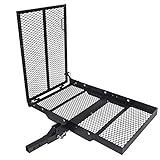
A heavy-duty folding steel carrier can cost less than a powered lift and is appropriate when the wheelchair is used occasionally, the owner can safely guide it up a ramp, and the vehicle’s hitch has sufficient tongue-weight capacity. These carriers commonly provide a 48-by-28-inch deck, a 500-pound rating, and a folding mechanism that reduces the carrier’s rearward projection when empty.
The trade-off is handling. A steel platform may weigh roughly 70 to 90 pounds before the wheelchair is loaded. Removing it from the vehicle often requires two people. Folding hinges and ramp pins also receive substantial impact when the carrier is loaded, so inspect them more often than you would on an electrically operated lift.
Do not confuse a high static load rating with a safe loading experience. A manual ramp is a poor match if the chair is near the carrier’s limit, the ramp is short and steep, or the operator cannot maintain a straight path. In that situation, a powered lift or professional installation is the safer direction.
How to compare the specifications that matter
1. Calculate the real transported weight
Add the wheelchair’s advertised weight to batteries, oxygen equipment, cushions, bags, ramps, and any removable accessory that stays on the chair. For example:
- Power wheelchair: 310 lb
- Two batteries and battery tray: 70 lb
- Cushion, headrest, and travel bag: 25 lb
- Total transported load: 405 lb
A 500-pound carrier leaves 95 pounds of rated capacity in this example. That is not permission to exceed the vehicle’s tongue-weight limit. The carrier itself also sits behind the receiver and creates leverage, so the vehicle owner’s manual and hitch label control the final limit.
2. Match the hitch class and receiver size
Most heavy wheelchair carriers require a 2-inch Class III or Class IV receiver. A Class II receiver with a 1¼-inch opening is usually not an appropriate foundation for a 500-pound platform. The rating stamped on the hitch is only part of the answer: the vehicle may have a lower maximum tongue weight, particularly when the carrier extends far behind the bumper.
Class IV hardware may provide a useful margin, but it does not automatically make an unsuitable vehicle compatible. Confirm the receiver rating, vehicle tongue-weight rating, carrier weight, and loaded-carrier weight together.
3. Look at ramp length, not just ramp presence
A short ramp saves space but creates a steeper approach. A 36-inch ramp rising to a 12-inch platform has an approximate 18-degree angle; a 60-inch ramp to the same height is about 11 degrees. That difference can affect traction, ground clearance, and how easily a power chair’s front casters climb the transition.
For heavier chairs, prefer a ramp with positive side guards, a secure deployed position, and a surface that remains usable when wet. A ramp that simply rests on the platform is less reassuring than one with a locking hinge or retaining pin.
4. Test folded clearance
Measure from the receiver pin hole to the rearmost part of the vehicle, then compare it with the carrier’s folded and unfolded dimensions. Leave room for the tailgate, spare tire, exhaust outlet, parking sensors, and license plate. A carrier that folds may still obstruct the rear camera or prevent the hatch from opening.
Vehicles with rear-mounted spare tires, short bumpers, or low ground clearance need particular care. A long hitch extension can solve one clearance problem while creating another by increasing leverage on the receiver.
Decision matrix
| Your situation | Most suitable direction | Why |
|---|---|---|
| Chair and equipment total 400–500 lb | Purpose-built 500-lb lift | Better loading control and stronger restraint provisions |
| Transport several times each week | Harmar or Pride powered system | Less repetitive manual lifting and more consistent positioning |
| Occasional trips and a capable Class III/IV hitch | 500-lb folding steel carrier | Lower cost and simple construction |
| Frequent rain, road salt, or coastal use | Aluminum platform or well-coated steel | Less corrosion exposure; still inspect fasteners and hinges |
| Rear hatch must open regularly | Carrier with verified swing-away or fold-clear function | A basic fold-up platform may not provide enough access |
Secure loading and ownership checks
Use four-point wheelchair tie-downs where the carrier instructions call for them, and secure the chair at approved frame locations rather than to plastic body panels, removable armrests, or the joystick. Engage the chair’s parking brake or drive-system lock, but do not treat that lock as a substitute for tie-downs. If the carrier supports a passenger occupant, it must meet different requirements; most exterior wheelchair carriers are for transporting the chair, not a person seated in it.
Before every trip, check the hitch pin, anti-rattle device, ramp latch, platform welds, wheel chocks, and tie-down tension. After the first few drives, recheck fasteners because vibration can settle brackets and hardware. Remove road salt and mud with fresh water, dry the hinge areas, and lubricate only where the manufacturer’s instructions permit it.
The components most likely to wear first are ramp hinges, retaining pins, tie-down straps, non-skid surfaces, and anti-rattle hardware. Replace frayed straps, bent pins, cracked welds, or loose mounting plates immediately. A carrier that has been overloaded or struck a curb should be inspected before reuse, even if it appears straight.
Bottom line
Choose the Harmar AL500HD or Pride Outlander XL when a heavy power wheelchair is transported often and controlled loading matters. Choose a 500-pound folding steel carrier when trips are occasional, the operator can manage a manual ramp, and the vehicle has adequate tongue-weight capacity. Whichever model you select, the safest purchase is the one that leaves capacity after adding batteries and accessories, fits the receiver without an improvised extension, and keeps the chair securely restrained without blocking essential vehicle access.