What's inside
- How to Choose a Dual Monitor Arm: 6 Decision Criteria
- Spec Comparison: 5 Popular Dual Monitor Arms
- Best Picks by Situation
- Decision Matrix: Match Your Setup to the Right Arm
- Will Your Desk Handle It? A Quick Stability Check
- Durability and Ownership Realities
- Setup Tips for a Clean Dual Display
- Frequently Asked Questions
- How to Choose a Dual Monitor Arm: 6 Decision Criteria
- Spec Comparison: 5 Popular Dual Monitor Arms
- Best Picks by Situation
- Decision Matrix: Match Your Setup to the Right Arm
- Will Your Desk Handle It? A Quick Stability Check
- Durability and Ownership Realities
- Setup Tips for a Clean Dual Display
- Frequently Asked Questions
As an Amazon Associate I earn from qualifying purchases. This post may contain affiliate links at no extra cost to you.
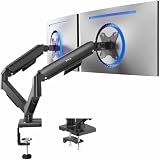
The best dual monitor arms for desk setup are the Ergotron LX Dual Stacking Arm for heavy-duty stability and full adjustability, the HUANUO HNDS6 for budget-friendly dual 27-inch setups, and the ErGear EGCM12D for mid-range gas-spring flexibility — your ideal choice depends on monitor weight, desk thickness, and how much motion you need.
As an Amazon Associate we earn from qualifying purchases at no extra cost to you.

Sections
- How to Choose a Dual Monitor Arm: 6 Decision Criteria
- Spec Comparison: 5 Popular Dual Monitor Arms
- Best Picks by Situation
- Decision Matrix: Match Your Setup to the Right Arm
- Will Your Desk Handle It? A Quick Stability Check
- Durability and Ownership Realities
- Setup Tips for a Clean Dual Display
- Frequently Asked Questions
How to Choose a Dual Monitor Arm: 6 Decision Criteria
Not all dual arms are interchangeable. Two 24-inch office monitors and two 32-inch curved gaming displays have completely different requirements. Evaluate these six factors before buying:
1. Weight Capacity Per Arm
This is the most common failure point. Manufacturers list capacity per arm, not total. A dual arm rated for 17.6 lbs per arm can hold two 15 lb monitors, but not two 19 lb ultrawides. Always weigh your monitors with stands removed — a 27-inch IPS panel typically weighs 9-12 lbs without its stand, while a 32-inch curved VA can weigh 14-18 lbs.
Gas-spring arms lose tension over time if run at 90%+ capacity. For longevity, choose an arm where your monitor is at 60-75% of its max rating.
2. VESA Compatibility
Nearly all modern monitors use 75x75mm or 100x100mm VESA patterns. Every arm in this guide includes both. The issue is not the pattern but the recess. Some monitors, especially Dell UltraSharp and curved Samsung models, have recessed VESA cavities that need longer M4 screws or spacers. Check if the arm includes spacers and 10mm/12mm screws — budget arms often do not.
3. Desk-Clamp Clearance and Mounting Options
Most C-clamps support desktops from 0.4″ to 3.3″ thick. If you have a thick butcher-block desk (1.75″+), a kitchen countertop, or a desk with a crossbar underneath, confirm clearance. Grommet mounting (through a desk hole) offers better stability for heavy setups but requires a 0.39″ to 2.5″ hole and access underneath.
Clamp footprint matters for stability. A narrow 2-inch clamp on a particle-board desk will wobble with two 27-inch monitors extended. Look for a clamp at least 4 inches wide or a reinforced base plate.
4. Adjustment Range
Three measurements define ergonomics: height adjustment, extension/reach, and tilt/swivel range. For a seated desk setup, you need at least 11 inches of height adjustability to get the top of the screen at eye level. Extension of 18-24 inches lets you bring monitors closer or push them back for depth. Tilt of -35 to +35 degrees is critical if you alternate between sitting and standing.
5. Cable Management
Integrated cable channels inside the arm prevent snagging when you swivel. Clip-on covers are cheaper but pop off. If you run two DisplayPort and two power cables, check channel diameter — some arms only fit two thin cables comfortably.
6. Desk Stability
Dual arms create leverage. Two 12 lb monitors extended 20 inches from the clamp generate significant torque on the desk edge. Solid wood, steel frame, or 1-inch+ MDF desks handle this well. Thin IKEA-style honeycomb or glass desks may flex, crack, or tip. For desks under 0.75″ thick, use a grommet mount with a reinforcement plate or choose a freestanding dual base instead of a clamp.
Spec Comparison: 5 Popular Dual Monitor Arms
| Model | Max per Arm | Screen Size | VESA | Height Range | Full Extension | Mounting Type | Arm Type |
|---|---|---|---|---|---|---|---|
| Ergotron LX Dual Stacking Arm | 25 lbs (11.3 kg) | Up to 32″ | 75×75, 100×100 | 13″ (33 cm) | 25.4″ (64.5 cm) | C-clamp 0.5″-2.6″, Grommet | Gas spring, polished aluminum |
| HUANUO HNDS6 | 17.6 lbs (8 kg) | 13″ to 27″ | 75×75, 100×100 | 13.5″ (34 cm) | 21″ (53 cm) | C-clamp 0.39″-3.15″, Grommet 0.39″-3.15″ | Gas spring, steel |
| ErGear EGCM12D | 17.6 lbs (8 kg) | 13″ to 32″ | 75×75, 100×100 | 11″ (28 cm) | 19.6″ (50 cm) | C-clamp 0.39″-3.35″, Grommet | Gas spring, steel/aluminum |
| VIVO STAND-V002F | 22 lbs (10 kg) | 13″ to 32″ | 75×75, 100×100 | 12″ (30.5 cm) | 24″ (61 cm) | C-clamp 0.39″-3.3″, Grommet | Gas spring, steel |
| Humanscale M2.1 Dual | 20 lbs (9.1 kg) | Up to 32″ | 75×75, 100×100 | 10.5″ (26.7 cm) | 21.5″ (54.6 cm) | C-clamp 0.5″-2.75″, Grommet, Bolt-through | Mechanical spring, aluminum |
Weight and material correlate with stability. The Ergotron LX and Humanscale M2.1 use heavier aluminum castings that reduce vibration when typing. Steel-bodied arms like the HUANUO and VIVO are strong but transmit more wobble at full extension if the desk is light.
Best Picks by Situation
Best Overall for Most Desk Setups: VIVO STAND-V002F
The VIVO STAND-V002F hits the balance between capacity, reach, and price. With 22 lbs per arm and support up to 32 inches, it handles dual 27-inch office monitors or a 27-inch + 32-inch mixed setup without being overbuilt. Its 24-inch extension allows side-by-side or slight arc positioning, and the gas spring stays smooth after months of height adjustments. The included clamp fits desks up to 3.3 inches thick, making it compatible with both standard office desks and thicker workshop-style benches. General market range: budget to mid-range.
Best for Heavy or Large Monitors: Ergotron LX Dual Stacking Arm
If you run two 32-inch displays or heavy color-accurate monitors for CAD and design work, the LX is the reference. Its 25 lb per-arm rating provides headroom that prevents sagging, and the 25.4-inch pole and extension let you stack monitors vertically — useful for code, long spreadsheets, or shop drawings. The build quality shows in the joints: tighter tolerances mean less drift. General market range: premium.
Best Budget Option: HUANUO HNDS6
For dual 22-inch to 27-inch monitors under 17 lbs each, the HNDS6 delivers gas-spring adjustment at an entry-level price. It allows 13.5 inches of height travel and full 360-degree rotation for portrait mode. Limitations: at maximum weight it requires more frequent tension adjustment, and the cable clips are external rather than internal channels. Ideal for home offices and student setups. General market range: entry-level.
Best for Maximum Flexibility: ErGear EGCM12D
The EGCM12D offers independent gas-spring arms on a single base, which is better than a straight bar design if your monitors are different sizes or weights. Each arm can be raised, lowered, and angled separately, allowing one monitor slightly higher for video calls while the other stays at eye level. It folds flat against a wall when not in use, saving depth on smaller 48-inch desks. General market range: mid-range.
Best Premium for Shared Workspaces: Humanscale M2.1 Dual
The Humanscale M2.1 uses a mechanical spring with counterbalance rather than gas, which holds position without creep and requires no tension knob tuning when swapping monitors. Its interchangeable clamp options (including bolt-through for benching systems) make it the choice for offices where desks are reconfigured often. The aluminum finish resists scratches and holds up in high-use environments. General market range: premium.
Decision Matrix: Match Your Setup to the Right Arm
| Your Situation | Recommended Type | Why |
|---|---|---|
| Two 24″ monitors, thin desk (<0.75″), tight budget | HUANUO HNDS6 or similar light-duty gas spring | Low weight keeps torque down; avoid overloading a thin top |
| Two 27″ monitors, standard 1″ office desk | VIVO STAND-V002F or ErGear EGCM12D | 22 lb capacity and 19-24″ extension give perfect eye-level arc |
| Two 32″ or ultrawide monitors, solid wood/standing desk | Ergotron LX Dual Stacking Arm | 25 lb rating + 25.4″ pole prevents sag and allows stacking |
| Mixed sizes (e.g., 27″ + 32″) or frequent portrait rotation | Dual independent gas-spring arms (ErGear style) | Independent height and tilt prevent mismatched alignment |
| Glass desk or rental where you cannot clamp hard | Freestanding dual monitor stand (base plate) | Avoids clamp pressure on fragile surfaces |
| Hot-desking / office benching, multiple users | Humanscale M2.1 Dual | Tool-free counterbalance and durable finish for frequent adjustments |
Will Your Desk Handle It? A Quick Stability Check
Before ordering, do this 30-second calculation:
- Step 1: Total overhang weight. Add both monitors without stands. Example: 11 lbs + 11 lbs = 22 lbs.
- Step 2: Estimate torque. Multiply total weight by extension distance. At 20 inches out: 22 lbs x 20″ = 440 inch-pounds of torque on the desk edge.
- Step 3: Check desk material. If your desk is solid wood, 1″ MDF with steel frame, or standing desk with crossbar, it will handle 400-550 inch-pounds. If it is hollow-core, particle board under 0.6″, or glass, stay under 300 inch-pounds — choose lighter monitors or a grommet mount with a 6″ x 6″ reinforcement plate underneath to spread load.
- Step 4: Test deflection. Place your monitors (in boxes) at the desk edge where the clamp will go. Press down firmly. If the edge deflects more than 1/8 inch, reinforce or choose a freestanding base.
A common mistake is clamping over a cable tray or modesty panel. The clamp needs full contact with the desktop. Move the tray or use a grommet mount instead.
Durability and Ownership Realities
Gas-spring arms are the most popular but have wear points. The gas cylinder itself typically lasts 5-8 years of daily adjustment; the first sign of wear is the monitor slowly sinking. Tightening the tension hex screw can extend life by 6-12 months, but over-tightening strips the screw — turn in quarter rotations.
What wears first is not the arm but the VESA tilt joint. Constant tilting loosens the friction washer. Periodically tighten the tilt bolt with the included Allen key and avoid hanging headset or cables from the arm.
Cable management channels hide wear too. HDMI and DisplayPort cables fail internally after repeated bending at the arm joint. Leave a 4-inch service loop near the joint and use 90-degree adapters if cables are pinched.
Cleaning is simple: wipe aluminum and steel with a dry microfiber cloth. Avoid silicone sprays on joints — they attract dust and make the arm drift. If an arm squeaks, a single drop of dry PTFE lubricant on the pivot, wiped excess, is enough.
For woodworkers and shop-adjacent desks, sawdust is abrasive to gas springs. If your desk is in a garage or shop, choose an arm with sealed joints (Ergotron, Humanscale) and blow out pivots with compressed air monthly.
Setup Tips for a Clean Dual Display
- Mount the clamp 4-6 inches off center toward your dominant eye side to center the bezels in front of you without maxing out one arm.
- Set height so the top third of each screen is at eye level when seated upright. This reduces neck flexion.
- Angle monitors in a slight arc of 20-30 degrees inward rather than flat. This keeps viewing distance consistent and reduces color shift on VA panels.
- Secure cables with enough slack for full 360-degree rotation, then tuck excess under the desk with a cable tray — not inside the arm joint.
- Use the same resolution and scaling on both monitors where possible. Mixed scaling makes one arm feel misaligned even when physically level.
Frequently Asked Questions
Do I need a dual arm or two single arms?
A single dual base saves desk edge space and costs less, but two single arms give complete independence for asymmetrical setups and let you place monitors farther apart. If your desk has a center support beam or limited clamp area, two singles are more flexible.
Can a dual arm hold one ultrawide 34-inch monitor?
Most dual arms can hold a single 34-inch ultrawide (typically 14-18 lbs) on one arm while leaving the other empty, but the empty arm will be unbalanced. For a single ultrawide, a single arm rated for 26-33 lbs with a heavy-duty clamp is more stable.
Will a monitor arm damage my desk?
Over-tightening is the main cause of damage. Tighten until the clamp is snug with no wobble — do not crank. Place the included rubber or felt pad between clamp and desk to prevent dents. On soft pine or veneer desks, add a small plywood pad under the clamp to distribute pressure.
What tools do I need to install?
Most arms include Allen keys. You will also need a Phillips screwdriver for VESA screws and, for grommet mounting, a drill with a hole saw. Installation takes 15-30 minutes. Have a second person hold the monitor while you hook the VESA plate — dropping a monitor during mounting is the most common accident.