
Key takeaways
- Best disc sanders for woodworking and smooth edges in 2026: dedicated disc machines and belt-and-disc combos compared, with five proven picks.
What's inside
As an Amazon Associate I earn from qualifying purchases. This post may contain affiliate links at no extra cost to you.
- Top Pick: WEN 6502T Benchtop Belt and Disc Sander
- Runner-up: Delta 31-140 12-Inch Disc Sander
- Also consider: Powermatic 31A Belt and Disc Sander
A disc sander flattens the end grain of a board, squares an edge, and shapes a curve with a precision no hand sanding can match. The spinning disc holds a flat sheet of abrasive against a tilting table, so the workpiece meets the paper at an exact angle and the cut stays true across the whole face. A good disc sander turns rough-sawn ends into smooth, square surfaces in seconds.
Most benchtop disc sanders sold today pair the disc with a belt, and this guide includes those combos, though it judges each machine on its disc: disc size, disc speed, tilting disc table, and paper attachment. The five picks cover the range a woodworker needs: a compact WEN combo, a dedicated Delta, a pro-grade Powermatic, a direct-drive BUCKTOOL, and a JET combo.
As an Amazon Associate, we earn from qualifying purchases.
Sections
Quick Answer
For most woodworking, the Delta 31-140 is the best disc sander, since its 12-inch disc, cast-iron tilting table, and manual brake give precise flat-face sanding at a fair size for the bench. Choose the WEN 6502T for a small bench, the Powermatic 31A for pro-grade power, the BUCKTOOL BD4801 for direct drive, and the JET JSG-6DC for heavy combo sanding.
WEN 6502T Benchtop Belt and Disc Sander
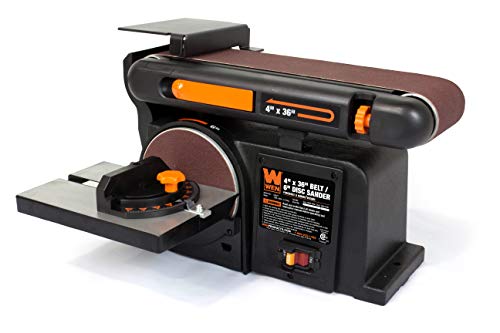
The WEN 6502T is the compact pick, with a 4 by 36-inch belt and a 6-inch disc on a cast-iron base that fits a small bench. A 4.3 amp motor drives both, and the belt tilts from horizontal to vertical for edge work while the disc table tilts for bevels. The machine suits small parts, boxes, and model work, where a 12-inch disc would be too large and too heavy for the bench.
A marketplace crawl from seven months ago named the exact model and ASIN with the part number and UPC, and a 2026 roundup confirms the ASIN as well. Confirm the model code 6502T before ordering, since an older model 6502 is a different listing. WEN covers the machine with a two-year warranty.
Specs: Model 6502T; 4.3 amp motor; 4 x 36 inch belt and 6 inch disc; cast-iron base; belt tilts 0 to 90 degrees; two-year warranty; ASIN: B07KL4QGSQ
Delta 31-140 12-Inch Disc Sander

The Delta 31-140 is the dedicated disc machine here, and it is the only pick with no belt at all. Its half-horsepower motor drives a 12-inch steel disc at 1,725 RPM, which is the slow speed that suits disc sanding: the paper cuts cleanly without burning the wood, and the large disc flattens wide faces in a few passes. A cast-iron table tilts to both sides with positive stops at 22.5, 45, and 90 degrees, and a miter gauge in the box sets angles for bevel work.
A top-mounted manual brake stops the disc quickly when the work needs checking, which is a practical feature no other pick here has. A tracker page named the exact model and ASIN with an in-stock offer. At 72 pounds the machine needs a solid bench, and Delta covers it with a five-year warranty.
Specs: Model 31-140; 1/2 HP motor; 12 inch disc; 1,725 RPM; cast-iron table with stops at 22.5, 45, and 90 degrees; manual brake; miter gauge included; 72 pounds; five-year warranty; ASIN: B00812RELM
Powermatic 31A Belt and Disc Sander

The Powermatic 31A is the pro-grade pick, built for a shop that sands all day. Its 2 horsepower motor drives a 6 by 48-inch belt at 2,410 surface feet per minute and a 12-inch disc at 2,375 RPM, which is the fastest disc speed in this group and the most power behind it. Precision-ground cast-iron tables with miter slots support large boards, and a miter gauge, fence, and disc table come in the box. At 275 pounds the machine is permanent once placed.
Note the exact model before ordering: this ASIN is the 2 horsepower, 230 and 460-volt three-phase version, model 1791292K, which needs a three-phase supply and does not run on a standard home outlet. A 1.5 horsepower single-phase sibling, model 1791291K, is the home-shop version. A marketplace crawl from nearly a year ago named the exact model and ASIN, though it showed no featured offers, so confirm the listing before ordering. Powermatic covers it with a five-year warranty.
Specs: Model 31A, 1791292K; 2 HP motor, 230/460V 3-phase; 6 x 48 inch belt at 2,410 SFPM; 12 inch disc at 2,375 RPM; cast-iron tables with miter slots; miter gauge and fence included; 275 pounds; five-year warranty; ASIN: B0007DHHHO
BUCKTOOL BD4801 Bench Belt Disc Sander

The BUCKTOOL BD4801 is the direct-drive pick, and its motor design sets it apart from the belt-driven machines here. The 4 by 36-inch belt and 8-inch disc run directly off the motor shaft, with no internal belt, gear, or pulley to adjust, maintain, or replace. A three-quarter-horsepower motor drives the disc at 3,450 RPM and the belt at 2,161 feet per minute, which suits fast stock removal on small and mid-size parts. Both cast-aluminum tables tilt from 0 to 45 degrees, the belt tilts from 0 to 90 degrees, and a miter gauge works on both surfaces.
A roundup table paired this model with its marketplace listing, and a 2026 comparison confirms the model and ASIN together. Two dust ports connect to a dust collector, and BUCKTOOL covers the machine with a two-year warranty. A rotating-base bundle of the same machine also exists, so confirm the standalone listing.
Specs: Model BD4801; 3/4 HP direct-drive motor; 4 x 36 inch belt and 8 inch disc; disc 3,450 RPM; belt 2,161 FPM; tables tilt 0 to 45 degrees; belt tilts 0 to 90 degrees; miter gauge included; dual dust ports; two-year warranty; ASIN: B07FPTS12C
JET JSG-6DC Benchtop Belt and Disc Sander

The JET JSG-6DC is the heavy combo pick, with a 1.5 horsepower motor that holds speed under load on large boards. The 6 by 48-inch belt runs at 2,500 surface feet per minute and the 12-inch disc at 1,725 RPM, which gives fast belt work and cool disc work in one machine. The disc table tilts 25 degrees up and 45 degrees down for bevels, the belt table tilts 20 degrees up and 45 degrees down, and a 4-inch dust port connects to a dust collector.
A manual for this model is hosted under its ASIN, which confirms the model and ASIN together, though no second page names the code, so confirm the listing before ordering. Note that the open-stand sibling, model JSG-6DCK, is a different listing with a stand included, so check the model code on the box. JET covers the machine with a five-year warranty.
Specs: Model JSG-6DC; 1-1/2 HP motor, 115/230V single-phase; 6 x 48 inch belt at 2,500 SFPM; 12 inch disc at 1,725 RPM; disc table tilts 25 degrees up and 45 degrees down; belt table tilts 20 degrees up and 45 degrees down; 4 inch dust port; five-year warranty; ASIN: B0007YZLS0
How to Choose a Disc Sander for Woodworking and Smooth Edges
Match the disc size to the work first. A 5 or 6-inch disc suits small parts, boxes, and model work, where a large disc would be too aggressive and too heavy for the bench. An 8 or 9-inch disc suits general shop work, from squaring edges to shaping curves on mid-size parts. A 12-inch disc suits large faces, wide boards, and flattening end grain, though the machine weighs far more and needs a solid bench.
Look at disc speed next. A disc near 1,725 RPM cuts cool and clean, which suits hardwoods and fine work where a burn mark would ruin the piece. A disc near 3,450 RPM removes stock fast, which suits softwood and rough shaping, though it can burn the wood if the feed is slow. Variable speed is rare on disc machines, so the fixed speed is a real choice: slow for precision, fast for removal.
Check the table, the paper, and the dust port. A cast-iron table with positive stops at common angles keeps bevel work accurate, and a miter gauge sets angles for end grain. Disc paper comes as pressure-sensitive adhesive sheets that stick to the disc or hook-and-loop discs that swap fast, so check which type the machine takes and whether refills are easy to find. A dust port that fits the shop collector keeps the disc clean, since a clogged disc cuts slowly and burns fast.
Consider the belt as a bonus, not the buying reason. A combo machine gives a belt for long edges and a disc for flat faces, which suits a shop that needs both in one footprint. A dedicated disc machine gives a larger disc and a simpler build for the same bench space, which suits a shop that already owns a belt sander. A machine near 275 pounds is permanent once placed, while a benchtop machine near 70 pounds moves when the bench is needed for other work.
Who Should Skip These Disc Sanders
A woodworker who only sands curves can skip a disc sander, since an oscillating spindle sander shapes inside curves better than a flat disc. A shop that only sands small parts can use a random orbital sander, which is lighter, cheaper, and easier to store. A woodworker who needs a belt sander only should buy a belt sander, since the disc adds cost and weight for a feature that will not be used.
Frequently Asked Questions
What is the difference between a disc sander and a belt sander?
A disc sander spins a round sheet of abrasive on a flat disc, which suits flat faces, end grain, and precise angles against a tilting table. A belt sander runs a loop of abrasive over a platen, which suits long edges and fast stock removal. Most benchtop machines here pair both in one body.
Should I choose PSA or hook-and-loop disc paper?
Pressure-sensitive adhesive paper sticks flat to the disc and stays put under load, which suits heavy sanding and gives a true flat surface. Hook-and-loop paper swaps fast without peeling and leaves no adhesive residue, which suits a shop that changes grits often.
What grit should I use on a disc sander?
Use 80 grit for shaping and removing saw marks, then move to 120 grit for smoothing and 150 grit for a finish-ready surface. Coarse grits below 60 remove stock fast though they leave deep scratches that take time to sand out. Change the paper when it looks shiny or cuts slowly, since a dull disc burns the wood instead of cutting it.
Can a disc sander sharpen tools?
No, not well. A disc sander is made for wood, and its paper clogs fast on steel while the flat disc cannot hold the angle a chisel or plane iron needs. Use a bench grinder for sharpening, with a slow speed and a proper tool rest.
Final Verdict
The Delta 31-140 is the best disc sander for most woodworking, since its 12-inch disc, cast-iron tilting table, and manual brake give precise flat-face sanding at a fair size for the bench. The WEN 6502T suits a small bench, the Powermatic 31A suits pro-grade power, the BUCKTOOL BD4801 suits a shop that wants direct drive, and the JET JSG-6DC suits heavy combo sanding. Match the disc size to the work and the speed to the wood.
Related guides
More from Amazon
Programs that pair well with the guide above. Offers and eligibility are set by Amazon and may change.
A free business account with business pricing and bulk-buying tools for work, shop or home office.
Create a business accountFree shipping on eligible items, Prime Video and more. Eligible new members can start with a free trial.
Start a Prime free trialAudiobooks and podcasts to listen to on the go. Eligible new members can start with a free trial.
Try Audible freeAd-free music streaming. Eligible new subscribers can start with a free trial.
Try Music Unlimited freeAs an Amazon Associate we earn from qualifying purchases.






Write Your Review
No reviews yet. Be the first to share your experience!