
Our Top Picks
What's inside
As an Amazon Associate I earn from qualifying purchases. This post may contain affiliate links at no extra cost to you.
If you want layout lines a saw or chisel can follow exactly, a marking knife beats a pencil every time: the blade severs the wood fibers and leaves a hairline groove with a definite edge, instead of a graphite smear that sits to one side of your measurement. For most carpenters, the best all-round choice is the Narex Dual Bevel Marking Knife, a spear point design that marks in both directions against a square. If you prefer a traditional single bevel, the Narex Right Hand Marking Knife 813701 and the KAKURI Kiridashi are the strongest options, while the Aeglemana and Qianying knives cover the budget tier with double bevel blades and sheaths included.
As an Amazon Associate, we earn from qualifying purchases.
Sections
Table of Contents
- Quick Picks
- Narex Dual Bevel Marking Knife (V2004070NX)
- Narex Right Hand Marking Knife 813701
- KAKURI Kiridashi Knife 15mm Curved Right Hand
- Aeglemana Woodworking Marking Knife
- Qianying Marking Knife
- How to Choose a Marking Knife
- FAQ
- Conclusion
- Product and ASIN Reference
Quick Picks
- Best overall: Narex Dual Bevel Marking Knife — spear point blade that marks in both directions against a square.
- Best single bevel: Narex Right Hand Marking Knife 813701 — a right hand striking and notching knife with a flat reference face.
- Best traditional Japanese style: KAKURI Kiridashi Knife 15mm Curved — hand forged carbon steel, made in Japan.
- Best budget pick with sheath: Aeglemana Woodworking Marking Knife — double bevel high carbon steel blade and leather sheath.
- Best budget alternative: Qianying Marking Knife — double beveled 5CR15 steel blade, composite handle and leather sheath.
Narex Dual Bevel Marking Knife (V2004070NX)
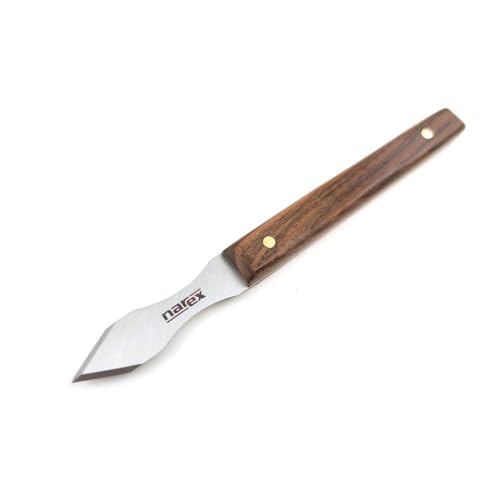
The Narex Dual Bevel Marking Knife is the most versatile pick in this roundup because its spear point blade is beveled on both faces. That geometry lets the blade ride against a try square or steel rule in either direction, so you can mark shoulder lines, dovetail baselines and hinge gains without swapping tools or flipping your grip.
The blade is AISI 420 stainless steel hardened and tempered to HRC 57, ground to a 55-degree tip with a 25-degree grind on both bevels. At 0.060 inches thick and half an inch wide, it is slim enough to slip into the tight cheeks of a dovetail socket, yet the stainless composition shrugs off the damp conditions that tarnish plain carbon steel in a site toolbox. Finger indents ground into the blade give your index finger a positive stop close to the edge, which helps when scoring end grain.
The handle is Mexican rosewood, hand sanded and polished, with the scales pinned to the tang by two brass pins. Its square profile is a practical detail: the knife stays where you put it on a bench instead of rolling onto the floor. At just over an ounce, it is light enough for all-day layout work. This is a mid-range knife for carpenters who want one tool that covers joinery layout in both directions.
Specs:
- Model: V2004070NX
- Blade material: AISI 420 stainless steel
- Blade hardness: HRC 57
- Blade profile: Dual bevel spear point with finger indents
- Blade length: 1-7/8 inches
- Blade thickness: 0.060 inches
- Blade width: 1/2 inch
- Bevel angle: 55-degree tip, 25-degree grind on both bevels
- Handle: Mexican rosewood, 4 inches, two brass pins
- Overall length: 5-7/8 inches
- Weight: 1.13 ounces
- Made in the Czech Republic by Mikov
Narex Right Hand Marking Knife 813701
The Narex 813701 takes the opposite approach to the spear point above. It is a right hand marking, striking and notching knife, sometimes called a violin knife, with the bevel arranged so that one face of the blade stays flat. That flat face is the whole point of a single bevel design: pressed against the edge of a square, it cannot rock, so the line it scores is exactly where the square says it should be.
Because it is also rated as a striking knife, the 813701 tolerates the light mallet taps used to deepen a line across end grain when laying out mortises. The right hand orientation suits marking from the most common square positions for a right-handed user; left-handed carpenters should look at the dual bevel or kiridashi picks instead, or track down the matching left hand version.
Published specification data for this model is limited to the manufacturer’s model record, so the bullet list below sticks to what Narex and the listing state. In the budget tier, it is the pick for a proper flat-backed layout knife from an established Czech toolmaker.
Specs:
- Model: 813701
- Type: Right hand marking, striking and notching knife (violin knife style)
- Bevel: Single bevel with flat reference face
- Orientation: Right hand
- Manufacturer: Narex, Czech Republic
- UPC: 700667464053
KAKURI Kiridashi Knife 15mm Curved Right Hand
The kiridashi is Japan’s traditional marking and utility knife, and the KAKURI 15mm Curved is a hand forged example from a long-established Japanese maker. Instead of a separate handle, the knife is a single plate of Japanese carbon steel with a hammered pattern on the flats. That texture is functional: it gives your fingers purchase on the steel when you choke up on the blade for a controlled pull stroke along a straightedge.
The 15mm blade width sits in the middle of the kiridashi size range, wide enough to register steadily against a square but narrow enough for dovetails and small tenons. The curved profile distinguishes this version from the straight kiridashi in the same range; the sweep brings the point into play at the start of a stroke and makes the knife handy for trimming and whittling as well as pure layout. As a right hand single bevel knife, it pulls the cut toward the flat side, so lines scored against a rule stay crisp.
Carbon steel takes a very fine edge on waterstones and is quick to refresh, but it does need a wipe of oil in a damp workshop to keep rust away, the standard trade-off for this class of steel. This is a mid-range to premium pick for carpenters who like traditional Japanese tools.
Specs:
- Brand: KAKURI
- Blade width: 15mm
- Profile: Curved kiridashi
- Bevel: Single bevel, right hand
- Blade material: Hand forged Japanese carbon steel
- Finish: Hammered pattern
- Intended uses: Wood marking, scribing, carving and whittling
- Made in Japan
Aeglemana Woodworking Marking Knife
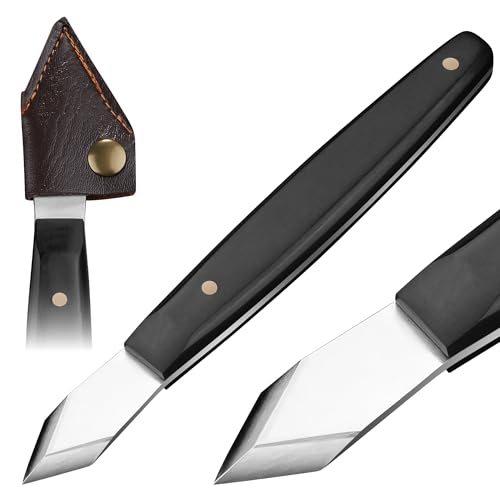
The Aeglemana marking knife is the straightforward budget option in this group: a double-beveled scribing blade in high carbon steel, a solid wood handle, and a leather sheath included so the edge is protected in a tool belt or pouch. The double bevel cuts a centered groove whichever way you draw it, which suits general carpentry layout — marking stud positions, scoring cut lines on sheet material, and setting out hinge recesses — where speed matters more than single-direction precision.
At 8.7 inches in overall item length, it is a larger tool than the compact Narex spear point, and the extra handle length gives a fuller grip for heavier scoring on rough timber. High carbon steel sharpens readily on an oil stone or diamond plate, which matters on site where a knife is honed quickly between tasks. The trade-off is the usual one for carbon steel: it will patina and can rust if put away wet, so the sheath and a dry toolbox drawer are part of the deal.
For apprentices putting together a first layout kit, or as a second knife that lives in the site box, the Aeglemana covers the essentials in the budget tier.
Specs:
- Brand: Aeglemana
- Blade material: High carbon steel
- Bevel: Double beveled scribing blade
- Handle material: Solid wood
- Included: Leather sheath
- Item length: 8.7 inches
- Part number: RDA-008
- UPC: 735099061020
Qianying Marking Knife
The Qianying marking knife follows the same practical formula as the Aeglemana but builds the blade from 5CR15 steel and pairs it with a composite wood handle. The blade is double beveled in a Japanese-influenced style, so it marks in both directions and centers its groove on the line, and a leather sheath is included for safe carry.
The double bevel format makes this a forgiving knife for newer carpenters: there is no flat side to keep track of, and the line lands in the same place whether you push or pull the stroke. The compromise, shared with every dual bevel design, is that neither face is a dead-flat reference, so for the finest joinery a single bevel knife registers against a square with slightly more certainty. For general layout and trim carpentry, that difference is rarely the limiting factor.
In the budget tier, the Qianying is a sensible choice if you want a dedicated marking knife with its own sheath rather than a utility knife, whose snap-off blades flex and wander against a rule.
Specs:
- Brand: Qianying
- Blade material: 5CR15 steel
- Bevel: Double beveled blade
- Handle material: Composite wood
- Style: Japanese
- Included: Leather blade-protective sheath and marking knife
How to Choose a Marking Knife
Start with the bevel. A single bevel knife has one flat face that registers against a square or rule, giving the most accurate line for joinery; you choose right or left hand orientation to match how you hold the square. A double bevel or spear point knife marks in both directions with either hand, which is faster for general layout, but the blade centers itself in the cut rather than hugging the rule.
Match blade thickness to the work. Thin blades around 0.060 inches slip into dovetail sockets and score fine lines with little pressure, suiting cabinet and joinery work. Thicker striking knives tolerate light mallet taps for deepening lines across end grain, suiting mortise layout and heavier site carpentry.
Consider the steel. Stainless blades such as AISI 420 resist rust in damp site conditions and need little care. High carbon and Japanese carbon steels take a finer edge and are quick to hone, but they need to be kept dry and oiled. Hardness in the high fifties HRC is typical for this class of tool.
Think about the handle and carry. A square or faceted handle will not roll off the bench and gives a repeatable grip; finger indents near the blade add control for delicate scoring. If the knife travels in a tool belt, a sheath is close to essential.
Set a tier and stick to it. Budget knives mark perfectly good lines for general carpentry. Mid-range options from established makers add better steel, better handles and more consistent grinding. Premium knives refine finish and feel rather than line quality, so buy them for the pleasure of ownership rather than straighter layout.
FAQ
Why use a marking knife instead of a pencil?
A pencil line has width, and graphite sits on top of the fibers, so a saw or chisel has to guess which side of the line is the true measurement. A marking knife severs the fibers and leaves a physical groove with a definite wall that a chisel can drop into and a saw can start against, which is why hand-cut joints fit more closely when they are knifed in.
Should I choose a single bevel or double bevel marking knife?
Choose a single bevel knife if your priority is joinery accuracy: the flat face rides against a square and cannot drift, but you must pick the orientation that matches your hand and marking direction. Choose a double bevel or spear point knife if you mark in both directions or do mostly general layout, where convenience matters more than the last fraction of precision.
How do I keep a marking knife sharp?
Hone the bevel on a fine waterstone, oil stone or diamond plate, keeping the factory bevel angle, and polish the flat face on the stone to remove the wire edge. Little and often is the rule: a few strokes at the end of a layout session restores the edge far faster than regrinding a dull blade. Store the knife in its sheath or a rack so the edge does not strike other tools.
Can a marking knife replace a utility knife for layout?
Not entirely. A marking knife is a layout tool with a short, stiff blade made for scoring along a rule; it is not designed for cutting sheet material, opening packaging or heavy trimming. A utility knife still earns its place for those jobs, but its thin, flexible blades wander against a straightedge, which is exactly the problem a proper marking knife solves.
Conclusion
For most carpenters, the Narex Dual Bevel Marking Knife is the easiest recommendation: it marks in both directions, the stainless blade shrugs off site conditions, and the rosewood handle stays put on the bench. If your work leans toward hand-cut joinery, the Narex 813701 covers the single bevel approach in the budget tier, while the KAKURI Kiridashi brings traditional Japanese forged steel to the same job. The Aeglemana and Qianying knives round out the list as budget picks that include sheaths and drop straight into a tool belt. Whichever style you choose, knifing your layout lines is one of the cheapest accuracy upgrades in carpentry.
Related guides
More from Amazon
Programs that pair well with the guide above. Offers and eligibility are set by Amazon and may change.
A free business account with business pricing and bulk-buying tools for work, shop or home office.
Create a business accountFree shipping on eligible items, Prime Video and more. Eligible new members can start with a free trial.
Start a Prime free trialAudiobooks and podcasts to listen to on the go. Eligible new members can start with a free trial.
Try Audible freeAd-free music streaming. Eligible new subscribers can start with a free trial.
Try Music Unlimited freeAs an Amazon Associate we earn from qualifying purchases.
Write Your Review
No reviews yet. Be the first to share your experience!