What's inside
- What this guide covers
- Why a table saw is the heart of many home workshops
- The main types of table saws
- Space, power and your electrical supply
- Key features explained
- Budget tiers described generically
- Who should buy what
- Setting up your saw correctly
- Table saw safety essentials
- Maintenance that keeps a saw accurate
- Common buying and using mistakes
- Buyer’s checklist
- Frequently asked questions
- Conclusion
As an Amazon Associate I earn from qualifying purchases. This post may contain affiliate links at no extra cost to you.
The short answer: the best table saw for a home workshop is the one that fits your space, runs on the electrical supply you actually have, and cuts accurately with a good fence. For most garage and basement shops, that means a portable jobsite saw if you are tight on room, a contractor-style or hybrid saw if you want a stronger motor and a more stable top, and a full cabinet saw only if you have the floor space, a dedicated circuit, and steady use to justify it. Whatever you choose, a sharp blade, a reliable fence, a riving knife and good habits matter more than any single spec on the box.
This guide explains how each type of table saw behaves in a real home shop, which features are worth paying for, and which common mistakes lead to disappointment or injury. It does not rank specific brands or quote prices, because models and pricing change often. Instead, it gives you a framework you can apply to whatever you find in a store or online listing.
Sections
- What this guide covers
- Why a table saw is the heart of many home workshops
- The main types of table saws
- Space, power and your electrical supply
- Key features explained
- Budget tiers described generically
- Who should buy what
- Setting up your saw correctly
- Table saw safety essentials
- Maintenance that keeps a saw accurate
- Common buying and using mistakes
- Buyer’s checklist
- Frequently asked questions
- Conclusion
Our Top Picks

What this guide covers
- Why a table saw is the heart of many home workshops
- The main types of table saws
- Space, power and your electrical supply
- Key features explained
- Budget tiers described generically
- Who should buy what
- Setting up your saw correctly
- Table saw safety essentials
- Maintenance that keeps a saw accurate
- Common buying and using mistakes
- Buyer’s checklist
- Frequently asked questions
- Conclusion
Why a table saw is the heart of many home workshops
Most woodworking projects begin with turning rough or oversized stock into accurate, square, consistently sized parts. A table saw does this faster and more repeatably than almost any other single tool. Ripping boards to width, cross-cutting panels with a sled, cutting dados and rabbets, and making repeat cuts for cabinet parts or furniture all become straightforward once you have a flat table, a blade that stays square to it, and a fence that locks parallel.
That said, a table saw is also one of the tools most associated with serious workshop injuries. Respecting that fact should shape how you shop. A saw that is slightly less powerful but has a solid guard system, a riving knife and a fence you trust is a better choice than a bigger saw you cannot set up properly in your space. The best table saws for home workshops are not necessarily the largest; they are the ones you will use correctly and keep tuned.
Before comparing types, be honest about what you build. Occasional shelves, garage storage and home repairs place very different demands on a saw than building kitchen cabinets, furniture from hardwood, or breaking down full sheets of plywood every weekend. Write down your three most common cuts and the thickest, widest material you expect to handle. That short list will do more to narrow your choice than any review.
The main types of table saws
Table saws are usually grouped into four families. The names are used loosely by manufacturers, so treat the descriptions below as general patterns rather than strict definitions.
Benchtop saws
Benchtop saws are compact, lightweight and designed to sit on a bench or stand. They typically use a universal motor, which is light and powerful for its size but loud and less suited to long, heavy cuts. Tables are small, so supporting large panels takes extra outfeed and side support. They suit small spaces, light-duty projects and people who need to carry the saw upstairs or store it on a shelf.
Jobsite saws
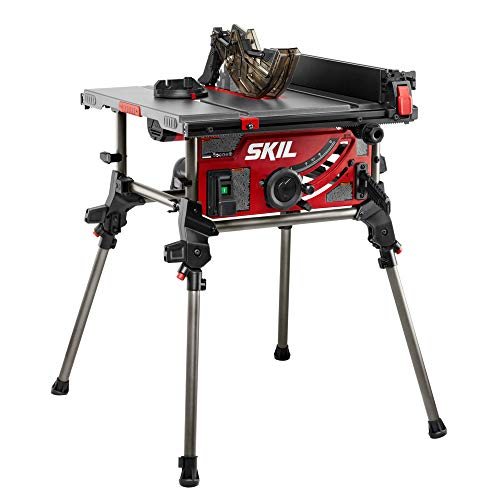
Jobsite saws are a step up in rigidity and are built to be transported, often with a folding or rolling stand. Many have rack-and-pinion fence systems and wider rip capacity than basic benchtop models. Because they still commonly use universal motors, they can be loud and are more sensitive to dust and heavy loads. For a home workshop with limited room, a good jobsite saw is often the most practical all-round compromise, especially when you can fold it away between projects.
Contractor-style saws
Contractor-style saws are larger, with cast-iron or heavy extension wings, an induction motor that hangs off the rear in many designs, and a belt drive. They are quieter and smoother than universal-motor saws, and the larger table is more forgiving for long boards. They are heavier and take more floor space, though many sit on mobile bases. Dust collection can be poor on older open-base designs because debris falls into the cabinet and the motor area, so check how a specific saw handles it.
Hybrid and cabinet saws
Hybrid saws blend contractor-style size and weight with an enclosed base that improves dust collection and stability. Cabinet saws have a fully enclosed cabinet, a heavy cast-iron top, an induction motor mounted inside and usually a belt drive. They deliver the most mass, the least vibration and the best sustained power, often on a dedicated higher-voltage circuit. They are also the heaviest, the largest and the most expensive category, so they make sense primarily when you have a permanent shop space and regular heavy use.
Comparison of table saw types
| Feature | Benchtop | Jobsite | Contractor / hybrid | Cabinet |
|---|---|---|---|---|
| Typical footprint | Very small | Small, often folding | Medium to large | Large, fixed location |
| Weight and portability | Light, easy to carry | Moderate, wheeled stands common | Heavy, mobile base advised | Very heavy, rarely moved |
| Motor style | Universal | Universal (some induction) | Induction, belt drive | Induction, belt drive |
| Noise | Loud | Loud | Moderate | Quieter running |
| Sustained heavy cuts | Limited | Fair for light hardwood | Good | Excellent |
| Dust collection | Basic port | Basic to fair | Fair to good (enclosed bases better) | Usually best |
| Electrical needs | Standard household outlet | Standard household outlet | Often standard, sometimes higher | Often a dedicated circuit |
| Best suited to | Light DIY, tight spaces | Mixed DIY and portable work | Serious hobbyists | Dedicated shops, heavy use |
If you want to browse current options in each category, a search for jobsite table saws is a sensible place to start for small shops, while hybrid table saws deserve a look if you have a bit more room.
Space, power and your electrical supply
Many buying mistakes come from ignoring the room and the wiring until the saw arrives. Think about both before you fall for a feature list.
Measuring the space you really need
A table saw needs far more room than its own footprint. For ripping a standard board you need clear space in front of the saw, space beside the blade side of the fence, and room behind the saw for the stock to exit. Long boards and sheet goods need outfeed support, whether that is a folding stand, a roller, or an outfeed table. As a rough habit, mark out the saw, the longest board you plan to cut, and a walking path around it on your floor with painter’s tape before buying. If the layout blocks your door, your workbench or your only exit, choose a smaller or more mobile saw.
Mobile bases and storage
Garage workshops often share space with a vehicle, storage and a water heater. A mobile base lets a heavier saw roll to the middle of the room for use and back to a wall afterward. Check that the base locks firmly, because a saw that creeps during a cut is dangerous. Folding jobsite stands serve the same purpose for lighter saws. Whatever you choose, never rely on a casual stand that flexes when you push a board through.
Understanding power
Motor ratings are advertised in several confusing ways, so compare like with like. Amp draw and voltage are the most honest indicators of what the saw requires from your circuit. Many portable and some contractor-style saws run on a standard household circuit, but a saw sharing a circuit with lights, a dust collector or a space heater can trip a breaker mid-cut. A tripped breaker or a bogged-down motor during a cut can cause kickback, so it is a safety issue as well as an annoyance.
Larger saws may require a higher-voltage dedicated circuit. If you are not experienced with electrical work, hire a licensed electrician to run and inspect any new circuit and follow local code. Do not extend with a thin or long household extension cord; voltage drop starves the motor. If you must use one, choose a heavy-gauge cord that is as short as practical and rated for the saw’s amperage.
Noise, dust and neighbors
Universal-motor saws are loud, and many people underestimate how tiring that is in an enclosed garage. Wear hearing protection every time. Fine dust is also a health concern, so plan on dust collection and a respirator from day one, particularly when cutting engineered boards such as MDF and plywood, which release fine particles.
Key features explained
The fence
The fence is the single most important accuracy feature. A good fence locks parallel to the blade, glides smoothly, resets to a measurement without fuss and does not deflect under side pressure. Look for a design that clamps along the front and ideally the rear of the rail, a face that is flat and straight, and a scale that you can calibrate. Rack-and-pinion fences are popular on portable saws because they keep the fence square as you adjust it, while T-square style fences are widely respected on larger saws. Test any fence before relying on it: lock it, push on the far end and see if it moves.
Rip capacity and table size
Rip capacity is the maximum distance from the blade to the fence. If you often cut full sheets of plywood down the middle, you need a capacity close to half a sheet width, or you will rely on a track saw or circular saw for the breakdown cuts. A larger table also gives better support and safer feeding. Do not buy capacity you will never use, but do not buy a saw that cannot make your common cuts.
Riving knife, guard and anti-kickback pawls
A riving knife is a thin plate that rises and falls with the blade and sits just behind it, keeping the kerf open so the board does not pinch the back of the blade and get thrown back at you. Modern saws should include one that can be installed and removed quickly without tools. Blade guards and anti-kickback pawls add protection for through-cuts, and a guard that is easy to attach is a guard you will actually use. Splitters are an older, fixed alternative; riving knives are generally preferred because they move with the blade height and tilt.
Blade tilt, depth and the miter slot
Bevel capacity matters for angled cuts and for chamfers, and the controls should be smooth and lockable. Miter slots should be parallel to the blade and wide enough for a standard miter gauge or a crosscut sled runner. A sloppy miter slot makes sleds inaccurate, so check how the slot is machined and whether the gauge fits snugly.
Dust collection
Look for a dust port that is large enough to connect to a shop vacuum or a dust collector and, on larger saws, an enclosed base that routes dust toward the port. Blade guards with an overhead dust pickup are a bonus. Even a good port will not catch everything, so supplement with a respirator and room air filtration.
Flesh-detection technology
Some saws on the market include systems designed to stop the blade extremely quickly on contact with skin. These can reduce injury severity, but they typically add cost, may need replacement parts after activation, and can be triggered by damp or conductive wood. Treat them as an extra layer, not a reason to skip safe technique. If you have young people in the workspace or a history of close calls, this feature is worth researching carefully.
Comparison of key feature priorities by user
| Feature | Occasional DIY | Furniture hobbyist | Cabinet and sheet-good work |
|---|---|---|---|
| Fence quality | Important | Critical | Critical |
| Rip capacity | Moderate | Moderate to large | Large |
| Motor sustained power | Moderate | High | High |
| Table mass and flatness | Nice to have | Important | Critical |
| Dust collection | Important | Important | Critical |
| Portability | Often valuable | Optional | Rarely needed |
| Riving knife and guard | Essential | Essential | Essential |
Budget tiers described generically
Instead of quoting prices that change by season and region, think in tiers of what you typically get as you spend more. These are general patterns, and there are exceptions in every tier, so always read the actual specifications.
- Entry tier: typically compact benchtop or basic jobsite saws. Expect a universal motor, a small table, a fence that works but needs checking, and basic dust collection. These are fine for light carpentry and learning, provided you are willing to tune the saw and build or buy supports for long stock.
- Mid tier: typically better jobsite saws and entry contractor-style or hybrid saws. You commonly see improved fences, larger tables, quieter or stronger motors, tool-free riving knives and better dust ports. This tier is where many home workshops find the best balance of capability and cost.
- Upper tier: typically full hybrid and cabinet saws. You pay for mass, sustained power, enclosed dust control, precision machining and long service life. The saw may also need a mobile base, a dedicated circuit and a decent amount of floor space.
- Specialty tier: saws with advanced safety electronics or sliding tables. These can be excellent for particular needs, such as heavy sheet-good work or shops where injury risk reduction is a priority, but they are rarely necessary for a first saw.
Remember to budget beyond the saw itself. A quality blade, a crosscut sled or miter gauge, push sticks and blocks, hearing protection, eye protection, a respirator, dust collection and outfeed support can add noticeably to the total. A modest saw with excellent accessories and technique often beats a more expensive saw used carelessly. If you need a replacement blade, a search for a table saw blade will show a wide range of tooth counts and grinds to compare.
Who should buy what
The apartment, shed or small-garage woodworker
If you must store the saw out of the way, a folding-stand jobsite saw is usually the most sensible choice. Prioritize a solid fence, a riving knife and a dust port. Plan to support long boards with a separate roller stand or folding outfeed table, and be willing to accept more noise.
The weekend home-improvement builder
If you build decks, shelves, trim and occasional furniture, a good jobsite saw or an entry contractor-style saw is likely plenty. If you also carry the saw to different job locations, portability should outrank mass.
The serious furniture hobbyist
If you mill hardwood, cut joinery and expect accuracy in thicker stock, consider a hybrid or contractor-style saw with an induction motor and a fence you can trust. A heavier table and a quieter motor make long sessions easier and cuts cleaner.
The cabinet and sheet-good builder
If you regularly break down plywood and build casework, large rip capacity, a flat top, outfeed support and strong dust collection become priorities. A cabinet saw or a larger hybrid with generous table extensions fits this work well, and a track saw can help with initial sheet breakdown.
The beginner
New woodworkers are often tempted to buy the cheapest saw and upgrade later. That can work, but only if you commit to learning safe technique first. Consider taking a local class, or ask an experienced woodworker to walk you through your first cuts. A saw with a riving knife, a good guard and a sturdy stand is a better starting point than a bare-bones saw lacking those features.
Setting up your saw correctly
A table saw straight out of the box is rarely perfectly aligned. Taking an hour to set it up properly improves accuracy and reduces the risk of binding and kickback. Always unplug the saw before making any adjustment.
- Assemble on a stable, level surface. A rocking stand makes every cut harder. Shim or adjust feet until the saw does not move when you push on the corners.
- Check the blade for square to the table. Raise the blade, set the bevel to zero and use a reliable square against the plate of the blade, not the teeth. Adjust the stop if the saw allows it.
- Align the miter slot to the blade. The distance from the slot to the blade should be the same at the front and rear of the blade. Measure at a tooth that you mark and rotate it. A misaligned blade pinches wood against the rear of the blade and increases the chance of burning and kickback.
- Align the fence to the miter slot. Most woodworkers want the fence parallel to the slot, or in some cases a hair of clearance at the rear. Check your manual and follow the manufacturer guidance, then make a test cut and inspect the result.
- Install and align the riving knife. It should sit in line with the blade and just behind it at a consistent gap. Verify that it rises and tilts with the blade.
- Connect dust collection. Attach a shop vacuum or collector, check for leaks and confirm that the hose is not going to tug the saw or snag stock.
- Set up outfeed and side support. Position support at the height of the table so boards do not tip off the back or the side.
- Make test cuts. Cut scrap and measure. Adjust, recut and record your settings for later reference.
If a new saw cannot be brought into reasonable alignment after careful adjustment, contact the seller about a return or exchange rather than living with a fundamentally poor tool.
Table saw safety essentials
Table saws are unforgiving because the blade is exposed to your hands and the workpiece can be thrown back by the spinning teeth. The following practices are widely recommended. They do not replace your manual, which should always take priority for your specific saw.
- Use the riving knife and guard whenever the cut allows it. Remove them only for non-through cuts such as dados, and then use additional protection like featherboards and push blocks. Reinstall them afterward.
- Keep your hands out of the blade path. Use push sticks or push blocks for narrow rips, and keep a long pushing tool within reach at all times.
- Stand slightly to the side of the blade line. If kickback happens, the board generally travels in line with the blade rotation, so avoid standing directly behind the piece you are feeding.
- Never use the fence and the miter gauge together to trap a piece. Cutting a piece that is pinched between the fence and the blade is a classic kickback scenario. When cross-cutting, don’t use the fence as a length stop right at the blade unless you use a spacer block set well before the blade so the cut piece is free to move away.
- Never reach over a spinning blade. Wait for the blade to stop before clearing offcuts, and use a stick rather than your fingers.
- Never perform freehand cuts. Always guide the stock with the fence or the miter gauge or a sled. Freehand cutting can twist the workpiece into the blade.
- Set blade height sensibly. A common recommendation is to expose roughly one tooth height above the work, not a full-height blade. Check your manual for its guidance.
- Wear eye and ear protection. Add a dust mask or respirator suited to the material, and avoid loose sleeves, gloves near the blade, dangling jewelry and long untied hair.
- Do not cut warped, twisted or wet stock without a plan. Joint one face and edge first, or use a sled. Unstable stock tends to bind.
- Disconnect power for blade changes and adjustments. Unplug the saw, not just switch it off.
- Keep the area clean and well lit. Sawdust and offcuts on the floor create trip hazards, and poor lighting leads to mistakes.
- Do not work when tired or distracted. Many accidents occur at the end of a long session when attention slips.
Consider buying a pair of quality push sticks and push blocks and keeping one hanging directly beside the saw. A safety tool you have to fetch is a tool you will skip.
Maintenance that keeps a saw accurate
Table saws are not high-maintenance, but a few regular habits extend life and preserve accuracy.
- Keep the top clean and protected. Cast-iron and steel tops can rust in humid garages. Wipe them down, remove sticky residue with a solvent suited to the finish, and apply a quality paste wax or a dedicated top protectant. Avoid silicone-based products if you finish wood, because they can cause finishing defects. Wax also helps stock glide.
- Clean the blade and replace it when dull. Pitch and resin build up on teeth and make a saw burn wood and strain the motor. Use a suitable blade cleaner, and have blades sharpened by a professional or replace them. A dull blade is more dangerous than a sharp one because it demands more feed force.
- Clear the dust. Vacuum the cabinet or base, the motor area and the trunnions. Compressed air can help but push dust away from you and wear a mask. Dust that gums up the raising and tilting mechanism makes adjustments stiff and imprecise.
- Lubricate where the manual says to. Use a dry lubricant on gears and threaded rods to avoid trapping sawdust, unless the manufacturer specifies otherwise.
- Check belts and bearings. On belt-drive saws, inspect the belt for cracking or glazing and replace it when worn. Listen for new noises or vibrations that signal a bearing issue.
- Re-verify alignment periodically. Transporting a saw, bumping it or even seasonal humidity changes can shift components. Recheck blade-to-slot alignment and fence parallelism every so often, and always after moving the saw.
- Inspect the cord, plug and switch. Replace damaged cords immediately, and make sure the switch and any paddle or kill feature work reliably.
Common buying and using mistakes
Buying on horsepower claims alone
Some portable saws advertise peak or maximum developed horsepower figures that do not reflect sustained cutting ability. Compare amperage, voltage, motor type and real-world user feedback about bogging down in hardwood. A well-tuned saw with a sharp blade often outperforms a more powerful saw with a dull one.
Ignoring the fence
A strong motor cannot compensate for a fence that drifts. If you can try a saw in person, lock the fence and check that it is repeatable. If you shop online, read reviews that discuss fence performance in detail, and look for patterns rather than one-off complaints.
Skipping the blade upgrade
Stock blades vary in quality, and many are general-purpose compromises. A good-quality thin-kerf or full-kerf blade, appropriate to your saw’s power, can dramatically improve cut quality. Match the blade to the task: fewer teeth for fast ripping, more teeth for smooth crosscuts, and a combination blade as an all-purpose option. Thin-kerf blades suit lower-power saws but need a matching riving knife thickness; always check that your knife is compatible.
Forgetting outfeed support
Without proper outfeed support, long boards tilt off the table’s back edge and bind against the blade. Simple support, even a folding stand or a rolling table at the same height as your saw, makes cuts easier and safer.
Cutting large panels on a small saw without help
Wrestling a full sheet of plywood across a small jobsite saw is awkward and dangerous. Break down large sheets with a track saw, a circular saw and a guide, or get help from a second person and proper supports.
Removing safety devices permanently
It is tempting to leave the guard off because it blocks visibility or feels clumsy. Fix the cause: try a different guard design, a riving knife-only setup for certain cuts, or featherboards. Removal as a habit is how people get hurt.
Buying a bigger saw than the shop can handle
A cabinet saw that you cannot fit, power or move comfortably will frustrate you. Matching the saw to the space and the circuit matters more than aspiration.
Neglecting dust protection
Fine dust causes long-term respiratory harm, and some woods can trigger allergic reactions or sensitization. Use dust collection and a respirator rather than a basic nuisance mask.
Buyer’s checklist
Use this checklist when comparing saws, whether in a store or in online listings.
- I have measured my workspace and marked out the saw, outfeed and walking space.
- I know what circuit the saw will run on and whether it shares power with other tools.
- The saw includes a riving knife that installs and removes without difficulty.
- A blade guard and anti-kickback pawls are included or available, and are practical to use.
- The fence locks parallel and does not deflect under side pressure.
- Rip capacity covers my most common cuts.
- The miter slot accepts a standard gauge or sled runner snugly.
- The dust port is a usable size and fits my vacuum or collector.
- Replacement parts, blades and inserts are available, and the manual is clear.
- I have a plan for outfeed and side support.
- I have budgeted for blades, push tools, hearing, eye and respiratory protection.
- I know the return policy and warranty terms in case alignment is poor.
- I will read the manual fully before the first cut.
Frequently asked questions
What is the best type of table saw for a small garage workshop?
For a small garage, a jobsite saw on a folding or rolling stand is usually the best fit. It stores out of the way and runs on a standard outlet. If you can spare floor space and want a quieter, more stable saw, an entry hybrid on a mobile base is a step up.
Do I need a cabinet saw for a home workshop?
Not necessarily. A cabinet saw offers excellent mass, power and dust control, but it is large and often needs a dedicated circuit. Many hobbyists build excellent work with jobsite, contractor or hybrid saws. Choose a cabinet saw if you have the space, the wiring and heavy regular use.
Can I use a table saw on a regular household outlet?
Many portable and some larger saws are designed for a standard household circuit, but check the saw’s rated amperage and the circuit’s breaker size. Avoid sharing the circuit with other heavy loads. For saws that require higher voltage, have a licensed electrician install a suitable circuit.
What is a riving knife and why does it matter?
A riving knife is a thin plate positioned just behind the blade that rises and tilts with it. It keeps the kerf from closing on the back of the blade, which reduces the chance of kickback. It is among the most important safety features, and you should use it for through-cuts.
Is a more expensive table saw always more accurate?
Not always, but higher tiers usually offer better machining, stiffer fences and more stable tables, which makes accuracy easier to maintain. Even a modest saw can cut accurately if aligned correctly, fitted with a good blade and used with proper support.
How do I reduce kickback?
Use a riving knife, keep the blade sharp, align the fence and miter slot, never cut freehand, never trap a piece between the fence and blade, stand out of the line of the board, feed steadily with push tools and avoid warped or wet stock. If a board pinches, switch off the saw and let the blade stop before freeing it.
What blade should I start with?
A good-quality combination blade is a versatile starting point for ripping and crosscutting solid wood. Add a dedicated rip blade for heavy ripping and a high-tooth-count blade for fine crosscuts or plywood as your work demands. Ensure the blade’s diameter, arbor size and kerf are compatible with your saw and riving knife.
How often should I maintain my table saw?
Wipe and clean the saw after each session, clean the blade when resin builds up, vacuum internal dust regularly, and check alignment whenever the saw has been moved or if cuts begin to burn or drift. Follow the maintenance schedule in your manual for lubrication and belt inspection.
Conclusion
The best table saws for home workshops are chosen by fit, not by hype. Start with your space and your electrical supply, decide how much sustained power and rip capacity your projects genuinely demand, and then judge candidates on fence quality, riving knife design, dust collection and build stability. Jobsite saws serve small or shared spaces well; contractor and hybrid saws suit serious hobbyists who want more mass and quieter operation; cabinet saws reward dedicated shops with heavy use.
Whichever you pick, set it up carefully, fit a good blade, build support for your stock and make safety habits automatic. If you are still weighing options, browse a selection of table saw accessories alongside your saw, so you have the sleds, push tools and support you need on day one.
Disclosure: As an Amazon Associate, we earn from qualifying purchases. If you click a link marked as sponsored and make a purchase, we may receive a small commission at no extra cost to you.