What's inside
As an Amazon Associate I earn from qualifying purchases. This post may contain affiliate links at no extra cost to you.
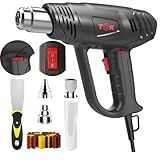
The best heat guns for DIY projects are 1500W dual-temperature models with variable airflow for most homeowners, while compact 300W-500W craft-focused guns are better for vinyl and detail work where precision matters more than raw power.
For paint stripping, adhesive removal, and bending PVC, you need sustained high heat (around 1000-1200F / 540-650C) and high airflow. For crafts, embossing, shrink wrap, and vinyl application, you need stable low heat (120-400F / 50-200C) and a narrow, focused nozzle. Buying the wrong type means either scorching delicate materials or spending hours waiting for paint to blister.
As an Amazon Associate we earn from qualifying purchases at no extra cost to you.



Sections
How to Choose a Heat Gun for DIY: 6 Decision Criteria
1. Temperature Range and Control
Heat guns fall into three control types:
- Dual-temperature (Low/High): Common on budget DIY models. Typically 500F / 260C on low and 1000F / 537C on high. Simple and reliable, but you cannot dial in 350F for vinyl without overheating it.
- Variable dial (analog): Allows stepless adjustment from about 120F to 1200F. Better for switching between stripping paint and softening vinyl in the same session.
- Digital / LCD display: Precise temperature in 10-degree increments with electronic regulation. The gun holds the set temperature even if airflow is restricted, which prevents temperature spikes that scorch wood.
For general DIY, look for a minimum low end of 150F or lower and a high end of at least 1100F. If you work with heat-shrink tubing, vinyl wrap, or resin crafts, the low-end stability is more important than the maximum.
2. Airflow Control
Airflow is measured in CFM or liters per minute. Two fans speeds (e.g., 7 CFM and 13 CFM) is standard. Variable airflow lets you keep heat high but reduce air volume so you don’t blow molten paint or overheat a small area. For electronics repair and crafts, low airflow with moderate heat prevents components from blowing off the board.
3. Nozzle Options and Compatibility
The bare gun produces a wide cone of heat. Nozzles focus it:
- Deflector / Glass protector nozzle: Shields window frames while stripping paint from sills.
- Reducer / Concentrator nozzle: Narrows airflow to a 0.5-inch spot for soldering, shrink tubing, and vinyl corners.
- Reflector / Spoon nozzle: Wraps heat around pipes for soldering or bending.
- Wide slot / Spreader nozzle: Spreads heat across 2-3 inches for quickly softening large vinyl decals or drying filler.
Check that the model includes at least two nozzles in the box and uses a standard 35-40mm barrel diameter so aftermarket nozzles fit. Proprietary barrels limit future options.
4. Cord Length, Weight and Ergonomics
A 6-foot cord forces you to use an extension cord on ladders or workbenches, which is a trip hazard. 8 to 10 feet is ideal for DIY. Weight matters for overhead work like stripping a ceiling: a 1.6 lb gun is manageable for 20 minutes, a 2.5 lb gun causes fatigue and wavering. Look for a flat rear stand or built-in kickstand for hands-free upright cooling and a side-to-side balanced housing so it doesn’t tip while hot.
5. Overheating Protection and Safety
All reputable guns have thermal cut-out. Better models add:
- Ceramic heating element with overheat shut-off that resets automatically
- Cool-down mode where the fan runs for 30-60 seconds after switching off to protect the element
- Housing that stays below 120F at the grip after 10 minutes of continuous use
Avoid guns without a clearly stated thermal fuse rating and never block the rear air intakes – that is the most common cause of element failure.
6. Corded vs. Cordless
Corded 120V models deliver consistent 1500W power for paint removal. Cordless 18V-20V models (like Milwaukee M18 or DeWalt 20V MAX platforms) max out around 875-1000F and run 15-25 minutes per battery, which is excellent for quick repairs, automotive vinyl, and jobsite touch-ups but insufficient for stripping a full door.
Best Heat Guns for DIY Projects: Spec Comparison
The table below compares common DIY-relevant models available in 2026 by the specs that actually affect performance.
| Model / Type | Power | Temp Range | Airflow | Weight | Cord Length | Nozzles Included |
|---|---|---|---|---|---|---|
| DeWalt D26960K (LCD Digital) | 1550W Corded | 120F – 1100F (50C – 600C), digital 50F steps | 5.2 – 16 CFM variable | 2.1 lbs (0.95 kg) | 10 ft (3.0 m) | 2 (cone, fish-tail) |
| Bosch GHG 20-63 (Digital) | 2000W Corded | 120F – 1150F (50C – 630C), LCD controlled | 5.3 – 17.6 CFM variable | 1.76 lbs (0.80 kg) | 6.5 ft (2.0 m) | 3 (glass, reducer, reflector) |
| Wagner Furno 750 (Variable Dial) | 1500W Corded | 125F – 1300F (52C – 704C), 12-step dial | 4.5 – 12 CFM dual fan | 1.8 lbs (0.82 kg) | 6 ft (1.8 m) | 5 (2 concentrator, deflector, reflector, wide) |
| Steinel HL 2020 E (Electronic) | 1500W Corded | 120F – 1150F (50C – 620C), stepless dial | 5.3 – 12.7 CFM variable | 1.9 lbs (0.86 kg) | 8 ft (2.5 m) | 2 (reducer, reflector) – wide range optional |
| Milwaukee M18 BHG-0 (Cordless) | 18V Battery (5.0Ah) | 150F – 875F (65C – 470C), guarded switch + lock | 6 CFM fixed | 1.1 lbs tool only (2.3 lbs with 5.0Ah) | cordless | 2 (concentrator, deflector) |
| Seekone 1800W (Budget Dual-Temp) | 1800W Corded | 480F / 250C Low, 1100F / 600C High | 7 / 13 CFM two-speed | 1.6 lbs (0.73 kg) | 5 ft (1.5 m) | 4 (2 reducer, deflector, reflector) |
Which Heat Gun Should You Buy? Decision Matrix
Match your primary projects to the right feature set instead of buying on watts alone.
| Your Situation | Recommended Type | Why |
|---|---|---|
| Stripping paint from doors, trim, or furniture a few times per year | 1500W-2000W corded with LCD or dial (DeWalt D26960K, Bosch GHG 20-63, Steinel HL 2020 E) | Needs 1000F+ sustained heat and variable airflow to blister paint without charring wood. Digital hold prevents temp drop when you slow down. |
| Vinyl wrap, window tint, and adhesive decals on cars or crafts | Variable dial 120F-750F range with reducer and spreader nozzles (Wagner Furno 750, Steinel HL 2020 E) | Vinyl softens at 180-250F. Precise low-end control and wide slot nozzle prevent bubbling and discoloration. |
| Electronics, shrink wrap, embossing, small crafts on a bench | Low-wattage precision or cordless with low-temp setting (Milwaukee M18 BHG, or 300W-500W craft gun) | Small parts need 250-400F with low airflow. Full-size 1500W guns overshoot and melt nearby plastic. |
| Quick home repairs, thawing pipes, bending small PVC, toolbox use | Cordless 18V platform you already own | Portability beats power for 5-minute tasks. No cord management on a ladder. |
| Tight budget, occasional use, still want paint removal capability | Budget dual-temp 1500W-1800W (Seekone type, Black+Decker HG1300 type) | Gets the job done if you learn to control distance (4-6 inches on high) and keep the gun moving. Accept shorter cord and less precise low heat. |
Practical Suitability by Task
Paint Removal
Use high heat (1000-1100F) with the deflector nozzle and a 4-inch scraper. Keep the gun 2-3 inches from the surface and move in 6-inch passes. If the paint smokes rather than blisters, you are too close. Wood scorches at about 400F surface temperature, so after the paint bubbles, lower to 750F for the final pass. Chemical strippers are safer for lead paint; heat guns can vaporize lead above 1100F.
Vinyl and Wrap Work
Set 280-350F with a spreader nozzle 5-6 inches away. Vinyl becomes pliable in 15-20 seconds. For inside corners, switch to a reducer nozzle at 300F and use a squeegee immediately after heating. Too much heat turns vinyl glossy and then brittle – if it stretches like cheese, reduce temperature by 30F.
Crafts and Embossing
Crafts need 300-400F max. Hold the gun 6-8 inches away and use the lowest airflow. A common mistake is using a 1500W gun on high for embossing powder, which blows the powder off before it melts. A 300W craft gun or a cordless on low solves this.
Repairs: Shrink Tubing, Adhesives, PVC Bending
For heat-shrink tubing, use 400-600F with a reflector nozzle that wraps heat around the tube for even shrinking. For softening old adhesive under stickers, 500-600F for 20 seconds lets you peel without residue. For bending 1/2-inch PVC, use 600-750F with a reflector and rotate the pipe slowly until it becomes flexible like a noodle – about 60-90 seconds.
Durability and Ownership Realities
Heat guns are simple but fail in predictable ways:
- Heating element: Wears first, especially if you run on high and then immediately unplug without cool-down. Always run on low / cool for 60 seconds before shutting off. Elements typically last 300-500 hours on quality brands, 100-200 hours on budget models with thin mica supports.
- Nozzles and scorching: Paint residue bakes onto nozzles. Clean with a wire brush while warm, not cold. Dropping a hot gun cracks the ceramic core – let it cool upright.
- Air intakes: Dust and paint chips clog the rear intake, causing overheating and thermal cut-out. Blow out with compressed air every 5-10 uses.
- Cord strain: The bend point at the handle fails if you wrap the cord tightly around the hot barrel. Wrap loosely after cooling.
- Consumables: No consumables except nozzles and scrapers. Budget for a set of glass protector and reducer nozzles if your kit omits them – usually in the general market range of $8 to $18 per nozzle set.
Market pricing in 2026 for DIY-grade heat guns generally falls between $25 to $55 for dual-temp budget models, $60 to $120 for variable-dial mid-range kits, and $130 to $250 for LCD digital models. Cordless bare tools typically run $80 to $140 before batteries.
Setup and Safe Use: 5-Minute Workflow
Follow this sequence each time to protect both the tool and the workpiece:
- 1. Select nozzle before heating. Attach it cold – it locks with a quarter-turn or set screw.
- 2. Set temperature to the lowest value for your task. You can always increase; you cannot undo scorching.
- 3. Plug into a grounded outlet with at least 15A capacity. Do not use a light-duty extension cord – use 12 AWG if an extension is required.
- 4. Hold 4-6 inches away at a 45-degree angle, keep the gun moving. Overheating one spot for more than 5 seconds chars wood and blisters nearby paint you wanted to keep.
- 5. When done, switch to cool/low setting and run fan for 60 seconds, place upright on its stand on a non-combustible surface, and do not store until the nozzle is cool to touch (about 10 minutes).
Common mistakes to avoid: heating in one spot, using high heat on plastic trim, leaving the gun face-down on wood, and pulling the plug to stop it instead of using the switch which cuts power to the element but leaves the fan running on better models.
FAQ
Can a 1500W heat gun be too powerful for crafts?
Yes. Power is not the problem – heat density is. At 2 inches, a 1500W gun on high delivers over 1000F, which melts embossing powder, craft foam, and PLA prints. For fine work, use low (500F) at 6 inches or choose a dedicated 300W craft gun with a pencil tip.
Do I need a heat gun or will a hair dryer work?
A hair dryer maxes out around 140F and low airflow velocity, so it will soften small vinyl stickers but will not strip paint or shrink industrial tubing. Heat guns produce 4 to 8 times the heat output.
How long can I run a heat gun continuously?
Most DIY corded models are rated for 15-20 minutes continuous on high before the housing needs a cool-down. For stripping a large surface, work in 10-minute intervals, letting the gun run on low for a minute between sections. Cordless models are limited by battery runtime of 12-25 minutes per charge.