What's inside
As an Amazon Associate I earn from qualifying purchases. This post may contain affiliate links at no extra cost to you.
Sections
Best AMD Budget Graphics Cards (GPUs) for 1080p Gaming
The best AMD budget graphics card for most 1080p builds is the Radeon RX 7600: it combines solid 1080p performance, 8 GB of VRAM, and a widely manageable power draw. Choose the RX 9060 XT 16 GB if you can spend more and want extra memory for newer games, or look for a discounted RX 6600 if keeping the total build cost low matters most.
Quick picks by situation
- Best all-round value: Radeon RX 7600, particularly when priced near the lower end of its typical market range.
- Best for demanding games and longer ownership: Radeon RX 9060 XT 16 GB, if its price fits your budget.
- Best for the lowest-cost build: Radeon RX 6600, provided you find a new or used card with a sensible warranty and price.
- Best for a small or modest-power system: RX 6600 or RX 7600, after checking the specific card’s length and power connectors.
1080p comparison: performance, memory, and fit
Frame rates vary with the game, processor, driver, and graphics settings. The figures below are broad estimates for demanding modern games at 1080p, high settings, with ray tracing disabled and upscaling off. They are useful for comparing tiers, not promises for a particular game. Esports titles can run much faster; demanding games can fall below the ranges, especially with maximum settings.
As an Amazon Associate we earn from qualifying purchases at no extra cost to you.


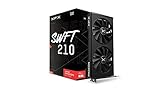

| GPU | Typical 1080p range | VRAM | Board power | Example card length | Typical market range |
|---|---|---|---|---|---|
| Radeon RX 6600 | About 50–85 fps | 8 GB | 132 W | About 190–270 mm | About $180–$250 |
| Radeon RX 7600 | About 65–105 fps | 8 GB | 165 W | About 200–280 mm | About $230–$320 |
| Radeon RX 9060 XT 16 GB | About 90–145 fps | 16 GB | About 160 W | About 200–300 mm | About $350–$450 |
Prices and dimensions are approximate market and model ranges, not fixed specifications for every card. Board partners make versions with different coolers, clocks, and lengths; confirm the exact model’s specifications before buying. The RX 9060 XT figures refer to the 16 GB version. Frame-rate ranges are rough cross-game estimates and should not be read as benchmark results for every title.
Which one is the better buy for your build?
RX 6600: prioritize a low total build cost
The RX 6600 remains a reasonable entry-level choice for 1080p if the price is clearly below that of the RX 7600. Its 8 GB memory pool is adequate for many games at sensible settings, and its 132 W board power makes it easier to cool than the faster options. It is a weaker fit if you expect to use high-resolution textures in new releases or want to keep the card for many years without lowering settings.
RX 7600: the practical middle ground
The RX 7600 usually offers a useful step up from the RX 6600 without demanding a much larger power supply or case. It suits players targeting high-refresh 1080p in a mix of games, though 8 GB of VRAM can become a limitation in some demanding titles when texture quality is set high. If the RX 7600 costs only a little more than the RX 6600, the extra performance can justify the difference. If it is priced close to a 16 GB alternative, compare those options carefully.
RX 9060 XT 16 GB: pay for headroom, not just today’s frame rate
The RX 9060 XT 16 GB is the stronger choice when you play graphically demanding games, value higher settings, or want more room for large textures. Its extra VRAM is useful headroom, not a guarantee that every game will run well indefinitely: the GPU’s processing power still sets limits, and performance varies by title. It also costs more, so it makes sense only if the rest of the build can take advantage of the upgrade.
Check case clearance and power before ordering
Graphics-card length can matter as much as the chip in compact builds. Measure the clear space from the rear expansion slots to the nearest obstruction, such as a front fan or drive cage. Leave extra room for the card’s power cable to bend without pressing against the side panel. A nominally compatible card can still be awkward if its cooler is thick or its cable exits close to the panel.
Compare the exact card’s power recommendation and connectors with your power supply. The board-power figures in the table are not the same as the system’s total power draw. A quality, correctly sized PSU matters more than simply matching a wattage number; allow for the processor, other components, and transient loads. Also check that your motherboard has a suitable PCIe slot and that the case has enough airflow to exhaust heat.
Decision matrix
| Your priority | Best starting point | What to verify |
|---|---|---|
| Lowest purchase price | RX 6600 | Condition, warranty, and whether the savings over an RX 7600 are substantial |
| Balanced 1080p gaming | RX 7600 | Exact card length, PSU connectors, and current price versus 16 GB options |
| Higher settings and more VRAM | RX 9060 XT 16 GB | Whether the performance gain fits your monitor and overall build budget |
| Small case or limited cooling | Shortest suitable RX 6600 or RX 7600 model | Manufacturer’s dimensions, cooler thickness, and airflow path |
How to judge the value of the upgrade
Compare the price increase with the performance increase rather than choosing by model number alone. For example, if an RX 7600 costs $60 more than an RX 6600 and delivers roughly 25% more performance in the games you play, the price premium is $60 ÷ 25 = $2.40 per percentage point of improvement. This is only a rough comparison: actual gains differ by game, and the RX 7600’s additional performance may matter more if you use a high-refresh monitor. Repeat the calculation with current local prices, and factor in VRAM, warranty, and fit.
Bottom line
For most budget 1080p systems, the RX 7600 is the sensible starting point when it is priced competitively. Choose the RX 6600 when it saves enough to improve the rest of the build, and step up to the RX 9060 XT 16 GB if you can afford it and value higher settings and additional memory. Before committing, check the precise card dimensions, power connections, and PSU guidance for the model you plan to buy.